Abbey had her first anxiety attack at 16. A teenager living alone in Paris, in the 3rd, on Rue Saint Martin. Too far north to associate with romantic notions of the Marais but just south enough to avoid the bustling sex worker scene that dominates the Boulevard Saint Martin.
In bed, sleepless, with shallow breath and racing heart, Abbey hugged the cool wall that felt slightly damp and on occasion off-gassed a smell so particular that it wasn’t dissimilar to the smell of a loved one’s pillow. Abbey focused on the coldness of the plaster and breathed in the dingy intimate odor of the ancient building trying to transform it into something tender.
These nights came more often as the distance from her life at home in Philadelphia with her father and sister grew. Now she had Svetas from Volgograd, Helens from Gyula, and Natalya’s from Pinsk. Instead of teachers there were managers and bookers. Men with accents, slicked back hair that curled at the neckline, and three-piece suits that looked appealingly soft but far too formal to make them touchable. The women spoke very quickly and their smiles were the kind that registered as a squinting of the eyes more than a happy reaction of the mouth, if that makes sense.
When Abbey first arrived, Jenny, the head booker, took her by the shoulders and gave her that smile. Jenny’s lips moved but her eyes disappeared, as if she didn’t really want to see Abbey as she delivered her spiel of impending success and the avalanche of money and fame to come. Suits and smiles that inspired the most conflicting emotions, pulling you in and totally alienating you all at once. The Central European girls had it down. They returned squinty eyes with squinty eyes and if the authority present was male, easy, they tucked their chin to their chest, peered up through their dark lashes and nodded deeply to whatever was said to them. The second Abbey started parroting this behavior, Massimo, the senior vice president of IMG, stopped eyeing her with suspicion and smiled and petted her.
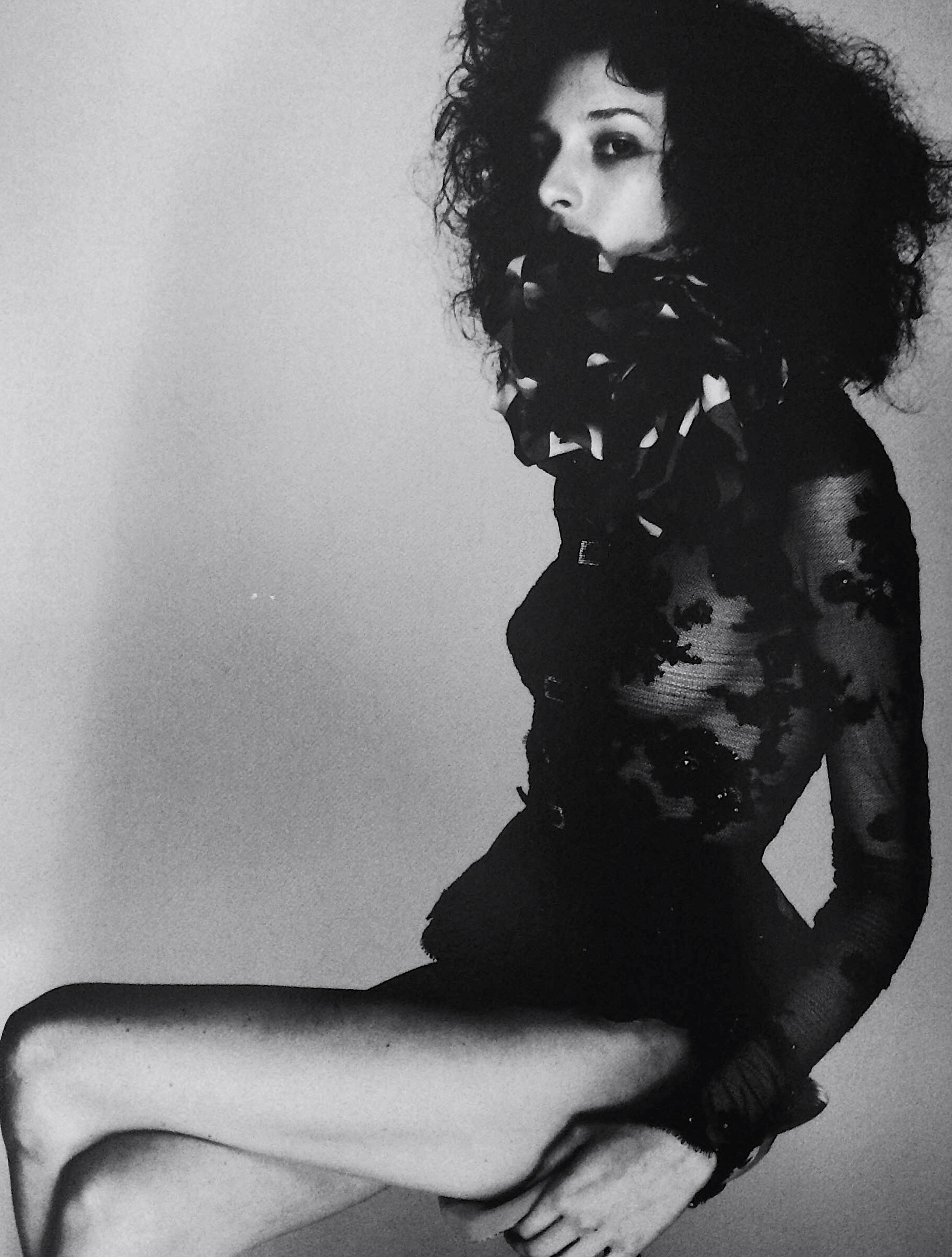
When they first met, Massimo congratulated her on a large story, lots of centerfolds, covering the season’s couture collection.
“A coup for such a new model!” He exclaimed.
“Thank you. I have to say, we took so many photos I was a little sad to see that some of them didn’t make it through to publication.”
“You’re being greedy.” He walked off.
When he spoke to her next, Abbey made sure to lower her chin and nod. He seemed to like that.
The anxiety couldn’t be traced to anything specific, any one overarching concern. It was the general feeling of being lost in an ocean, a large, grey, tumultuous ocean that had zero concern for Abbey’s wellbeing.
To combat the anxiety Abbey came up with a problem to consider. It’s a very specific problem. It included a convex form made of brass with water running along its external contour, like an upturned bowl, with a running spigot of water pouring a constant, enveloping skin of water over its external surface. The challenge was this: was there some way of manipulating the interior lip of the brass bowl to make the water climb up it, against gravity, towards the bowl’s interior center? Could this be achieved by producing a very unique curve, whose line was so gradual that it could trick gravitational pull? Or perhaps there was the perfect velocity the water could achieve so that it would magically cling to the bowl’s interior surface after exhausting the exterior surface area, like the delicate meniscus that forms with a brimming glass? Abbey would think this problem through, dreaming of water’s controlled movement over a smooth surface. And eventually it worked. This game of fluid dynamics calmed her. The sea mellowed. The ancient smell ceased to tingle her nostrils and found home there.
Eventually the anxiety attacks diminish. The rhythm of modeling took on a metronomic swing. Being constantly surrounded by adults kind of rubbed-off on Abbey and she started to see herself as an adult or adult-like, which was good enough. Abbey started to drink wine at Le Fumoir, Flor, or one of the places on Rue Vielle du Temple, a book sitting unread on the table. The wine eased her into sociality. Her constant, mocking self-awareness faded, the 1/8th of an inch of flesh that padded her hip-bones ceased to concern her. Wine rendered everything okay, not great, but she was okay.
In Milan, during a fashion shoot. Abbey was dressed in the season’s newest Dolce and Gabbana, and holding onto thick sailboat, mooring lines,when she felt the 5 o’clock aperitivo rolling around and the overwhelming itch of desire for a glass of Montepulciano. She made it known. The day was long, it seemed. Longer than it should have been, surely. It’s not like she was getting paid anything for the bullshit print work, maybe 150 Euro, maybe. “Someone get me a glass of wine, please!” Her voice was shrill even to her own ears. “Since when did the palliative treatment for life bleed into work?” Abbey wondered and it freaked her out. That sudden psycho-emotional pang of need caught her off guard, or rather it just caught her, like a tackle from some unseen linebacker. To need anything so strongly, bodily, sent the waves of that big, grey ocean roiling.
At 19, Abbey was still a virgin, never had a boyfriend, a great love, or even a kiss since a few errant make-out sessions in the old cemetery of her middle school. The beast of physical desire was mostly unknown to her.
Cathexis. In Paris, Abbey found an old dingy translation of Freud, and the term stuck. It helped her understand the feelings she had for the stinky corner, or her pathological need to feel her own sharp hip-bones, like a child’s constant fondling of a teddy bear’s ear, even Abbey’s meditational brass and water quandary had something of the fetish to it. But this glass of wine operated differently. It did the opposite of all the other objects and actions with which Abbey cathected. Unlike the hipbone fondle or the intimacy she shared with her apartment odor, the wine pulled her out of herself and made her available. With just a glass during a simple aperitivo, men all around shouting for their negronis or evening espressos, grabbing fistfuls of the antipasto on the bar or a solitary glass on the Rue Saint Martin, at one of the cafes facing the Centre Pompidou, Abbey was open. A conversation could happen. Men would approach or other models would join her. It’s like models are all embedded with low-jack technology allowing them to locate each other and swarm extemporaneously. Abbey was open to other things as well, like the memory of kissing Charles DeVoe in the St. Peter’s library and under the low-slung trees of the cemetery on 4th street in Philadelphia. She’d recall the taste of her mom’s pancakes, always dotted with blueberries, and the smell of their home. But she would also feel the absence of her mom, the plunging sadness that comes with remembering death and what it takes away. No, wine was not good. Not good at all. Availability was of no service to her.
She lost the habit that day when she heard the need in her own voice. The wine she demanded came an hour later and she flushed it down the toilet. It’s crazy to demand wine on set, crazier still not to drink it after some poor schleper obtained it. So, the habit was lost and Abbey returned to herself for a few more years of celibacy, self-control, and lots of self-monitoring.
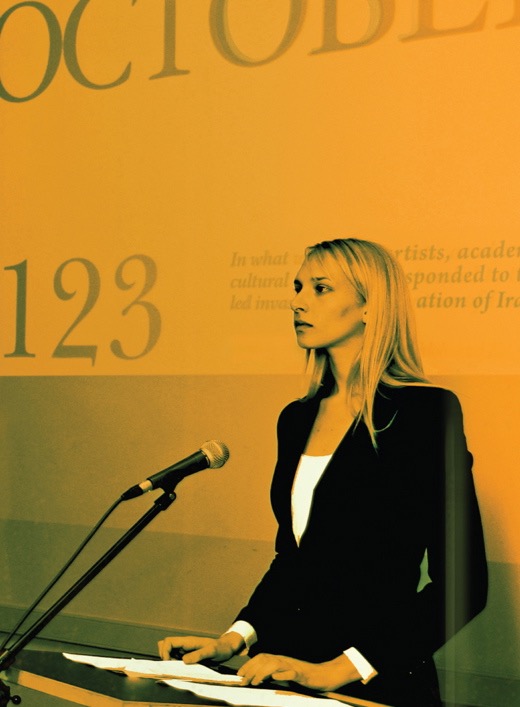
Years later, 4am, a crappy and cramped hotel on the outskirts of Karlsruhe, Germany. Abbey is pressed against the cool plaster wall trying to steady her breath and find sleep. She visualizes the water pouring over the bowl, rounding its lip and following the contour magically up and in till it evenly and unrealistically slowly cascades from within the upturned, bowl. In the morning Abbey is delivering the keynote address to a room full of academics, artists, and theorists as the opening act for a three-day conference. She’s been nauseous and dizzy for days. A pregnancy test sits in her toiletry bag at the ready, but not just yet.
Abbey just finished her undergraduate education at Columbia and accepted a position at UCLA’s MFA program. She will make art under the direction of Charles Ray, Catherine Opie, and Andrea Fraser. She is happy, she thinks. She has a rent controlled apartment on State Street, a street that has held onto a bit of old Brooklyn charm. She’s in love, at least she thinks, with Dmitri. He has two PhD’s, one in art history from Columbia and one from Harvard in religion, and he loves her? She runs through this list of “accomplishments” trying to convince herself that she’s good enough and smart enough.
Abbey is not yet convinced of her right to have a voice, an opinion. She’s uncertain of her ability to accurately narrate her own experience of life, even her diary is permeated with second-guessing. Just the thought of a baby decimates her. Abbey acknowledges that under the conditions of a child and being hinged to Dmitri she will never find certainty in a voice that is hers and hers alone. Abbey Shiane; baby mama to Dmitri Greene of two PhD’s. None of this will bleed into her coffer of self-worth. She gets up, plods across the sticky, green, shag carpet and grabs the paper from her backpack with urgency.
GETTING THERE FURSTEST WITH THE MOSTEST, Keynote Address, Zentrum für Kunst und Medientechnologie | Karlruhe
Nathan Bedford Forrest, a cavalry commander of renown during the American Civil War – and a truly odious man – supposedly claimed that his military tactics were based on the principle of “Getting there furstest with the mostest.” Maybe Forrest never said this. Maybe this is just a legend about him, but for the sake of argument, let’s agree that he said it.
What this meant was that one dispatched a critical mass of armed men on horseback to a location proximate to the enemy, yet tactically advantageous – say, in a forest or on a hill top — an action that would ideally persuade the enemy to abandon its own violent objectives. From this standpoint, it is irrelevant what you plan to do once you control a situation, or what others might wish to do in your place. Arrive “in force” at the right place at the right time and the rest will take care of itself.
“Getting there Furstest with the Mostest” is an imprecation to advance without worrying about the constraints on one’s forward progress — to move without a grand design as to what will eventually happen; it is a belief in a kind of speed. In any professional military situation there is a built-in propensity toward the fetishization of command hierarchy and superfluous weaponry, so in the realm of military planning, placing one’s trust in “getting there furstest with the mostest” embodies a profoundly “de-professionalizing” attitude, although not a de-skilling. And it is worth noting that Forrest never received any formal military training.
Forrest’s innovations were only fully recognized after a delay, when during the Second World War armor commanders began to employ similar tactics. Once their units broke through the enemy’s initial lines of defense, their forces could have turned around in order to wreak havoc “from the rear.” This would appear to be the most “logical” decision, as it immediately consolidates the situation in the attacker’s favor.
However, instead you witness the strategic logic of the Breakthrough.
Rather than securing a ready advantage – the tanks pushed further onward, away from their antagonists – thrusting through the countryside, across the horizon, streaming forward as fast as fuel and moving parts would allow. This manner of attacking concretized Forrest’s insight: by getting to unexpected locations in sufficient numbers — the enemy’s ability to comprehend the parameters of the situation begins to falter. One could even say that something like an “event” in Alain Badiou’s sense of the term takes place. The enemy forces find themselves confronted with too many choices: a situation that breeds discord, hesitation and — ultimately – self-destructive paralysis.
If we are living within a neoliberal “military-entertainment complex,” as is stated in a recent issue of the journal October, then it seems accurate to say that the Cultural Left has been hesitant to contemplate the military implications of this phrase. Is it not time that we begin to take “the militarization of the world” seriously as a cultural project? Even with a new administration in Washington, it seems inevitable that we will be obliged to come to terms with the Military-Entertainment Complex’s methods and means, even in contemplating our most intimate hopes and fears.
Among academics today, tactical flexibility is a must.
With the perfecting of information technology, it is only a matter of time – if in fact it is not already the case – that cultural administration and professional management will determine an academic’s value according to how many hits her name returns on various search engines. The Internet can quantify and verify your informational worth in seconds. This technical development will almost certainly lead American public university systems to abandon tenure in favor of “pay for performance” – an alternative that the general public will consider much more democratic. So far, academics have hardly begun to respond to such transformations.
So one might ask: what would “Getting there furstest with the mostest” look like in the contemporary academic arena?
Such an orientation would pivot on the fact that it will be necessary in the future to design environments in which the textual ceases to be the exclusive mode for the distribution of “scholarly information.” Furthermore, it will also become necessary to abandon the assumption of authorial and professional synchronicity (that is, the automatic pairing of the scholar and the voices that inhabit her texts), and to revisit the unexamined requirement that modes of explication and presentation be narrowly stable and singular, rather than improvisational and collaborative. As an act of intellectual self-preservation, the scholar will need to produce situations that create advantageous conditions for future action without knowing precisely what these conditions will yield.
In other words, we must embrace the strategic logic of the Scholarly Breakthrough.
A kind of “thinking-in-situations” will become the definitive mode of future art historical and art critical activity. The individual will discover the value of being in particular spaces at particular times to engage in quasi-improvisational undertakings that will not yet have been efficiently “mapped,” “quantified,” or even named.
Such approaches offer the best prospect for shrugging off the sickly embrace of the mediocre text and our managed subjectivity, by redefining, or better, “dedefining” our actions as the production not of “finished works,” but of “texts-in-process.” As such, Bernadette Corporation’s “production novel” Reena Spaulings – which purportedly was written by a team of 150 people — is a prototype of this genre. By employing similarly problematized modes of attribution and “authorship,” the future scholar will “get there furstest with the mostest” by abandoning the accomplished, authorial text in favor of collaborative manifestations of theoretical intensity, and all manner of presentational force multiplication.
In this way, the academic will become much more scholarly by ceasing to be a “professional scholar.”
“Time = money is an economic equation derived from the scholarship that if life is the pursuit of money (life = money) and time is the primary aspect of life (life = time), then necessarily time = money. In an inevitable adjunct, the essential time-component of music makes it the pre-eminent modern art form. Because music requires a commitment of time from the listener, it is now considered precious in a way other art forms are not.” Ian Svenonius, The Psychic Soviet
Mid-century transformations in the popular music industry may suggest useful parallels with the situation of contemporary scholarship:
Today, we are leaving a period dominated by University Press-published, Ivy League Department-backed, Blue Chip Singers – the scholarly equivalents of Elvis, Sinatra, and Chuck Berry — superstar scholars who produced great texts — hit singles, one could say — without spending much time wondering about how their material reached the public (that is, without wondering who played the instruments, produced the records, designed the packaging, organized the tours, etc.).
Instead, we are entering a zone in which all materials connected to scholarly activity are potentially available for transformation into vital, signifying surfaces. We are on the verge of seeing the scholarly equivalent of singer songwriters, gatefold album covers, outdoor music festivals, artist-run record labels, and super groups.
University Administrators and Straight Cultural Professionals – that is, the people who pass critical and managerial judgment, like the befuddled, yet beguiled Ed Sullivan of the late 1960s, will not be able to reject these coming contributions because they will be offered up by serious people in serious venues under the rubric of established professional activity. However, when the need to establish the value of such activities arises, much more attention to the dynamics of intellectual labor and the didactic possibilities of form will be required.
“In the middle, where nothing is supposed to be happening, there is almost everything.” Bruno Latour, We Have Never Been Modern
Hybrids.
It is already a cliché to say that the Hybrid will shape the fate of human presence on this planet – up to and including the mixing of the human and the post-human (as we already see in the proliferation of “performance-enhancing drugs”). It is also obvious that stable notions of ethnic identity, retail specificity and institutional propriety are rapidly disappearing. As a result, it is not in the zones of criticism, analysis and judgment in which one will find the most compelling cultural activity today, but in murky in-between areas.
Likewise, as a hyper-mediated world of half-forms and quasi-content surrounds us more vigorously via the Internet and twenty-four hour news cycles, the textual orientation of contemporary scholarship is having the inadvertent effect of flattening the signifying structures of whole constellations of non-textual practices. Not unlike the holders of a theological worldview confronting a rapidly secularizing environment, today we have a text-based critical apparatus incapable of coming to terms with an explosion of activities that have let loose all manner of textual/visual/performative hybrids.
As the art historian, curator and critic come into greater contact with such unhinging and destabilizing forces, intellectually-serious activity is ceasing to focus on the creation of self-contained books, exhibitions or articles. Instead, critical interventions are growing more adventurous as administrative demands for novelty and “client recruitment” increase.
None of this is new.
Even from its beginnings in the sixteenth century, art history has been constituted as a paradoxical activity. It is an arena in which “scientific analysis” and “artistic activity” border each other with few enduring boundaries separating the two endeavors. As a result, art history has always been in danger of being transformed into a subset of its own object of study. Recall that Vasari wrote not as an amateur but as an artist; his schema of stylistic rise and fall was an extension — not an explanation — of his painterly practice. Similarly, Riegl insisted that art history only worked when it was “artistic” itself..
As the putative subjects of the art historian’s inquiry moved closer to the present — as the art historian began to study not only Ancient and Medieval themes but also modern ones — art history began to occupy terrain that was increasingly similar to that of art. And with the plunge into the Contemporary, art history was further transformed into an academic discipline very much in synch with Modernism’s expressive devices and productive mechanisms. This is a collective professional repression that must finally be confronted.
In retrospect, it is not hard to understand what was happening. Art historians were beginning to realize, however dimly, that they were infringing on alien aesthetic territory – and that the projects of the visual artist and the art historian were drawing ever closer together.
Consider the forms endorsed by the editors of the journal October. Clearly, the journal’s favored art practices corresponded closely to the actions of the art historian:
Hans Haacke investigating provenance records;
Marcel Broodthaers curating art exhibitions;
Dan Graham publishing materials in art magazines;
James Coleman manipulating slide projections;
Andrea Fraser giving gallery talks;
Michael Asher printing art catalogues.
Thus, there can be no question that the era’s most acclaimed “critical” artists were those whose practices intersected most inventively with the daily professional activities of art historians. Benjamin Buchloh referred to these impulses under the rubric of “the aesthetic of administration,” yet perhaps it would be more accurate to call this “the aesthetic of the art historian.”
In the standard version of art historical practice, the slide lecture, the roundtable, the publication, the academic conference – that is, the art historian’s literal medium —- is never the message. All of the meaningful stuff of art history, so this untold story goes, exists within a circumscribed discursive landscape of representation and interpretation. However, it is only a matter of time before art history’s ancillary spaces and incidental activities cease to be viewed as abstract, neutral backdrops. They are becoming historical in front of our eyes.
From this perspective, it seems that our discipline has come full circle. First, we witnessed the production of a refined, rigorous vocabulary, and the cultivation of a profound sense that there were “stakes” to art history and art criticism, the qualities that made the publications of the High October-period (roughly, from the late 1970s to the mid-1990s) the only postwar art writing that always carried its own weight. The October writers created and preserved a space for “verifiable” criticism and an interpretative sensibility that was neither exclusively formalist, nor narrowly sociological in its thrust. In other words, for most of us, they made art contemporary.
Then at some point, these writers’ books and essays became progressively looser in form and more adventurous in content. And gradually it began to dawn on us that the most significant art historians to emerge in the 1960s and 1970s were perhaps not so much historians of modern art, but Modernists who employed art history in the service of a mixed media practice. In this sense, we see the gradual maturation of a commonly-held para-artistic project that begins with Rosalind Krauss’s hearing about David Smith’s death in 1965 and the ensuing production of her book Terminal Iron Works…
…that then culminates with T.J. Clark’s appropriately titled 2006 study, The Sight of Death – a work that functions as a nearly indescribable hybrid of self-portraiture, poetry, observation and, most striking, a literal record of the art historian acting as an art historian. It should come as no surprise that the work bears the appropriately “modernist” subtitle “an experiment in art writing.” And for anyone who has read it, it is obvious that The Sight of Death is an art project that just happens to take the form of reading a book.
One must remember that an older academic generation considered Krauss, Buchloh, and Company to be vulgar and lazy: they wrote about their friends and lovers; they failed to patiently reconstruct the past; they employed interpretative techniques that had remained far beyond the scope of art history.
Timid and opportunistic, our generation of art historians, critics and curators has converted these disjunctive and innovative forms into the decoration of official method. Somnambulistic careerism and its accompanying methodological conservatism have bred an aversion to self-risking experiment. As a result, our academic environment is now dominated by minor texts, and minor ideas.
But you are probably still wondering: what is Literal Speed?
Perhaps the most familiar and striking examples of such phenomena can be found in the history of the American Civil Rights Movement. That is, the 1955 Montgomery Bus Boycott was not exclusively “about” Rosa Parks refusing to give up her seat, or even “about” demanding civil rights for American citizens – in some very important way, the Bus Boycott was about the ability to launch and sustain the Bus Boycott. In other words, it was perhaps the “Boycottness of the Boycott” that made it so experientially compelling and politically persuasive. The boycott’s beauty as a performance — its strangeness as a collective, improvisational event – empty buses crisscrossing the city juxtaposed to an enveloping proliferation of good natured hitchhikers and their hosts — created an eventful, formal “becomingness” that might be called “literal speed.”
So, as the system as we knew it implodes all around us – perhaps as knowledge workers and artworkers — perhaps we should not only whisper in the hallways about budget cuts, or wonder aloud about dwindling job prospects, perhaps we should ask: what is OUR literal speed?
Thank You.
Abbey puts the text back in its folder and falls asleep. She’ll finish the talk. Pee on the stick and fly home to Dmitri.
 abjour