Abbey Shaine and Dmitri Greene’s love affair, which began as a clichéd, student-professor, stalker-esque event, finds resolve as a domestic partnership. Dmitri takes sabbatical as Abbey enters her sophomore year. Abbey attends class on Columbia’s campus untethered and free from the allure of dipping into Dmitri’s office hours. She’s simply a student. It’s fine. At night she goes home to her Boerum Hill apartment, which she shares with Professor Greene. She finds him hunched over Guattari, Deleuze, or Cache transmogrifying the words on the page to contorted, AutoCAD shapes on his laptop.
“It’s simple fluid dynamics. I’m using these programs to produce organic forms.” Typing keys and entering a complex string of commands into his PC, his brow furrowed, illuminated only by the LED light emitted by his computer. Brooklyn is dark by 5. It’s winter. And these early onset nights give the impression of long evening hours spent righteously working.
“Produce a form, any form, and then set parameters. See? This is your foil. Then watch as the fluid streams past and through. See where it pools? See where it produces turbulence?”
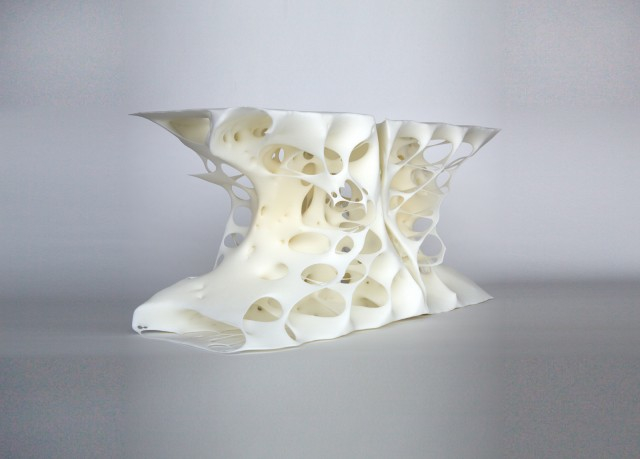
“I see.” Cocooned in their small live-work environment huddled around the desktop like it’s a hearth, Abbey is all in. Fluid dynamics to produce architectural forms that can range in scale and function, from a sitting stools to a building, all the while embodying the most basic principle of movement on the most basic particle level? Yes. That is sexy. To Abbey’s ears, no concept of equal allure has ever been spoken. Dmitri’s intellectual propositions paired with actions on the computer that called for words like “algorithm” and examples of Turing set new standards of pleasure for Abbey. Nothing is happening. She is listening. That is all, yet the sensations gush and nerve endings tingle. Dmitri tells a story of material sensuality and it turns Abbey on in unparalleled ways.
https://arthist.net/archive/3435
3 years later. A big academic conference in Berlin called Performative Languages of Emotion. The presentations and discussions take place in English to accommodate monolingual Americans. Abbey Shaine is among the presenters.
The conference features literary theorists, philosophers, opera and theater specialists, artists, anthropologists, performers, a real mixed bag all coming together for 3 days of performative lectures in Berlin’s Schiller Theater. It advertises itself as “an attempt to discuss emotions in the performative arts as a dialogue between theory and praxis, art and scholarship.”
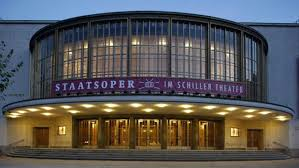
The presentation that most wholeheartedly embodies the ethos of the conference occurs on day two. It is titled, “Can One Rehearse an Emotion? An Attempt to Simulate an Opera Rehearsal.” Abbey is sitting in the back of the auditorium as Sandra Leupold, an opera director, works with a singer on Elvira’s “Mi Tradi” scene from Don Giovanni. The aria is loaded with arpeggios and rapid scales. It is dramatic, emotional, and exhausting. Director and performer run through the aria a dozen times, the beauty of her voice and the physical taxation of performance are staggering. Abbey tears up, overwhelmed. “This is the kind of thing people want to see and be a part of. It is reassuring in its celebration of talent and excavation of our expressive capacities.” Abbey concludes, wiping her tears away. Abbey’s own presentation could not be more different.
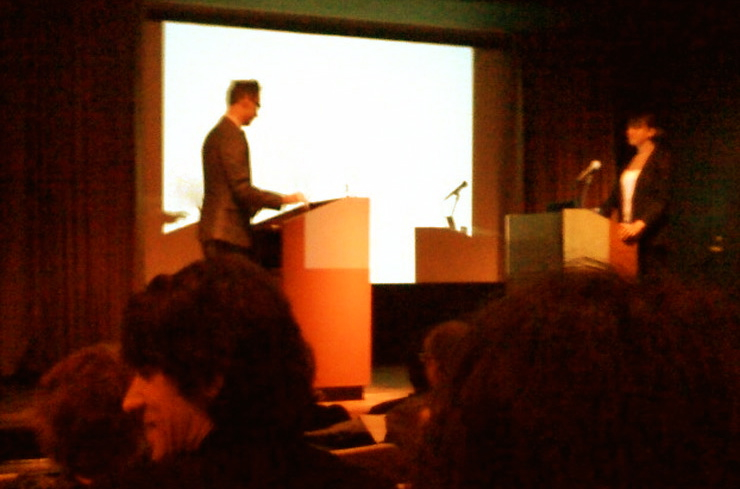
On the final day of the conference, as the last presentation, Abbey takes position behind a podium. A man, another performer, John Spelman, stands mutely a few yards away behind his own podium. He occasionally advances the Powerpoint that displays bland, grainy images.
Abbey tells the story of the night she ended up at the Playboy Mansion following her first gallery show in Los Angeles. My Parents Destroyed Communism and All I Got Was Art with Utopian Strategies, the title of the show garners splashes of stifled laughter, then progressively fewer guffaws, and by the time it’s over the audience is worn down and confused.
A question and answer segment follows.
Without raising her hand, an academic in the front row asks a simple question. She is Lydia Goehr, attractive, mid-fifties, dressed in all black, asymmetrical, avant-gardian garb, a philosophy professor from Columbia University.
“What is the relationship between pornography and regressive art theory?” The question is phrased with a mix of confrontation and playfulness.
A long silence ensues.
“Well?” Goehr prods, smiling.
“No doubt, there is a relationship.” Abbey mutters.
“What makes this different from pornography?” Goehr insists.
“Well, I suppose what I just did occupies space and time differently from conventional porn and I don’t think what I am doing is regressive at all.”
“Can you elaborate?”
“I mean, it may have had some pornographic content, but I’m presenting it in a space, and at a time, where pornography cannot really exist. The conditions make it impossible.”
“Impossible?”
“Yeah. Look at me, I’m wearing a suit, standing behind a podium. This situation is too professional, too analytical. This context is basically geared toward neutralizing any porno impulses. Your mind can’t totally get to the porn, it gets too caught up in the critical thinking and the conference vibe, the bad bagel you had this morning and the professional concerns you might have about your own talk and how you handled your Q and A. Without your mind being able to go there, your body will be arrested in a state far from arousal, I mean, I think. Like, I’m sure you’re thinking and feeling very non-pornographically… If anything I am producing friction between that analytical space and the space of porn. Like this would be the worst place to get an erection.”
A wave of discomfort drifts through the crowd.
“You’re saying all your talk can do is lead us to some ideas about the pornographic in this particular context, not to the experience of pornography?”
Abbey’s grateful. Goehr’s formulation is clearer than her own. “Right. I’d argue that those unexamined, neutralizing, analytical conditions are the key here. I’m asking: What makes the pornographic impossible in this situation, but possible practically everywhere else? And my next question is: by banning pornographic punch from discourse aren’t we falling out of touch with society, a society that lives with explicit sexuality as a basic part of their conceptual diet? Artist’s, whose job it is, presumably, to say something about the nature of contemporary experience inhabit this world of ours, which is inundated with borderline pornographic content. And as a female artist the conditions of our sexualized landscape are accordioned. The surface area of day-to-day experience vibrates with sexual nuance. My job, as an artist, a female artist, is to make those vibrations felt, make them audible.” Abbey suddenly feels like a vigilante, feminist cult leader. Will Goehr call her out on that as well?
“And this is art that you are doing right now?”
“‘Yes, for me, it is.”
“Performance art of some kind?”
“Of some kind.” Abbey does some quick mental mathematics and figures the only way to get this crew of liberal, academic, ivory-tower living professionals anywhere near her team is to take it to the art history books and strip the argument of its licentiousness.
“It’s like, this,” Abbey continues, “I’ve been asking myself, ‘What would a de Kooning look like today? Feel like? Behave like?’ I mean, it wouldn’t be some oil on canvas. It would need to be something formalized, but jagged and retooled, you see? Can a lecture in 2012 be like a canvas in 1947? I think so. In a way that painting simply cannot.”
Goehr nods, making a noncommittal face.
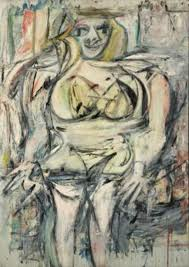
Abbey continues, feeling the audience’s willingness to follow her down this tamer path of theory. “De Kooning painted nudes, right? But the paintings move far enough away from the nude so that they make you think about the nude, while not being a nude. If you see what I mean. De Kooning gets you to a place where you’re thinking about women, about the body, about beauty, about the desire for women, beauty, and bodies, but at the same time you’re not really getting any of that in the actual painting. The mental gymnastics behind the art, is the art. And that’s what I value in de Kooning. That’s what I’m trying to get here. I’m trying to get strong nearness.”
“Strong nearness?”
What Abbey really wants to say , no scream, is “What gives with the apartheid segregation of the body from the mind!” Instead, in a level tone, Abbey explains, “Strong nearness. I want to bring the audience close to feelings that contradict the mind’s desires or expectations. I want to get you close enough for you to think the feelings, but not so close that you can really feel them. This is not meant to be sensational. Like you need to consider the erection and its social taboo without really getting one. Get it?”
The Q and A ends with stilted applause.
Abbey leaves the lecture hall and goes for a drink. The audience’s inhibition or their unwillingness to examine the productive gap between what is going on before their eyes and the storm of events in their heads leaves her cold. What she did was not the performed rehearsal of Don Giovanni from the day before. Beautiful as that was, you knew what to think, you knew what to feel, and you knew what to do. Crying was appropriate. Silence a must. Not a shred of disquiet ran through her mind during that performance. Isn’t disquiet the invitation to inquiry? Can’t the power of the mind and imagination outrun and trump any scenario played out in reality?
Abbey thinks of Dmitri. Their relationship has been over for a good two years, but his mastery of the psychosexual; his fluency in the psychological theater of sexual impulse and desire sticks with Abbey like a perfume. And nowhere is the brain and imagination more potent than in the realm of seduction and sex.
Being in bed with Dmitri always consisted of a lesson, Abbey recalls: “Consider the most elementary and simple geometrical elements as though on a grid.” He lifts the sheet off Abbey’s naked back and presents it pulled taught. “Given certain spatial and programmatic demands, figure out the most suitable arrangements. You will see that you need to combine this shape,” he waves the white fabric, “with that shape,” he runs his hand from shoulder to bum, “and then this element with that.” He drops the sheet, the fabric situates itself along Abbey’s contours. “And before long I have shown you a geometrical grammar and a compositional syntax all the while putting Nature aside and pointing definitely elsewhere.” At which point he flings all the covers, all the sheets, and all the pillows, which had served their duty as provocative and obstructive props.
Abbey has a second martini and toasts Dmitri, wherever he is, and considers the writhing, internal discomfort of performing a feminist while struggling against the formative male voices that permeate much of her vocabulary and academia writ large, come to think of it.
 abjour