Miami Art Basel. The Scales of Disaster

IMG_0033 Instead of going to Art Basel Miami, Abbey Shaine stays in New York, intent on quiet indulgence. Coming off a big night with contemporaries who seem to be doing much better than herself, an impression that keeps her holding on till 5am, hungry to find out what makes her so different from these others: the ones who own production companies, who have fixed significant others, who do MDMA on a week night, but just a little.

Who are these socially and professionally successful beings? Abbey ended up at a dive bar with two of them. She lives in the city, the Upper East Side compliments of a “Family Friend.” They live in Williamsburg. They inhabit different worlds, with different languages and cultures. The two men buy her drinks, pointing out that if she was a Williamsburg chick they wouldn’t, but UES implies a lady. They grow theatrical, or maybe they began that way, and treat her like Lauren Bacall in Key Largo and she happily plays the part.

The night ends with Abbey Shaine, alone, at home, plowing through a bag of cheese puffs, scraping the top of her mouth, while mulling over the evening. At 11 am she wakes up not-in-Miami. Not-in-Miami means going to get the haircut she did herself over her toilet a few weeks ago professionally adjusted. Not-in-Miami also means taking advantage of the salon’s close proximity to the Angelika Theater on Houston and dropping off old rolls of film foraged from a childhood bedroom drawer. It’s a day of anticipation instead of art-fair feigned enjoyment. Unknown1 Force Majeure. The critics like it. Abbey Shaine buys a ticket.
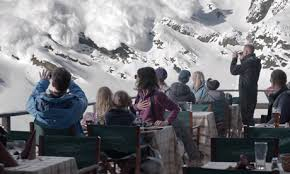
The opening scenes are set high in the French Alps. Drone like establishing shots of aggressive, white peaks to a lyrical Shostakovich-esque soundtrack introduce Abbey to the inhospitable beauty of this film. The cocktail of threat and majesty remind Abbey of something she saw in Kassel Germany, a few summers ago.

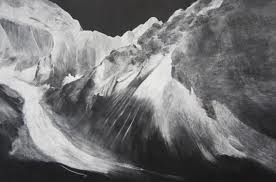
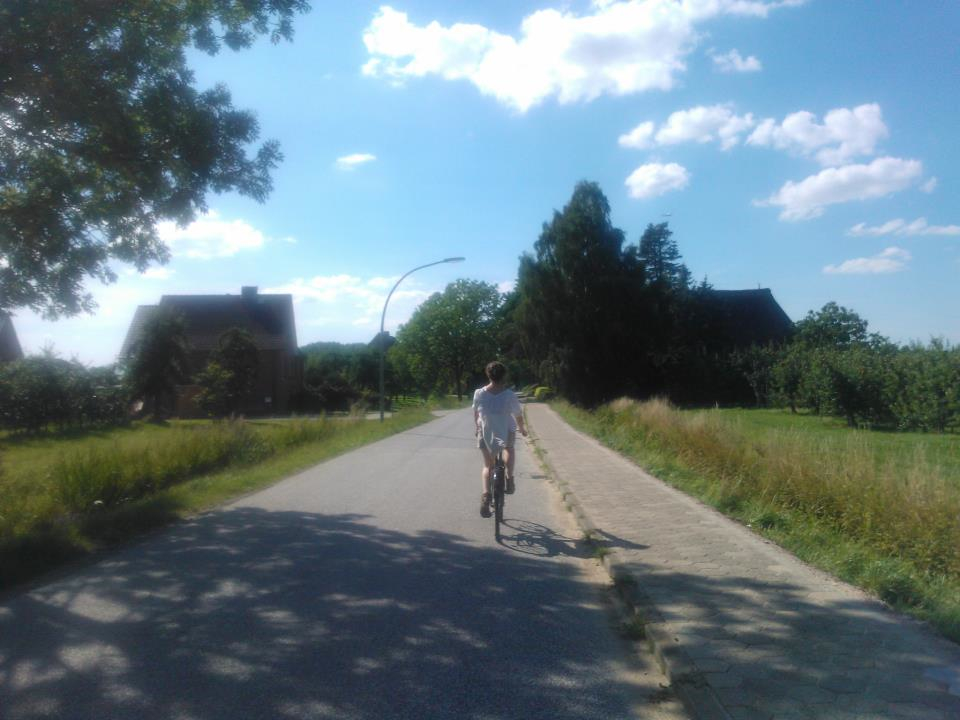
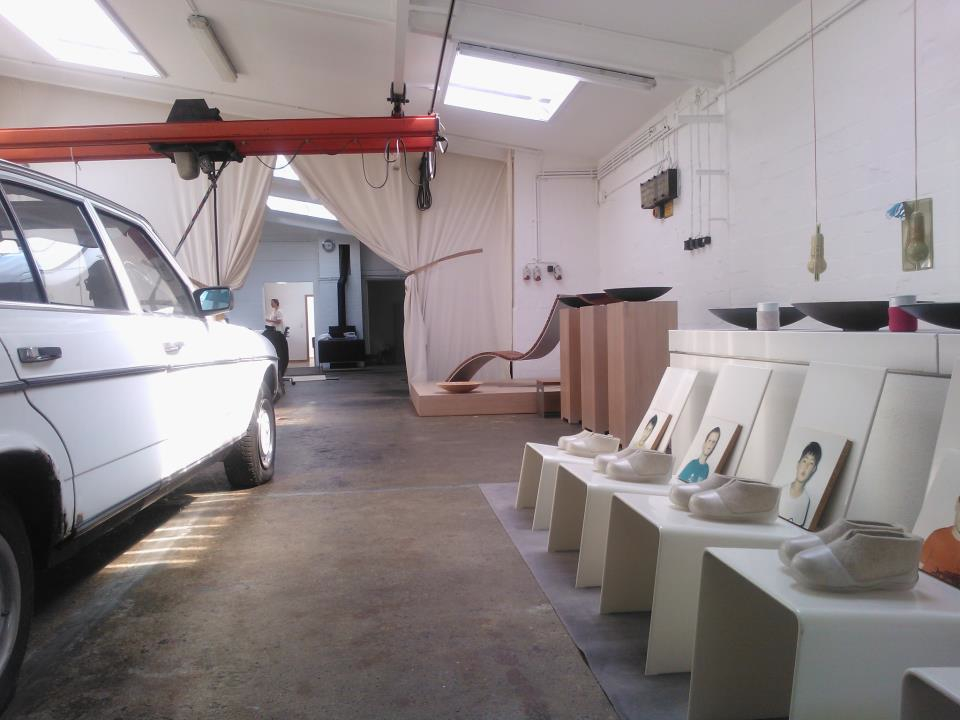
The artist Tacita Dean produced a series of large-scale chalk drawings on the walls of a two story former tax building in the German town of Kassel. The drawings were painfully beautiful and depicted the mountain range of the Hindu Kush. Notes in the artist’s hand, just a few words here and there, described the extreme weather systems that ravaged the area. The drawings follow the chronological lapse of time as the Kabul River crashes through the mountains flooding the landscape. “Violent yet quiet,” that was how Abbey described the drawings. DEAN Abbey was living in Germany at the time. Living with Jan near Hamburg. They met dancing in Paris at David Lynch’s bar Silencio in its early days of being open, when potential still seemed infinite and to be there was to engage in the momentum of something exciting and fast. She moved in with Jan within a month, abandoning her shitty 9th arrondissement apartment and moving into his vast design atelier in Finkenwerder. DEICH “Go bike along the deich.” He’d encourage. Abbey grew up in Philadelphia in the 90’s, where to have a bike meant being mugged for your bike. So, ambling about the deichs of a small agrarian German island felt like a version of success. She had gone far, far away. It was alien and it felt good. Being Jewish made it feel deliciously transgressive as well. When Abbey arrived in Finkenwerder in late July she had a cold, was suffering from asthma, and, as Jan diagnosed, was in desperate need of a haircut—a theme in Abbey’s life. On her second day in the foreign land he made a number of appointments for her with his doctor, his acupuncturist, and his hair stylist. He handed her a map and the list of engagements. Lost in the winding streets of Hamburg and lulled by the wide Elbe, Abbey abandoned the appointments and napped in the park. The relaxation and clean German air washed her lungs from the Parisian oppression; the asthma subsided. She returned by ferry late that afternoon to the atelier she and Jan called home. JVN
“There’s hair everywhere!” He screamed in a British accented version of English upon her entrance.

“Everywhere! You don’t understand the terror you have brought with you! I see everything that has fallen out of place or apart since your arrival! And you are sun burnt! Are you stupid? You are stupid!”

“I fell asleep in the park…” Abbey offered,  while she emotionally and physically withdrawing from the shouting Jan.

“And the doctor! She called! You never showed up!”

“The subway wasn’t running properly and I tried…”

He interrupts, “Tried! You organize! Last night you should have been googling public transport and mapping the routes! You aren’t rich! There are no taxis for you! I am rich. I have the freedom to be lazy with this. You do not!”

Abbey open-palm slapps Jan shut from on high, hitting the upper portion of the left cheekbone where it edges on the ocular cavity. A burst of adrenaline and satisfaction flush her cheeks.

He apologizes. They make love. She cries a little.

The next day they’re supposed to go to Kassel together to see dOcumenta, the art fair. Instead, Jan drops her at the train and tells her to text him with her return details. He has things to do. And he hates conceptual art. Found it pointless. In Kassel, being a lone Jew feels less victorious than it had biking the orchards of Finkenwarder. The city is grey and depressed. Abbey wanders, visiting the exhibitions that inhabit dozens of municipal building across the city. She finds Tacita Dean’s space of quiet illustration. She experiences the drawings as contemplative and spacious. The work gives space to fury and a delicacy to violence.dean4Isn’t it true that as humans, we experience everything to the scale of ourselves? Disasters are measured by the amassing of individual casualties to reach a multitude or holocaust. In Dean’s installation, the only people are those wandering through the space, looking close, then backing up to look again. The only human presence within Dean’s work is found in the smudges and letters executed by her own hand. dean1 Force Majeure opens with the same landscape of impending, natural disaster. Nestled in the range is the lotus of human suffering; the ski resort. The only man made structures, looking concrete, aggressive, but still fragile against the impossible, white mountain range. The contraptions that keep the slopes sloped and operable for skiers look like objects of man-made self-aggression. The film offers a flavor of self-loathing reminiscent of a Lars von Trier. There’s a uselessness and smallness to humans made devastatingly obvious against the inarguable strength of the mountains.
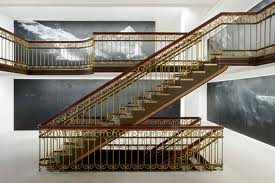

Abbey examines Dean’s wallpaper-like depiction of the Hindu Kush. It is the majesty of these mountains that awes us and reminds us of our utter insignificance. No matter what, they will outlast us. Abbey stretches her limbs to feel herself alive and just as effective at taking up space as the depicted mountains before her. dean2 Kassel was the sight of the deadliest air strike from the allied forces during World War 2. Thousands died while the city burned for a week. A Dachau sub-camp was located in Kassel. Abbey’s relatives, almost all of them, were sent to Poland to be worked to death. She was unsure, while wondering the streets of Kassel trying hard to picture the place as it had been under the Führer, if her feelings of loss and victimization were geographically appropriate and really hers to feel.
Force Majeure renders all human emotions ridiculous. The men are insecure and cowardly. The women are petty and provocative. The question the film asks, a late night rhetorical, is if some terrible natural disaster were to befall you and your family, what would you do? Save yourself? Protect the ones you love? It’s a fun game to play. Sitting in the dark theater, Abbey runs through the men she has been with. They occupy three categories: those who would run; those who would protect her out of love; and those who would protect her knowing that they would be saving their egos and self-evaluation in the process, should it all work out and all. The man Abbey is currently seeing is the only man to fall into the middle category, the selfless hero. She doesn’t love him though.Unknown In Force Majeure a ginger-haired mountaineering looking man with a sizeable paunch points out that the real enemy is the mythological male hero, which no man can live up to. The female lead, playing out the protective mama bear stereotype, rises to meet the avalanche that threatens the lives her and her family, protecting her children without hesitation.
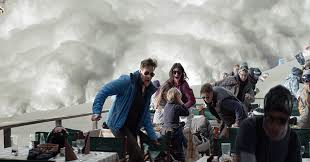
Abbey watches skeptically, “are women not against the same heroic stereotype?” The feminist and brat in Abbey asserts her right to be as selfish and cowardly as the leading male character in the film, who flees, abandoning wife and children.

In 2001 Abbey’s a model backstage at the Donna Karen fashion show when word circulated that something strange had happened in the financial district. It took 10 minutes for a linear story to emerge: a plane crashed into one of the World Trade Center buildings. Apparently a second had just hit the other tower.

Abbey rode into the city that morning from Carroll Gardens with her older sister. Dropping her in the Financial District, where she worked at one of those way-before-it’s-time online startups. In a sea of Russians and makeup artists, bile rose in Abbey’s throat. If her sister was going to die and her world forever changed, damnit to all hell, it would not happen surrounded by these assholes.

Abbey ran out of the Herald Square tents and darted down Broadway. Calling her sister’s office and cell. The inimitably annoying busy signal sounding with every attempt. Somewhere around Canal Street the top portion of the first tower pancaked, one floor smacking to the next. Abbey froze. She met the gaze of others, who for their own reasons were following the impulse to rush towards the disaster. Abbey Shaine did something peculiar, something she never told anyone about. She ran into a bodega, bought a disposable camera. On the street she continued to run south, but this time looking through the small oculus of the gaze finder, snapping.

When the air around her became thick with debris and her lungs near exhaustion, she stopped and looked up. The tower, still partially erect, gave up and collapsed. The sound was deafening, more harrowing was the rush of cement and material that was devouring the world. Those still on the street, the ones not already running north, froze. This is the moment in the movie when you run, Abbey Shaine concluded. That split moment decision to run or seek shelter plays out in Force Majeure.

If Abbey Shaine had kids, like she had a sister, she probably would die in an effort to save them before giving up, she concedes. It took her weeks before she stopped coughing up grayish matter. She was still hacking while walking the runway shows in Milan and Paris in the weeks that followed September 11th.

She lost that camera in a series of moves from borough to borough but finally unearthed it back in Philly with a bunch of other undeveloped rolls of miscellaneous origin.

Force Majeure wraps as it began, with the premise that people, men and women alike, are feeble and reliant on the lies we tell others and ourselves. Is it true? Next to the absolute, immutable, reality of the mountains, the nature of man seems inconsequential and disaster’s produced by nature or ourselves provides the stage upon which we act out who we are or who we want to be perceived as being. And all of it is of dubious consequence; small dramas lost in the shadow of the mountain.

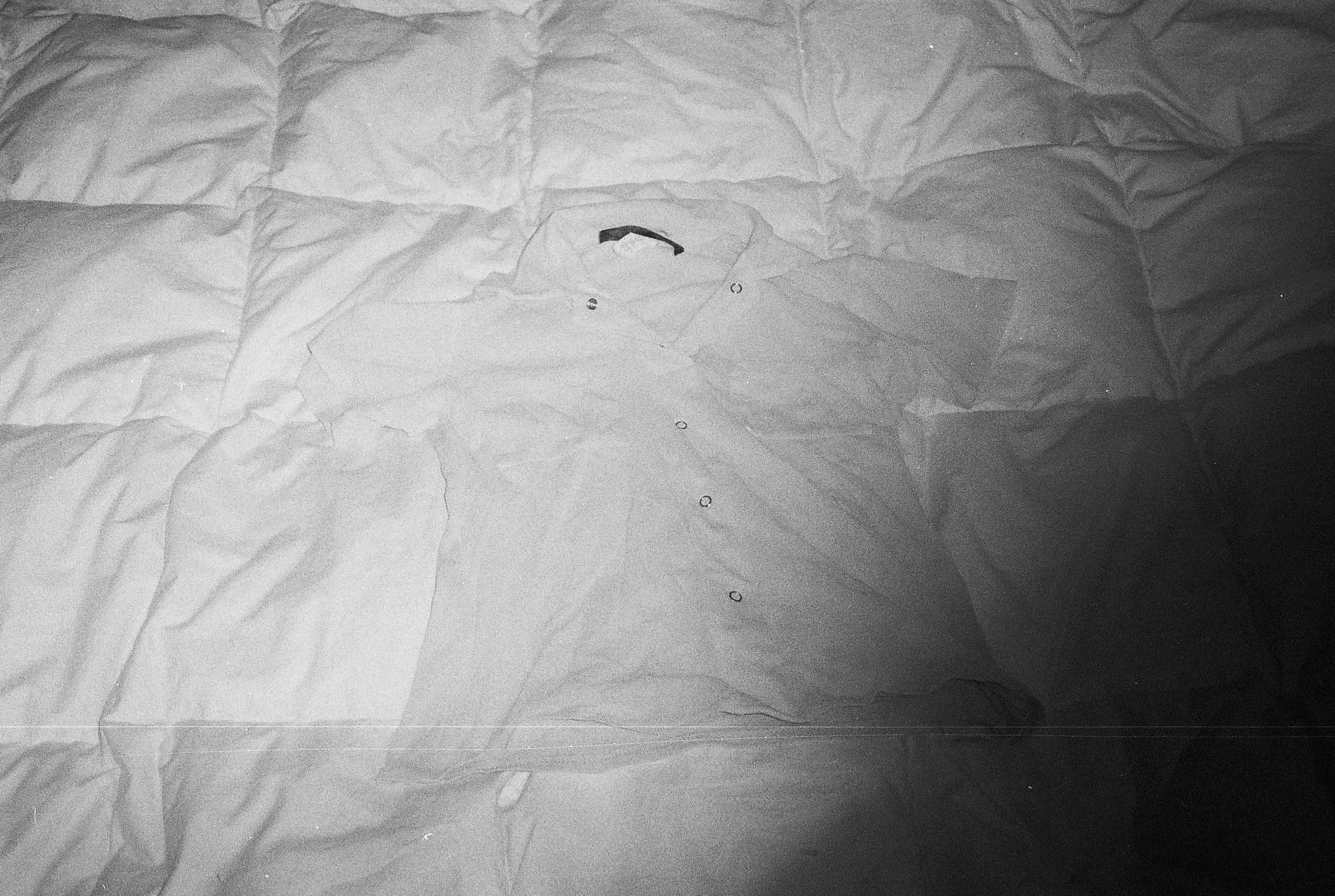
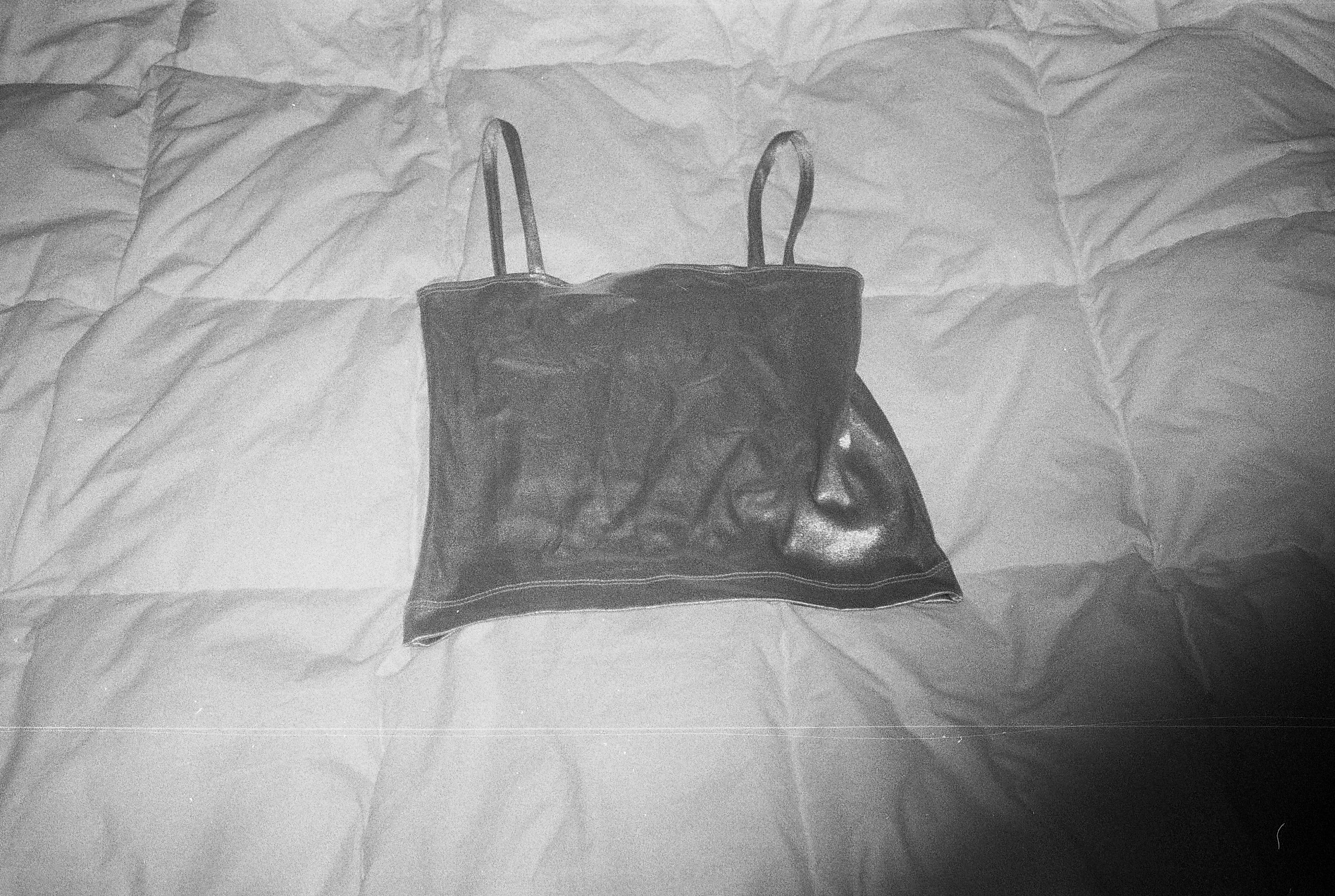
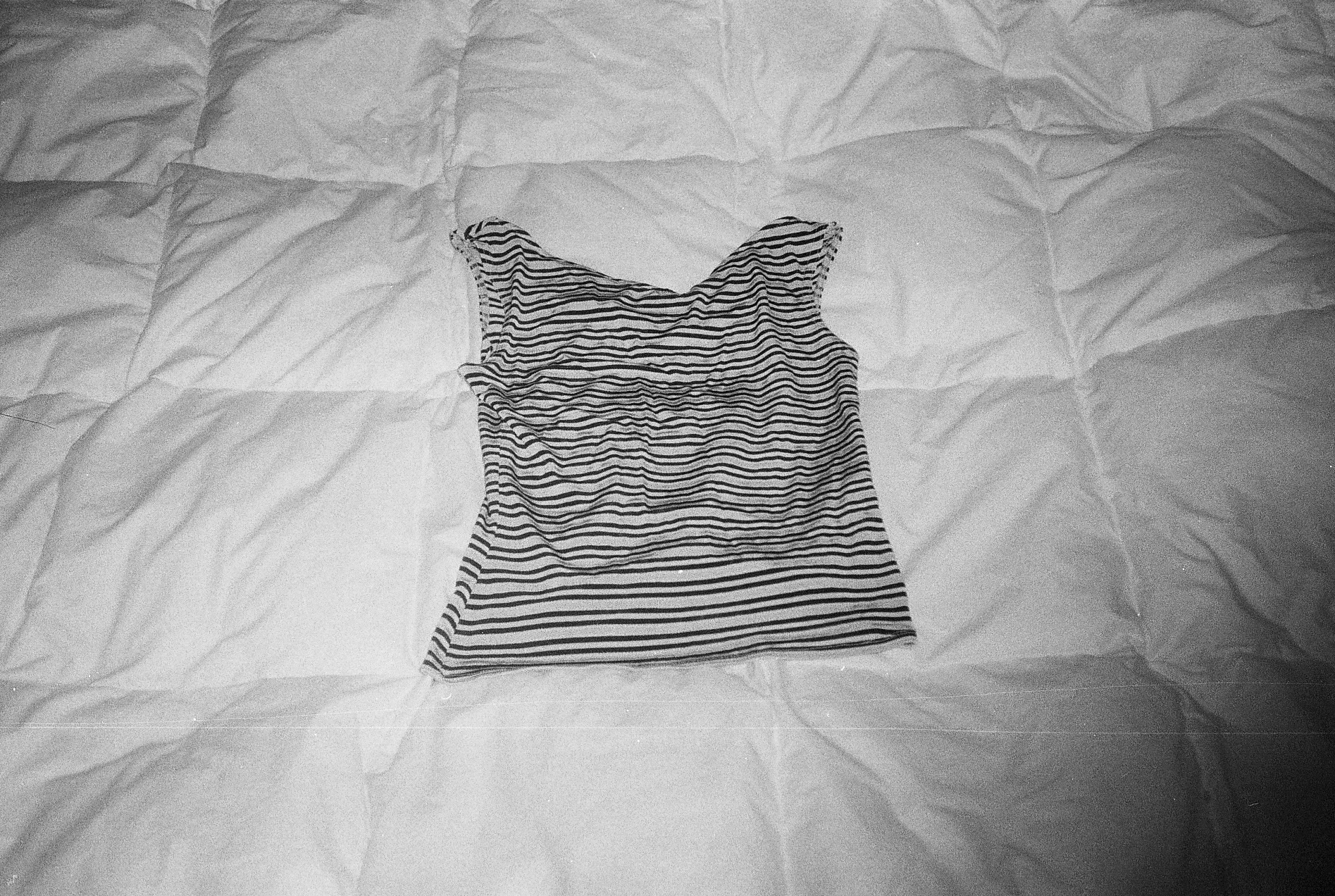
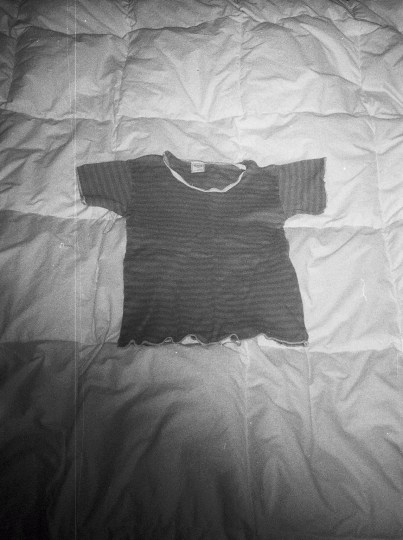
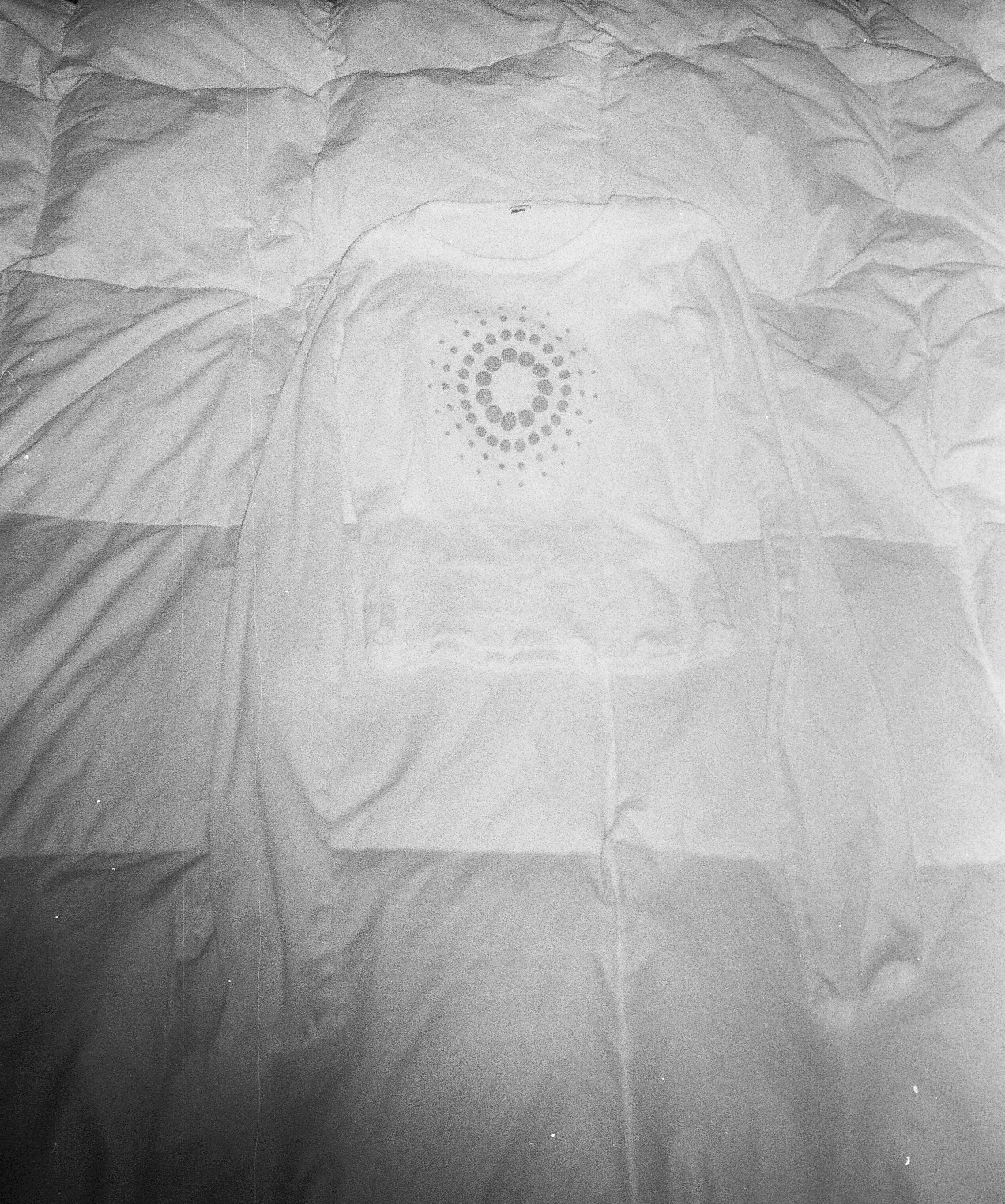
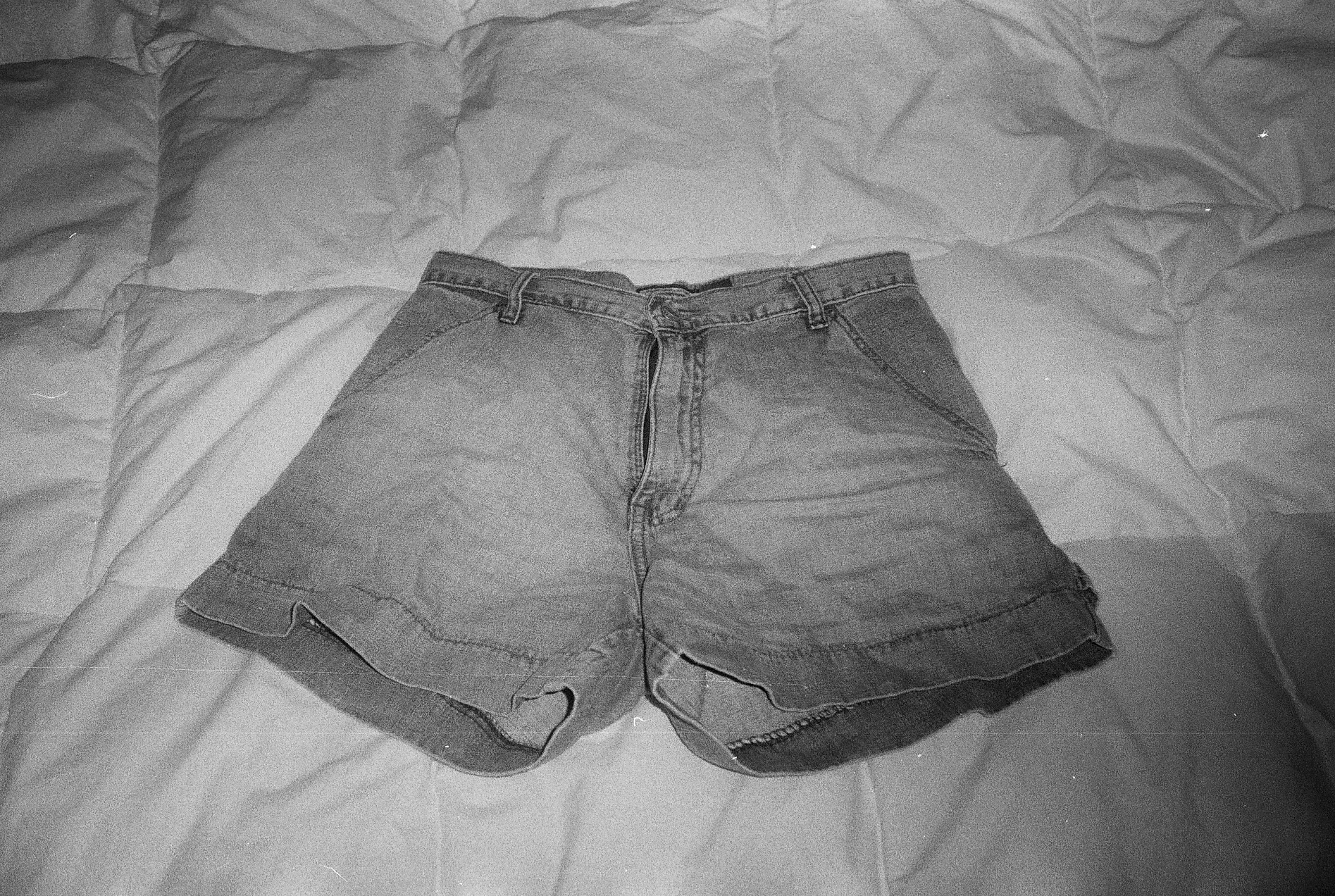
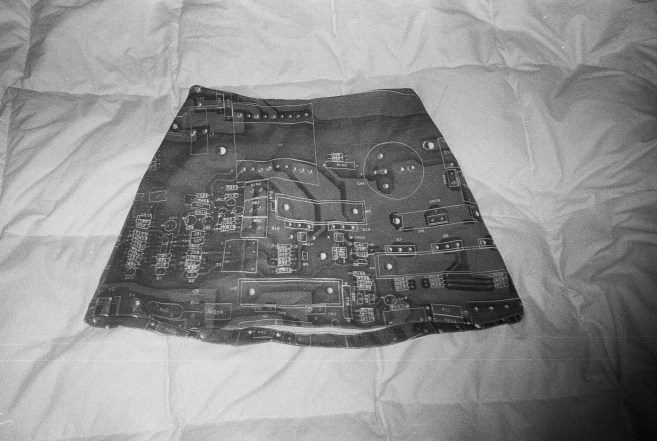
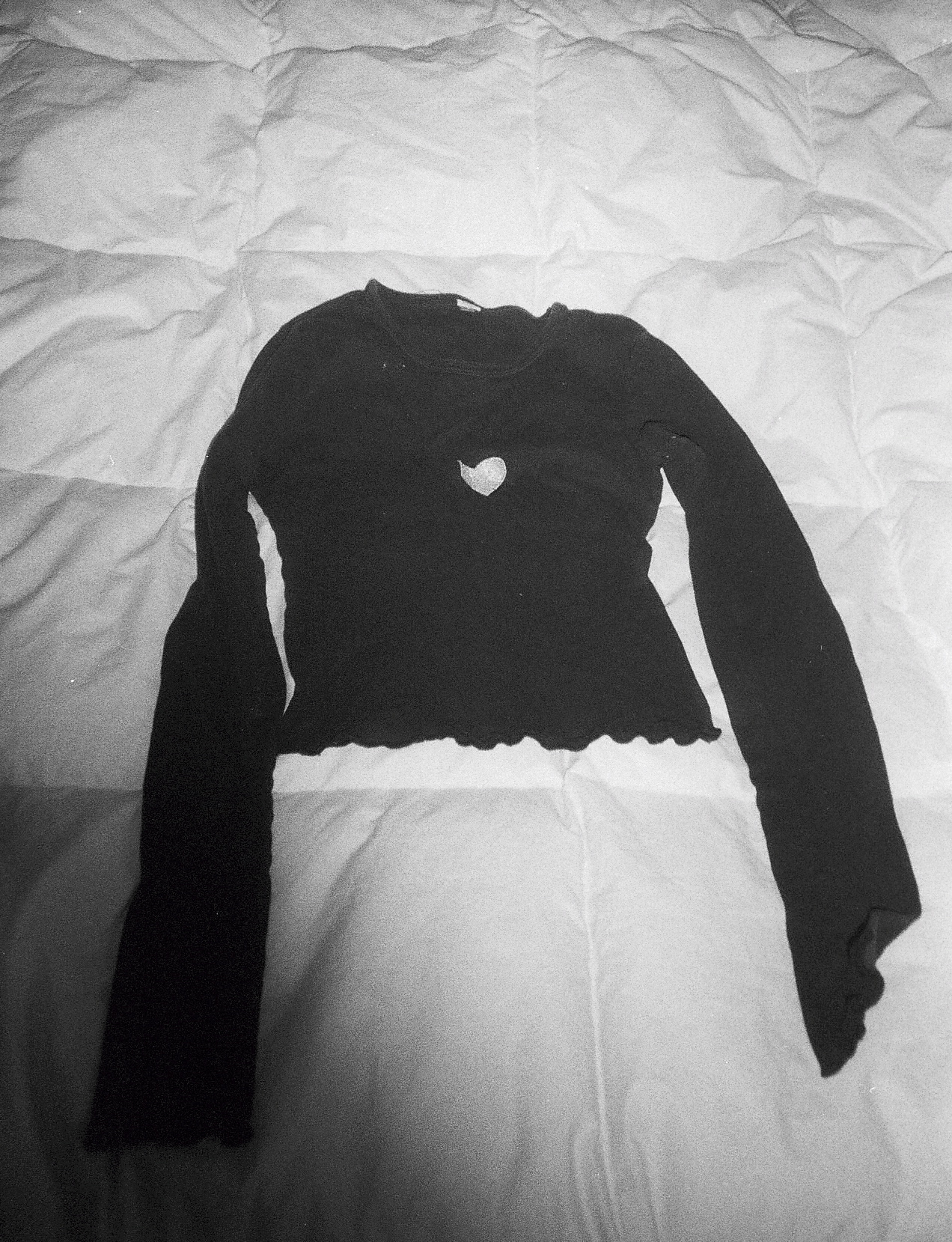
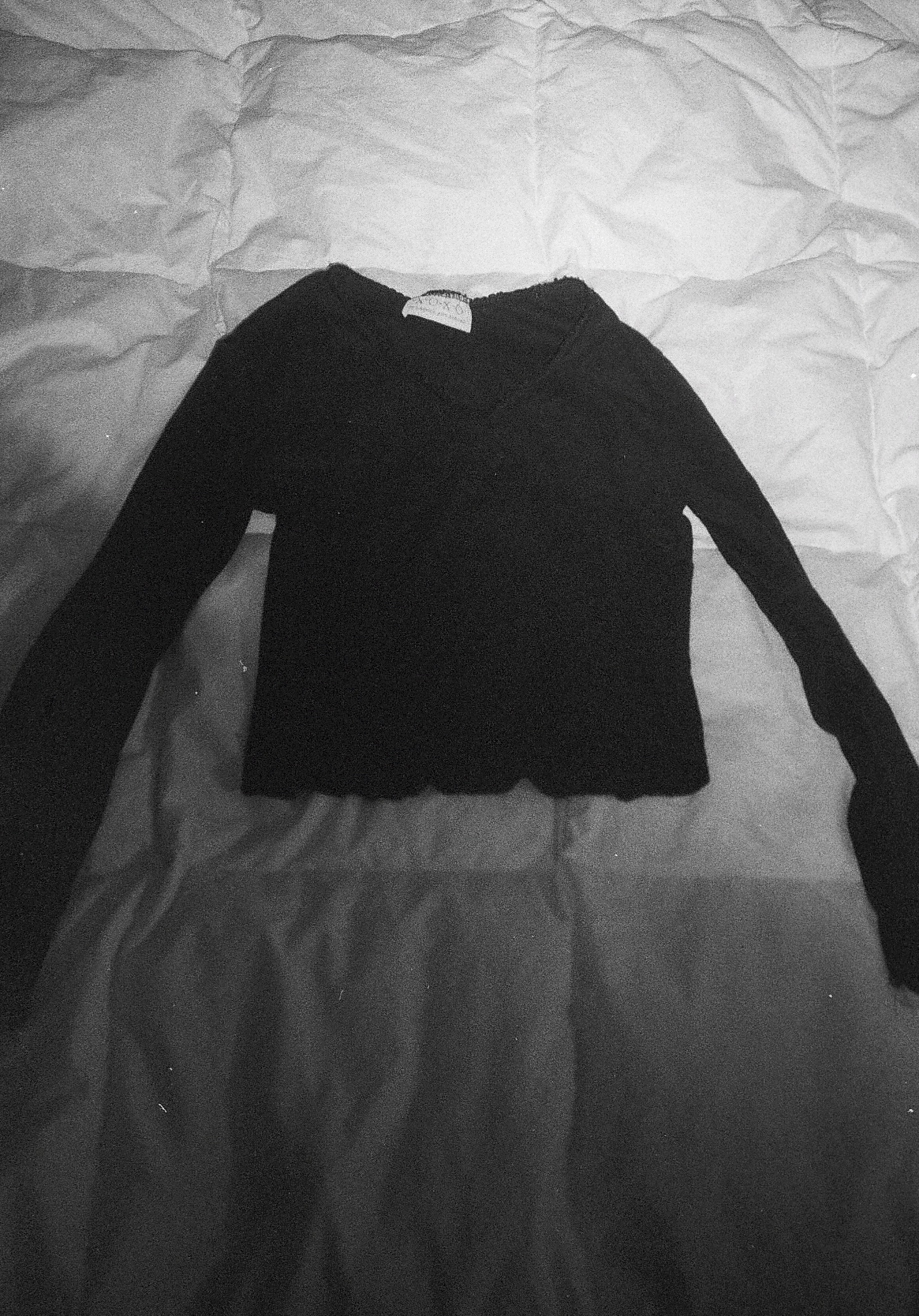
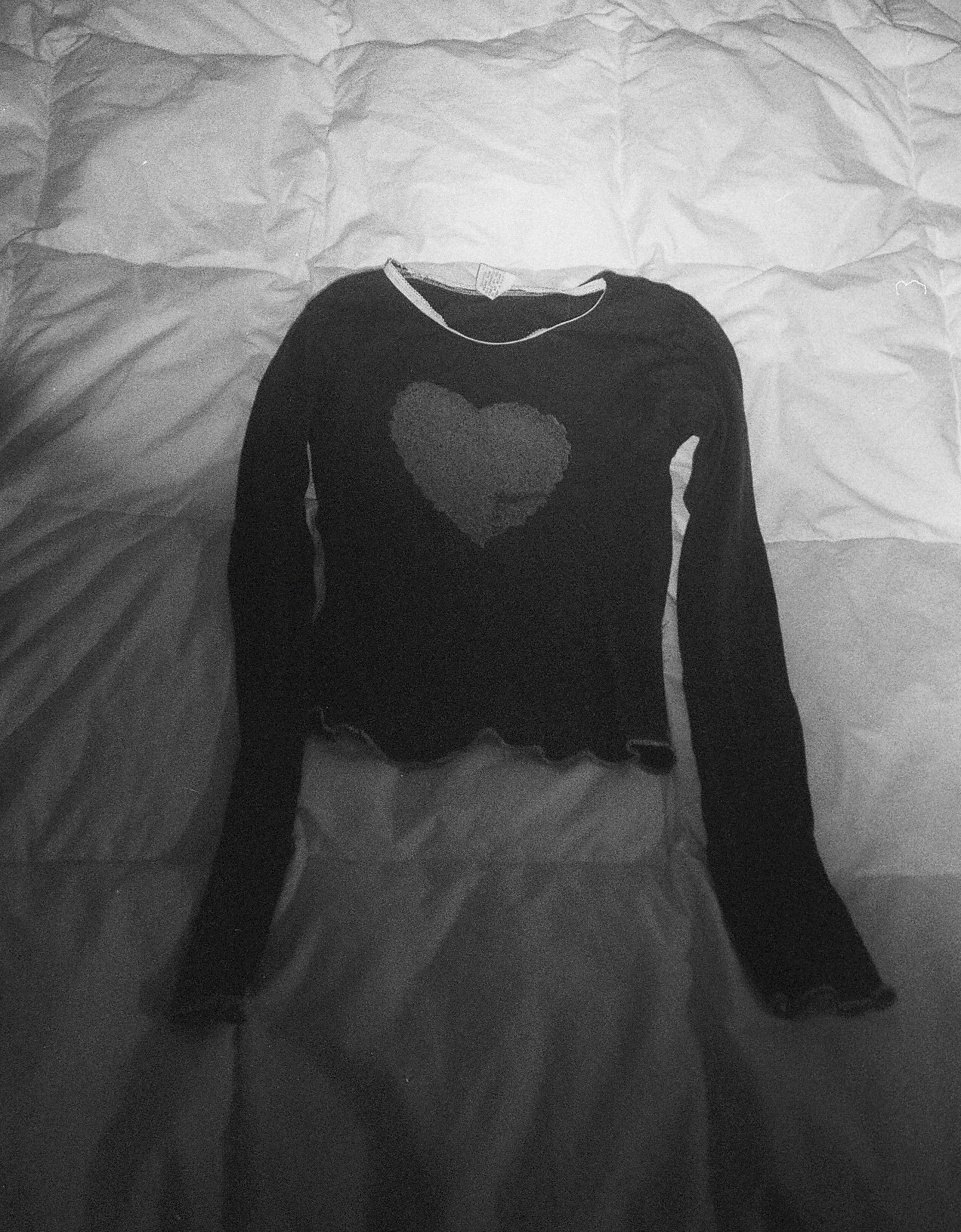
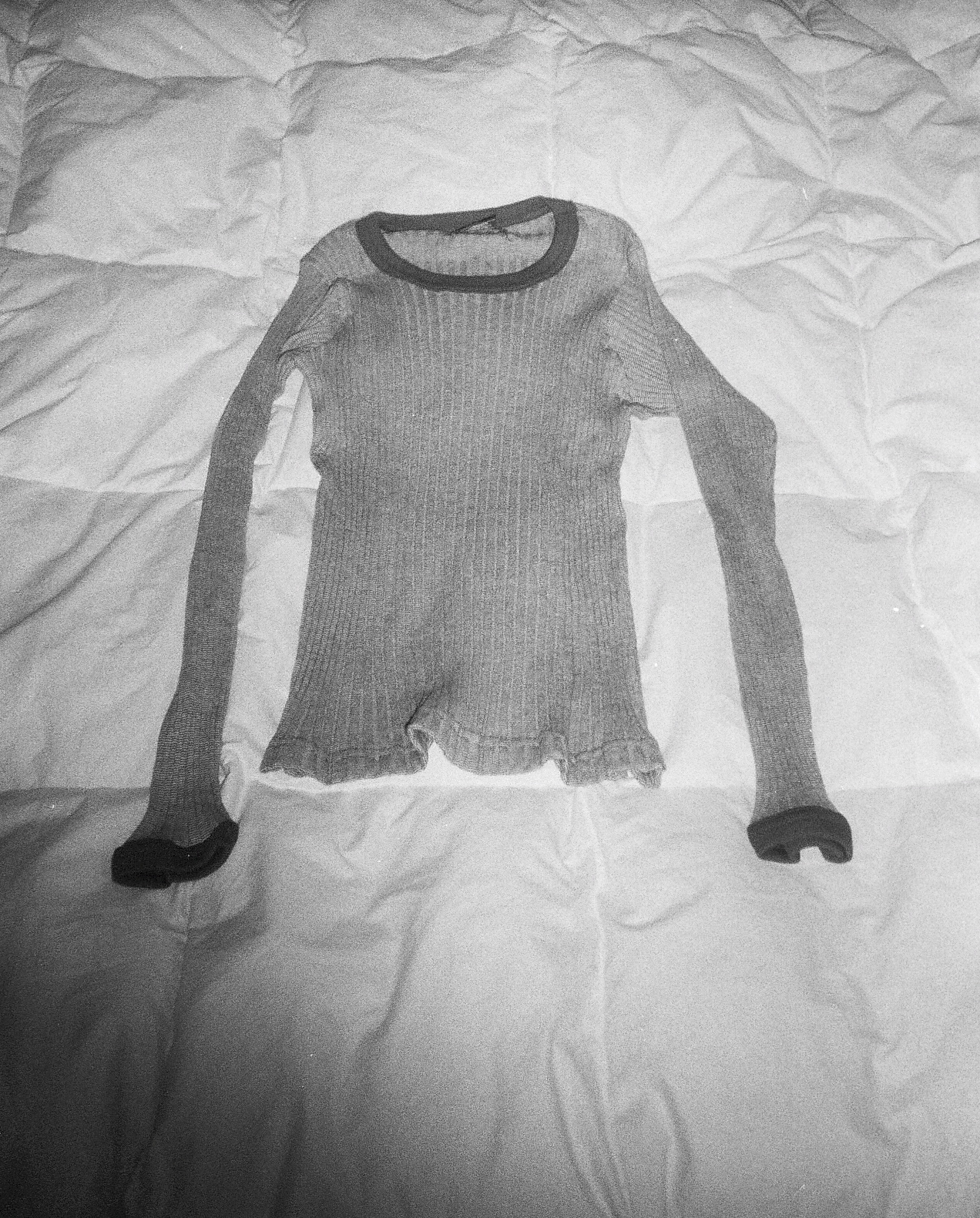
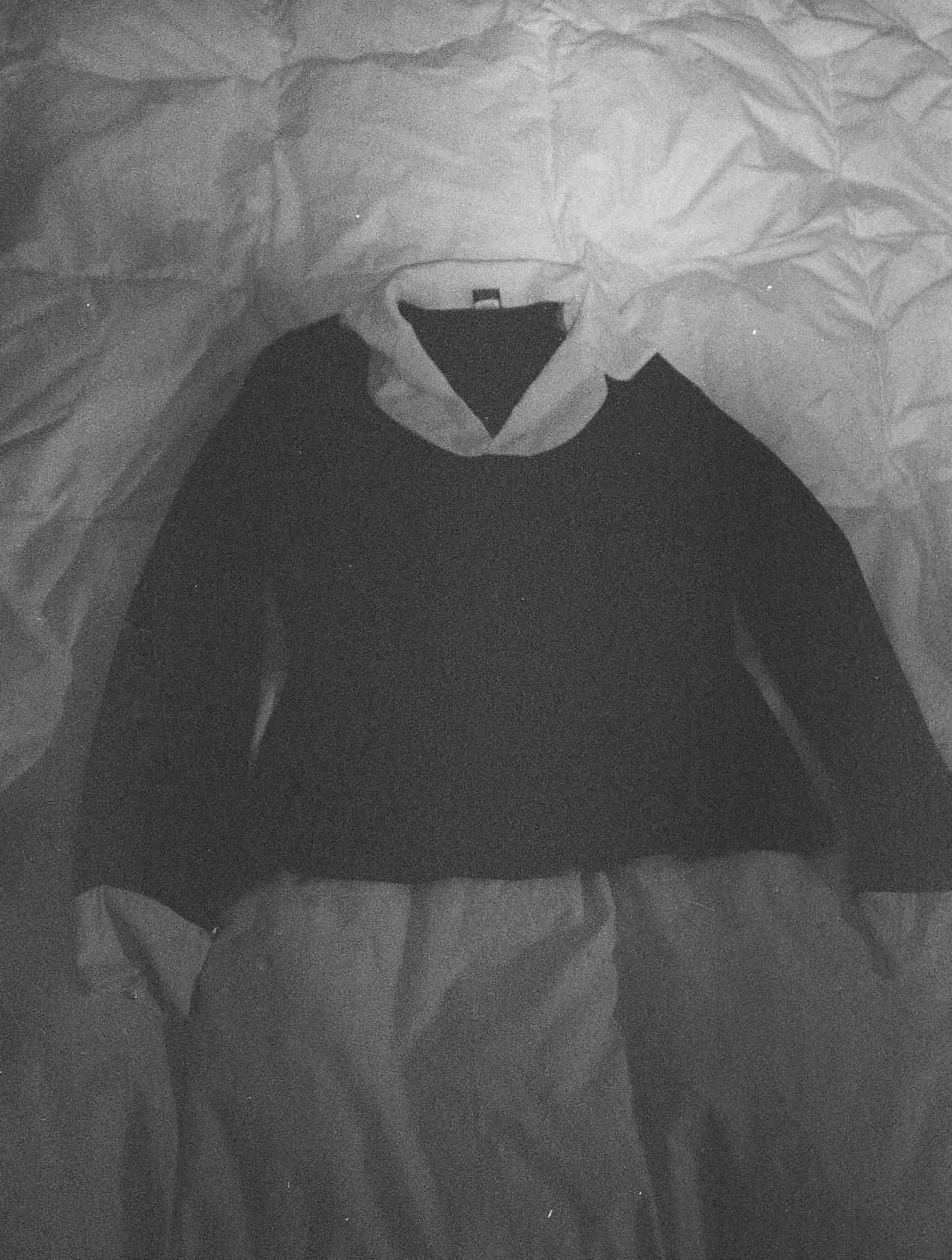
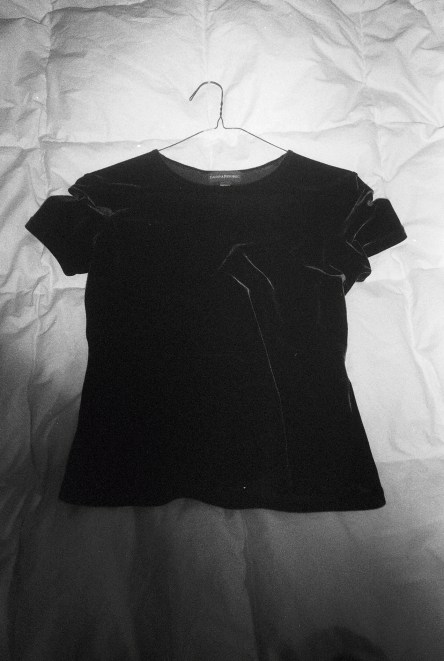
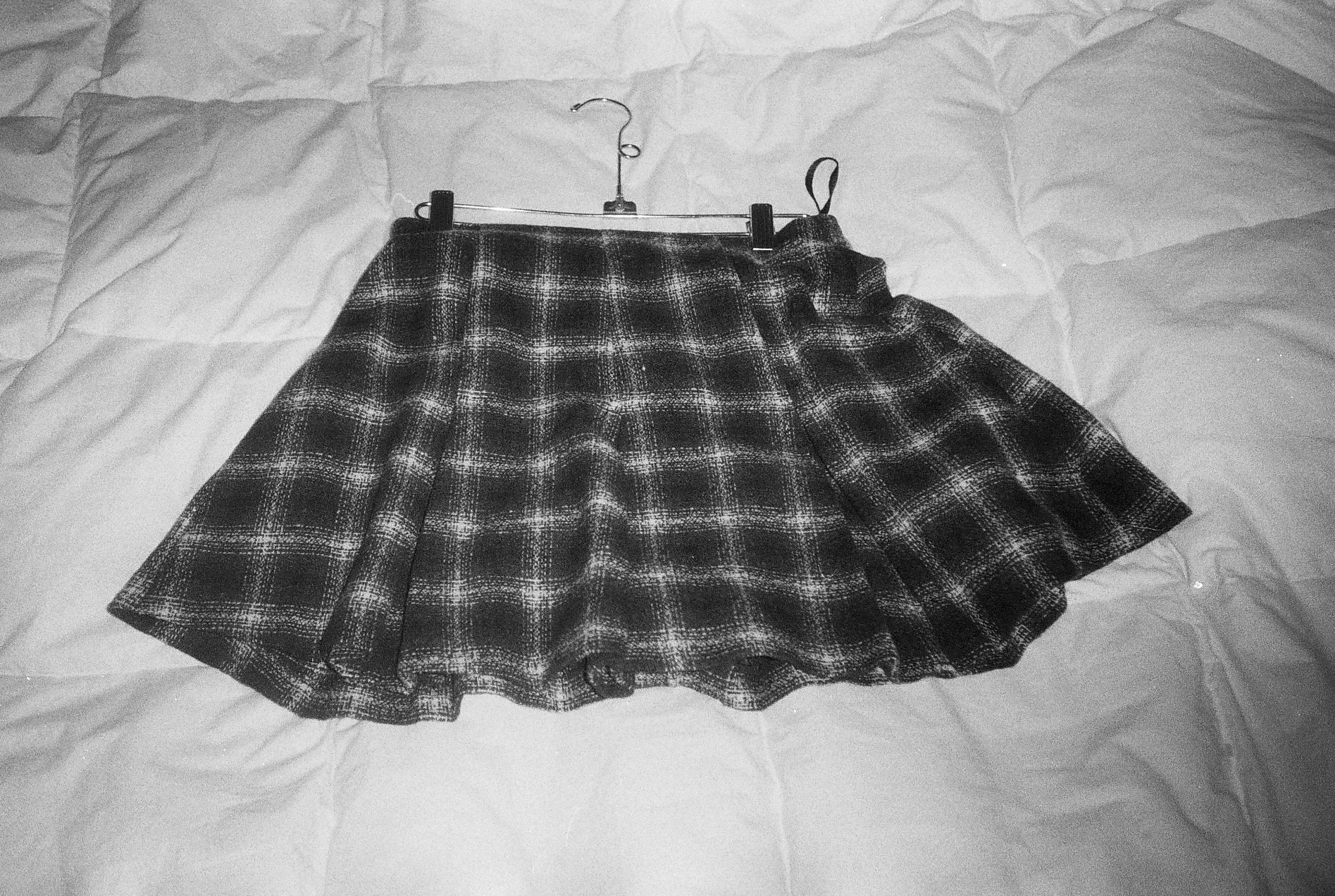
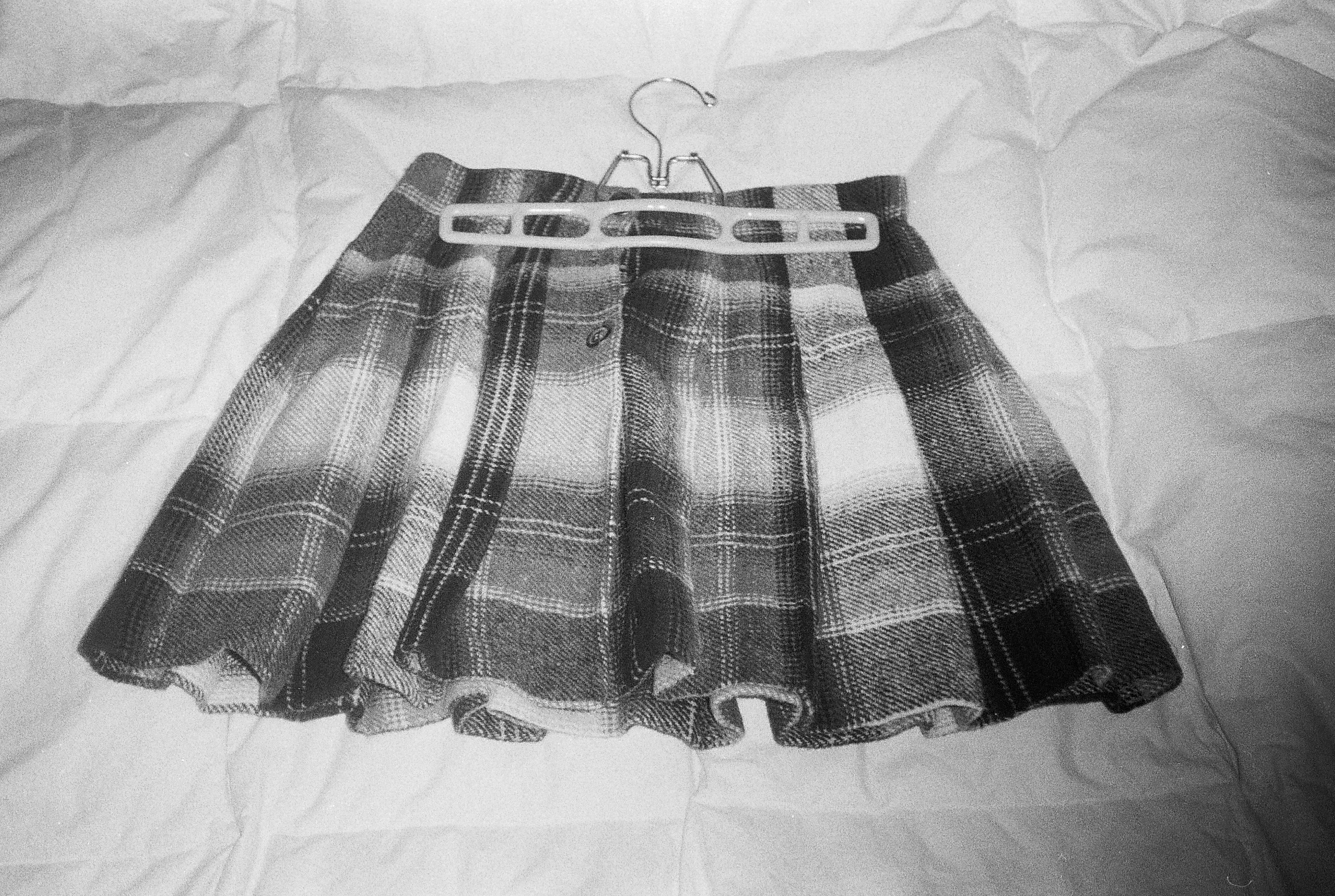
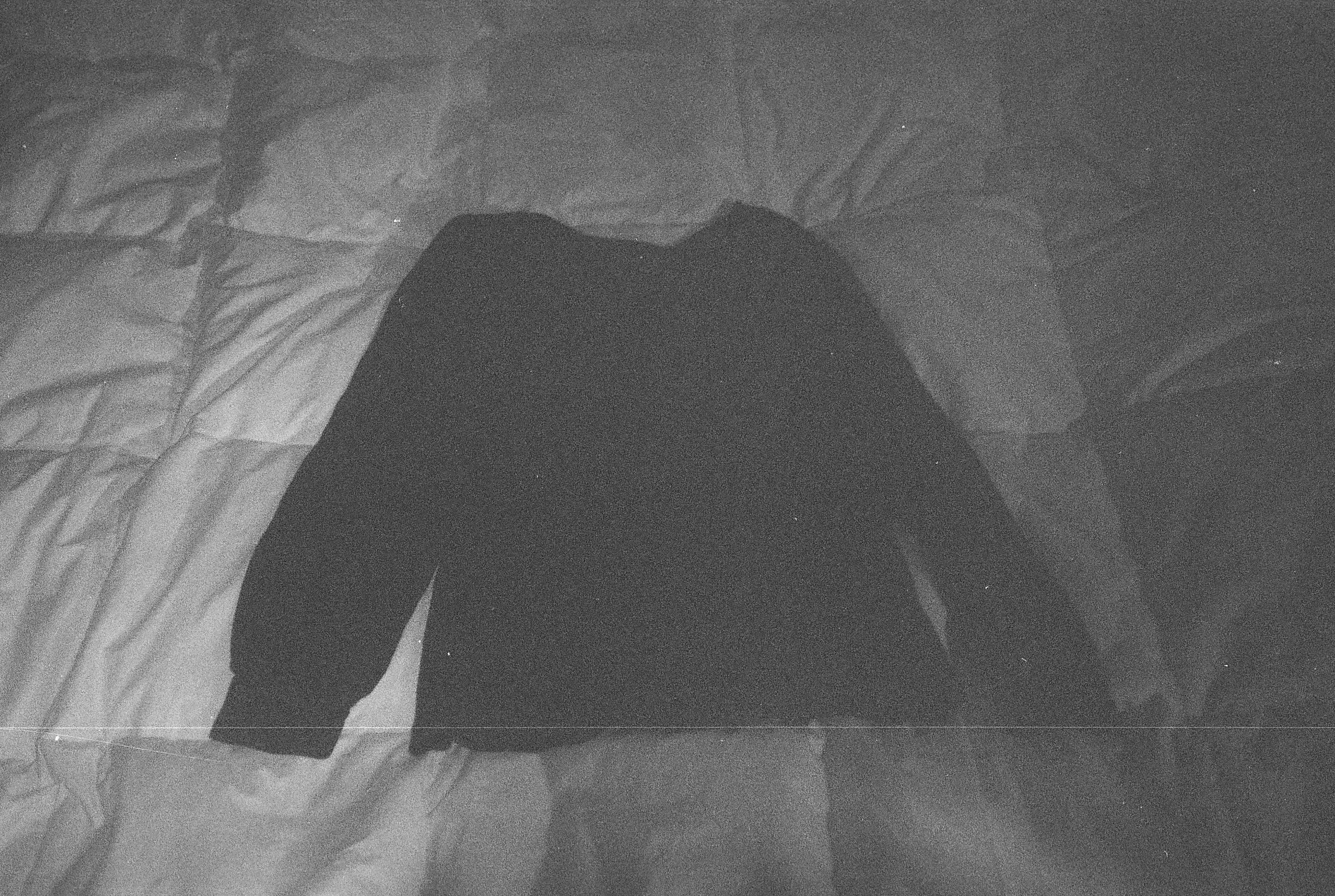
Abbey leaves the cinema, riding the upside of existentialism: “None of it matters!” And before the crash of, “shit, nothing matters…” there’s the ecstatic wave of power and freedom that comes with feeling utterly inconsequential. This is the emotional wave she rides to the film developers. For the first time, she wants to see the images she took on September 11th. She wants to discover the minutia that the film captured, but that her mind could not. Photo02_2 It all comes back as grayscale. Not a single discernible image of the towers or of the dust caked men in three-piece suits moving, zombie-like, up Broadway. Nothing. The only images that developed successfully are black and whites of a high-school, Abbey Shaine’s wardrobe. All of her favorite accessories and items of clothing, laid across the teenage Abbey Shaine’s bare down comforter and carefully photographed are the placeholders for the most traumatic event of New York City’s recent history. Abbey Shaine flips through the photographs repeatedly hoping to find some detail, something, anything from 9/11. Mostly she’s incredulous that history should allow her archive to be forever lost and in its place she’s left with the emo version of a Wet Seal catalogue. Photo04_4 Photo05_5 Photo06_6 Photo07_7 Photo03_3Photo09_9Photo11_11 Photo10_10  Photo08_8 Photo12_12Photo13_13Photo14_14 Photo15_15Photo16_16Photo19_19 Photo17_17 Photo18_18

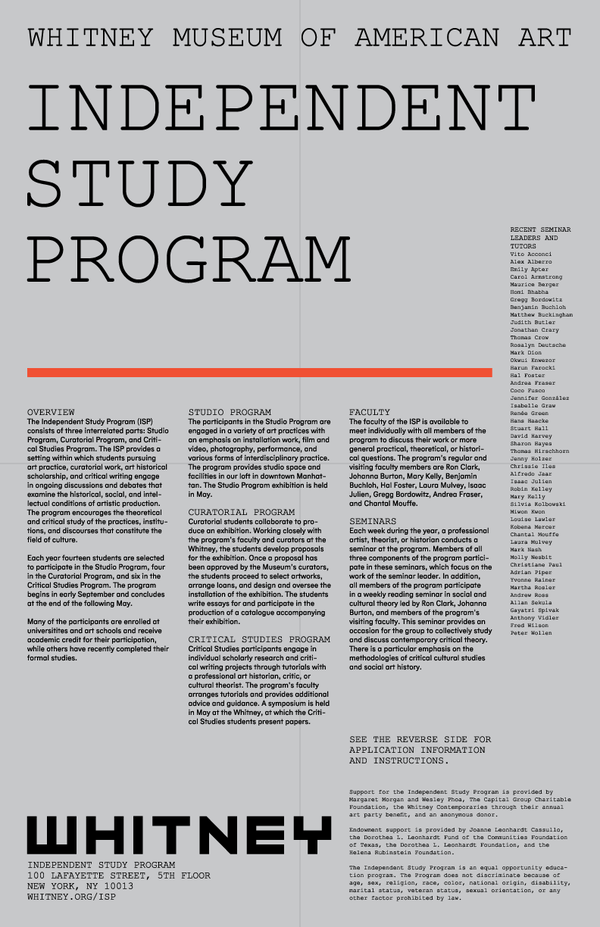
The Whitney Museum of American Art, Independent Study Program

whitneyisp

It’s the Fall of 2015, and the 47th year of the Whitney Independent Study Program.

Each new participant gives an artist’s talk or an academic introduction into one’s field of study.

Abbey asks two fellow participants in the ISP studio program, David Birkin and Gavan Blau, to assist her with the presentation.

Abbey sits before the class in a darkened room. Projected onto the wall behind her are the lyrics from Ice Cube’s 2007 “Gansta Rap Made Me Do It.”

“I can act like an animal, ain’t nothing to it. Gangsta rap made me do it.
If I eat you like a cannibal, ain’t nothing to it. Gangsta rap made me do it. . .
If I shoot up your college, ain’t nothing to it. Gangsta rap made me do it.
If I rob you of knowledge, ain’t nothing to it. Gangsta rap made me do it. .
If I sell a little crack, ain’t nothing to it. Gangsta rap made me do it.
If I die in Iraq, ain’t nothing to it. Gangsta rap made me do it. . .
If I take you for granted, ain’t nothing to it. Gangsta rap made me do it.
If I fuck up the planet, ain’t nothing to it. Gangsta rap made me do it.”

Abbey Shaine Dubin: Let’s follow Ice Cube and say that (scare quotes) “gangsta rap” embodies a kind of shorthand, catchall term for a pervasive, intense, disruptive psychological force that shapes crucial aspects of the early twenty-first century. Or, perhaps we could say that, in Freudian terms, (scare quotes) “gangsta rap” functions as a psychic placeholder that stands for much more than a genre of popular music, it more accurately represents something like the Id of contemporary capitalism.

David Birkin: Okay, so gangsta rap is das Es, the Id, of contemporary capitalism?

ASD: Uhm. No, no, I’m not saying it is the Id of contemporary capitalism. I’m just saying that there’s obviously something in this particular American phenomenon. . .

DB: which, I mean, is already thirty plus years old. . .

ASD: Right. . . But something still allows it to stand in, even if ironically, as the (scare quotes) “reason” behind this gigantic reservoir of destructive activity: War. Addiction. Environmental Collapse. . .

DB(cutting in): So, it’s probably the timing. You know, it’s important when gangsta rap came along then. . .

ASD (cutting in): Right. (pause) What later gets called gangsta rap appears in the United States.

DB: What, around 1985?

ASD: Sure. We could argue about the exact moment. Whether it was Ice-T, or N.W.A., or someone else who made the decisive step to gangsta, but what is clear is that (scare quotes) “gangsta rap” comes on the scene, and achieves mass popularity, at a very specific moment.

DB (slowly): In other words, from a geopolitical perspective, it’s no accident that the emergence, the. . .

ASD: the efflorescence

DB: yeah, sure, of this extremely hedonistic and violent mode of cultural expression directly parallels. . . hmmm. . .

ASD (slightly over DB): the arrival of glasnost and perestroika. . .

DB: the eventual collapse of (scare quotes) “actually existing” socialism.

ASD: So. . . it’s no accident that N.W.A.’s Straight Outta Compton comes out the year before the Berlin Wall comes down.

DB: You mean that the black urban proletariat is rising up in Los Angeles and N.W.A. is voicing a desire similar to the Velvet Revolution, just a year in advance. . .

ASD (cutting in): No. No. (pause) No. The bond. The synchronicity. The coevality, you know, it’s a lot darker, a lot more complicated. From now on: No One Is Getting Out of Compton. It’s like hedge fund managers on Wall Street, their fantasies of possession, aggression, and domination: all of their hunger for maximum profit in sexy new markets and all of the violence that comes with it. . .

DB (blandly): “Gangsta Rap Made Me Do It.”

ASD: Exactly.

DB (blandly): “Get Rich or Die Trying.”

ASD: Precisely. That’s the situation that gangsta rap makes legible. (pause) That’s Das Gangsta Kapital.

DB (quizzically): Hmm. . . so, there’s a subterranean bond between the arrival of capitalism on an integrated global scale and this form of cultural expression that is all about possession, aggression, and domination. (pause, as if thinking to himself) So if we were trying to write a psychic history of the late Cold War, the antipode of gangsta rap would be. . . uh. . . what exactly?

ASD: You mean, gangsta rap’s opposite term?

DB: Yeah.

ASD: You mean. . . the Super Ego. . . to. . . gangsta rap’s Id, so to speak?

DB (slightly speaking over ASD): I suppose. Yeah. (pause) So to speak.

ASD: Well, with hindsight, I’d say capitalism’s Super Ego, so to speak,

DB (rapidly): so to speak

ASD: was, well, embodied by the liberal, Eastern European intelligentsia’s most treasured possession:

DB: And what’s that?

ASD (long pause): the research institute.

DB: You mean, like…the (scare quotes) “research” institute. . . you mean: capital “I,” capital “S,” capital “P” and everything we popularly associate with the Whitney Independent Study Program, its “atmosphere?”

ASD: Right. Right. (spreads hands, looks up and around quickly to indicate the room)This embodies something like the Super Ego of contemporary capitalism.

DB: Okay, I’m with you.

ASD: But, hey, let’s go further: okay, maybe we can say that the dynamic interplay of gangsta rap-ism

DB: the Id

ASD: and research institute-ism

DB: the Super Ego

ASD: represents the symbolic drama of the Ego within the culture of contemporary capitalism. (pauses, surveys room)

DB: So you’re saying that gangsta rap symbolically brings the antinomian energies within the culture of contemporary capitalism to a kind of self-annihilating crescendo, while at roughly the same moment actually existing socialism’s ethos of pedagogical propriety and self-discipline begins to collapse. So the Id wins?

ASD: For now, yeah, the Id wins. (pause) And the bottom line is this. The future of capitalism is now a global race to Gangsta Everything. Not just rap. Not just music. Everything.

DB: EVERYTHING?

ASD (cuts in): Everything. Everything’s gonna get gangstafied.

DB: Like we used to just have the news. . . you know, the nightly news and CNN, newspapers. . .

ASD: Then everything got gangstafied.

DB: The approach to information distribution got more

ASD (rapidly): sexualized. . .

DB: belligerent. . .

ASD: The newscasters started to look like porn stars. . .

DB: reporters started to attack the people they interviewed. . .

ASD: business programs—I mean, they used to be the most boring programming on television—started having flashing lights,

DB (slightly over ASD): with jump cuts, guys leaping around, clutching microphones

ASD (slightly over JS): shouting “boo yah” above a bank of stock tickers. . .

DB (pauses, then speaking directly to the audience, as if knowingly): And now you can see where all of this is going.

ASD: If everything will be gangstafied in contemporary capitalism, if everything is going to be saturated by the Id, then it’s only a matter of time before we get the gangstafied research institute.

DB: Okay, I accept that. That’s logical. But I mean we already have this gangstafied research institute in its embryonic form, don’t we?

ASD: Well, yes, we have its first wave, though it hasn’t transformed the whole university, yet, but, yes. . . the gangstafied research institute has a name, and that name is. . .

DB and ASD (in unison): The business school. (long pause)

ASD: Strangely enough, business education, which had once been viewed as the prototypical bourgeois engine of stultification, codification, and middle class propriety, has become a kind of GLOBAL GANGSTA RAP.

DB: You mean Naomi Klein’s “disaster capitalism”, that kind of thing?

ASD: Right; a world economy grounded in “disruptive innovation,” but what they really mean is that we will witness the progressive gangstafication of everything, everywhere, all the time.

GAVAN: So if the present-day business school functions as a gangstafying research institute, a zone dedicated in the last instance to churning sensual exploration ruled only by the demands of the market, okay, then. . . (as if thinking to himself) what embodies the research institute dedicated to understanding this process of global gangstafication? What today, if anything, embodies the antipode to the all encompassing all devouring ID?

ASD (pause): The answer? The answer. . . is art.

GAVAN: Art? So, the future of art is the opposite of the business school? You mean, then, that art will bring us closer to the Super Ego and business is going to bring us closer to the Id?

ASD (hesitantly): Yes, yes, to me. (shaking head) I know it contradicts every idea of artists and business people that we have historically possessed, but, yes, that’s the situation today. Art, which had been modernity and postmodernity’s engine for disrupting and sensualizing the world. . .

DB (speaking partially over ASD): . . .from Courbet to Mapplethorpe, it’s true. . .

ASD: will now begin to perform the opposite role. It must. It will haul all of these gangstafying gestures from the larger culture into places where the gestures can begin to educate and teach.

GAVAN (questioningly): So, miniature? Uh, you know. . . virtual? . . .uh. . . research institutes built out of self-reflexive gangstafication would be the future of contemporary art? Right?

ASD: Yes. Sure. I think that’s right. Like, important contemporary art is no longer about making individual objects, things to sell, or anything like that. It self-consciously intensifies gangastification and reproduces it in the most inappropriate places. You could say that art after the fall of the Berlin Wall. . .

DB (cutting in): you mean, in a way, post-Soviet art. . .

ASD (cutting in, as if having a “Eureka” moment): Right, like ALL art today is conceptually (scare quotes) “post-Soviet art”. . . art after actually existing socialism.

DB: Right. That seems right.

ASD: So ALL art after the fall of the Berlin Wall—post-Soviet art—has to come to terms with the psychological debris of the Cold War. . .

DB: global commodification and mass gangstafication

ASD: and some art runs with that commodification, channels that gangstafication. You know, this is the art. . . this is the art of the art market. The stuff you see in galleries and museums of contemporary art.

DB: Okay, and then some art. . .

ASD (emphatically, gesturing with hands): Some art, the serious art. . .

DB: . . .important art. . .

ASD: the art that matters. Today, this art usually doesn’t look like art at all. These days real art always seems to show up in the wrong place at the wrong time in the wrong form. Like, you want to educate people about LGBT rights in a repressive society? Go make some art that no one will even know is art until it’s already over.

DB (questioningly): Like this art might appear as an unannounced punk rock prayer performed in a church?

ASD: Right.

DB: So, you basically can’t find important contemporary art in galleries or museums anymore?

ASD: Let me put it like this: it’s kind of like food and fast food. Most food is fast food because you can make a profit producing it, even though everyone agrees that fast food is barely even food. Same with art.

GAVAN: Going to a gallery to see art is the same thing as going to Chili’s for dinner?

ASD: That’s too extreme, but there are similarities. Today, here’s what real, serious art looks like: it looks like somebody’s making a big, mystifying mistake in public. . . but then later you realize, “Oh, hey, that was art.”

DB: You mean, you could be sitting in a room and looking directly at contemporary art and not even know that contemporary art’s happening?

ASD: That’s right. It’s almost axiomatic. That’s what usually happens. The spectator ends up feeling like she’s been summoned to an experiment against her will. That’s the virtual research institute in action. That’s art in action. You’re given artful information and you got to deal with it, whether you want to, or not.

DB: And that’s art?

ASD: That’s art. That’s what art is today.

DB: And what about actual research institutes? Like the one we’re sitting in right now, what happens to them?

ASD: Well, I think you could argue that the analogy of the vaccine explains the situation best: the real research institute must contemplate a certain amount of gangstafication in order not to become gradually and surreptitiously gangstafied.

DB: Immunization through self-aware exposure?

ASD: Exactly.

DB: So, you could say that today we’ve made our effort to vaccinate this research institute?

ASD: Correct. (long pause)

The lights come on and the next artist takes the podium to express his discontentment with African conflict diamonds, and the trans-global effects of this trade as viewed through a Marxist materials lense. He proposes his oil paintings, produced for distribution through the gallery system, as speaking points to a Chantal Mouffe-ian exploration of agonostic pluralism. Abbey wonders why she’s doing any of this. At All. Ever. And To What End.

MMokgosi

Performative Languages of Emotion

GRAHAM

Abbey Shaine and Dmitri Greene’s love affair, which began as a clichéd, student-professor, stalker-esque event, finds resolve as a domestic partnership. Dmitri takes sabbatical as Abbey enters her sophomore year. Abbey attends class on Columbia’s campus untethered and free from the allure of dipping into Dmitri’s office hours. She’s simply a student. It’s fine. At night she goes home to her Boerum Hill apartment, which she shares with Professor Greene. She finds him hunched over Guattari, Deleuze, or Cache transmogrifying the words on the page to contorted, AutoCAD shapes on his laptop.

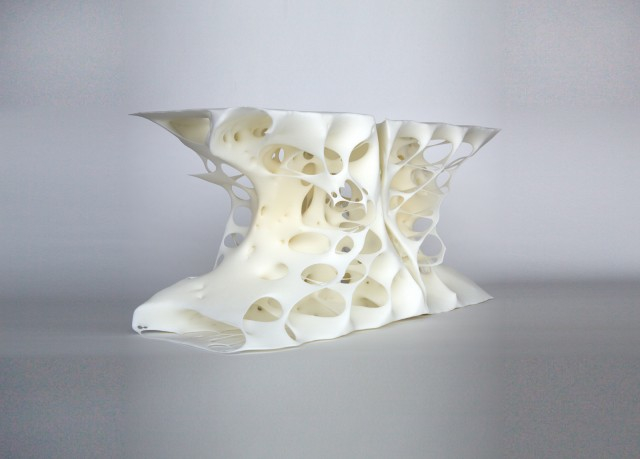
“It’s simple fluid dynamics. I’m using these programs to produce organic forms.” Typing keys and entering a complex string of commands into his PC, his brow furrowed, illuminated only by the LED light emitted by his computer. Brooklyn is dark by 5. It’s winter. And these early onset nights give the impression of long evening hours spent righteously working.

“Produce a form, any form, and then set parameters. See? This is your foil. Then watch as the fluid streams past and through. See where it pools? See where it produces turbulence?”

23IMG_0788Aasmall-640x459

“I see.” Cocooned in their small live-work environment huddled around the desktop like it’s a hearth, Abbey is all in. Fluid dynamics to produce architectural forms that can range in scale and function, from a sitting stools to a building, all the while embodying the most basic principle of movement on the most basic particle level? Yes. That is sexy. To Abbey’s ears, no concept of equal allure has ever been spoken. Dmitri’s intellectual propositions paired with actions on the computer that called for words like “algorithm” and examples of Turing set new standards of pleasure for Abbey. Nothing is happening. She is listening. That is all, yet the sensations gush and nerve endings tingle. Dmitri tells a story of material sensuality and it turns Abbey on in unparalleled ways.

https://arthist.net/archive/3435

3 years later. A big academic conference in Berlin called Performative Languages of Emotion. The presentations and discussions take place in English to accommodate monolingual Americans. Abbey Shaine is among the presenters.

The conference features literary theorists, philosophers, opera and theater specialists, artists, anthropologists, performers, a real mixed bag all coming together for 3 days of performative lectures in Berlin’s Schiller Theater. It advertises itself as “an attempt to discuss emotions in the performative arts as a dialogue between theory and praxis, art and scholarship.”

images

The presentation that most wholeheartedly embodies the ethos of the conference occurs on day two. It is titled, “Can One Rehearse an Emotion? An Attempt to Simulate an Opera Rehearsal.” Abbey is sitting in the back of the auditorium as Sandra Leupold, an opera director, works with a singer on Elvira’s “Mi Tradi” scene from Don Giovanni. The aria is loaded with arpeggios and rapid scales. It is dramatic, emotional, and exhausting. Director and performer run through the aria a dozen times, the beauty of her voice and the physical taxation of performance are staggering. Abbey tears up, overwhelmed. “This is the kind of thing people want to see and be a part of. It is reassuring in its celebration of talent and excavation of our expressive capacities.” Abbey concludes, wiping her tears away. Abbey’s own presentation could not be more different.

66

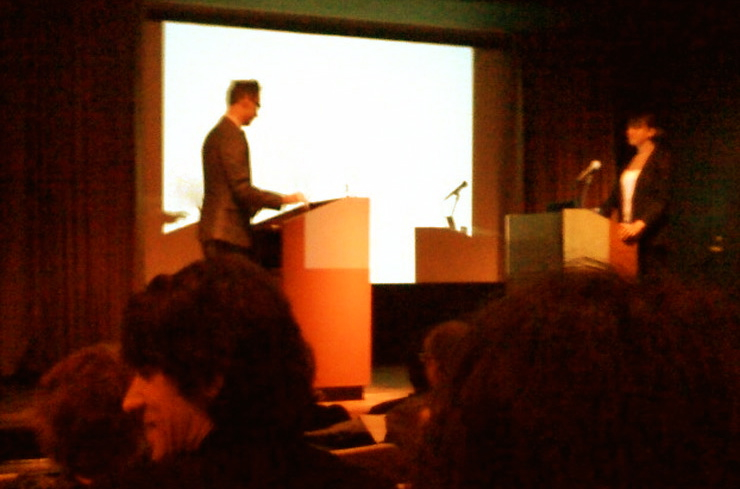
On the final day of the conference, as the last presentation, Abbey takes position behind a podium. A man, another performer, John Spelman, stands mutely a few yards away behind his own podium. He occasionally advances the Powerpoint that displays bland, grainy images.

Abbey tells the story of the night she ended up at the Playboy Mansion following her first gallery show in Los Angeles. My Parents Destroyed Communism and All I Got Was Art with Utopian Strategies, the title of the show garners splashes of stifled laughter, then progressively fewer guffaws, and by the time it’s over the audience is worn down and confused.

A question and answer segment follows.

Without raising her hand, an academic in the front row asks a simple question. She is Lydia Goehr, attractive, mid-fifties, dressed in all black, asymmetrical, avant-gardian garb, a philosophy professor from Columbia University.

“What is the relationship between pornography and regressive art theory?” The question is phrased with a mix of confrontation and playfulness.

A long silence ensues.

“Well?” Goehr prods, smiling.

“No doubt, there is a relationship.” Abbey mutters.

“What makes this different from pornography?” Goehr insists.

“Well, I suppose what I just did occupies space and time differently from conventional porn and I don’t think what I am doing is regressive at all.”

“Can you elaborate?”

“I mean, it may have had some pornographic content, but I’m presenting it in a space, and at a time, where pornography cannot really exist. The conditions make it impossible.”

“Impossible?”

“Yeah. Look at me, I’m wearing a suit, standing behind a podium. This situation is too professional, too analytical. This context is basically geared toward neutralizing any porno impulses. Your mind can’t totally get to the porn, it gets too caught up in the critical thinking and the conference vibe, the bad bagel you had this morning and the professional concerns you might have about your own talk and how you handled your Q and A. Without your mind being able to go there, your body will be arrested in a state far from arousal, I mean, I think. Like, I’m sure you’re thinking and feeling very non-pornographically… If anything I am producing friction between that analytical space and the space of porn. Like this would be the worst place to get an erection.”

A wave of discomfort drifts through the crowd.

“You’re saying all your talk can do is lead us to some ideas about the pornographic in this particular context, not to the experience of pornography?”

Abbey’s grateful. Goehr’s formulation is clearer than her own. “Right. I’d argue that those unexamined, neutralizing, analytical conditions are the key here. I’m asking: What makes the pornographic impossible in this situation, but possible practically everywhere else? And my next question is: by banning pornographic punch from discourse aren’t we falling out of touch with society, a society that lives with explicit sexuality as a basic part of their conceptual diet? Artist’s, whose job it is, presumably, to say something about the nature of contemporary experience inhabit this world of ours, which is inundated with borderline pornographic content. And as a female artist the conditions of our sexualized landscape are accordioned. The surface area of day-to-day experience vibrates with sexual nuance. My job, as an artist, a female artist, is to make those vibrations felt, make them audible.” Abbey suddenly feels like a vigilante, feminist cult leader. Will Goehr call her out on that as well?

“And this is art that you are doing right now?”

“‘Yes, for me, it is.”

“Performance art of some kind?”

“Of some kind.” Abbey does some quick mental mathematics and figures the only way to get this crew of liberal, academic, ivory-tower living professionals anywhere near her team is to take it to the art history books and strip the argument of its licentiousness.

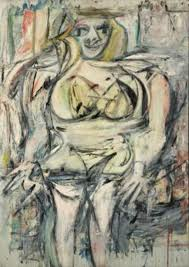
“It’s like, this,” Abbey continues, “I’ve been asking myself, ‘What would a de Kooning look like today? Feel like? Behave like?’ I mean, it wouldn’t be some oil on canvas. It would need to be something formalized, but jagged and retooled, you see? Can a lecture in 2012 be like a canvas in 1947? I think so. In a way that painting simply cannot.”

Goehr nods, making a noncommittal face.

Unknown

Abbey continues, feeling the audience’s willingness to follow her down this tamer path of theory. “De Kooning painted nudes, right? But the paintings move far enough away from the nude so that they make you think about the nude, while not being a nude. If you see what I mean. De Kooning gets you to a place where you’re thinking about women, about the body, about beauty, about the desire for women, beauty, and bodies, but at the same time you’re not really getting any of that in the actual painting. The mental gymnastics behind the art, is the art. And that’s what I value in de Kooning. That’s what I’m trying to get here. I’m trying to get strong nearness.”

“Strong nearness?”

What Abbey really wants to say , no scream, is “What gives with the apartheid segregation of the body from the mind!” Instead, in a level tone, Abbey explains, “Strong nearness. I want to bring the audience close to feelings that contradict the mind’s desires or expectations. I want to get you close enough for you to think the feelings, but not so close that you can really feel them. This is not meant to be sensational. Like you need to consider the erection and its social taboo without really getting one. Get it?”

The Q and A ends with stilted applause.

Abbey leaves the lecture hall and goes for a drink. The audience’s inhibition or their unwillingness to examine the productive gap between what is going on before their eyes and the storm of events in their heads leaves her cold. What she did was not the performed rehearsal of Don Giovanni from the day before. Beautiful as that was, you knew what to think, you knew what to feel, and you knew what to do. Crying was appropriate. Silence a must. Not a shred of disquiet ran through her mind during that performance. Isn’t disquiet the invitation to inquiry? Can’t the power of the mind and imagination outrun and trump any scenario played out in reality?

Abbey thinks of Dmitri. Their relationship has been over for a good two years, but his mastery of the psychosexual; his fluency in the psychological theater of sexual impulse and desire sticks with Abbey like a perfume. And nowhere is the brain and imagination more potent than in the realm of seduction and sex.

Being in bed with Dmitri always consisted of a lesson, Abbey recalls: “Consider the most elementary and simple geometrical elements as though on a grid.” He lifts the sheet off Abbey’s naked back and presents it pulled taught. “Given certain spatial and programmatic demands, figure out the most suitable arrangements. You will see that you need to combine this shape,” he waves the white fabric, “with that shape,” he runs his hand from shoulder to bum, “and then this element with that.” He drops the sheet, the fabric situates itself along Abbey’s contours. “And before long I have shown you a geometrical grammar and a compositional syntax all the while putting Nature aside and pointing definitely elsewhere.” At which point he flings all the covers, all the sheets, and all the pillows, which had served their duty as provocative and obstructive props.

Abbey has a second martini and toasts Dmitri, wherever he is, and considers the writhing, internal discomfort of performing a feminist while struggling against the formative male voices that permeate much of her vocabulary and academia writ large, come to think of it.
IMG_3868

My Parents Destroyed Communism and All I Got Was Art with Utopian Strategies. Abbey’s First Art Exhibition

Unknown

Abbey Shaine’s one of a multitude of Los Angeles MFA students. She’s fidgeting in an Alvar Aalto chair in a Beverly Hills gallery that’s all windows and white walls.

“So, tell me,” a middle-aged woman with a black bob and tight Balenciaga suit says, “The artists I’m curating into this show utilize utopian strategies in their work, how do you think your practice relates to this concept, I mean, to the idea of utopia, to utopian strategies?”

Sensing she needs an answer fast, Abbey says, “I think art is different from most things, you know, because we’re never really sure what art is. That’s art’s motivating paradox, to me, the thing that makes art baffling, even antagonizing. Some might argue that art is ‘an ontologically unstable category of cultural production,’ but I’d say that art is more like a trinket that we’ve stuffed into our pocket on our way to civilization.”

Abbey examines the gallerist’s expression. It hovers between mild irritation and boredom. She pushes on: “You know, art is like a remnant…a remnant of believing in magic, the incantatory power of mumbo jumbo, stuff like that. Art has its roots in desire and fear made over into stuff, and most of the time, the really powerful art did not even look like art, at least, not at first. I mean if you look back, every important work of art was once hard to even see as art, much less as great art, from Rembrandt to Picasso to Warhol…”

The woman raises her hand, cutting her off. “Okay, okay. That was just a formality. I needed to be sure you know how to talk to collectors, to dealers, that kind of thing.” She pauses, glances down, rearranges some papers on her desk, “So we’re putting you in the show. Take a quick look around. Make sure everything works for you and we’ll be in touch in the next few weeks.”

And that’s how Abbey Shaine got her first art exhibition.

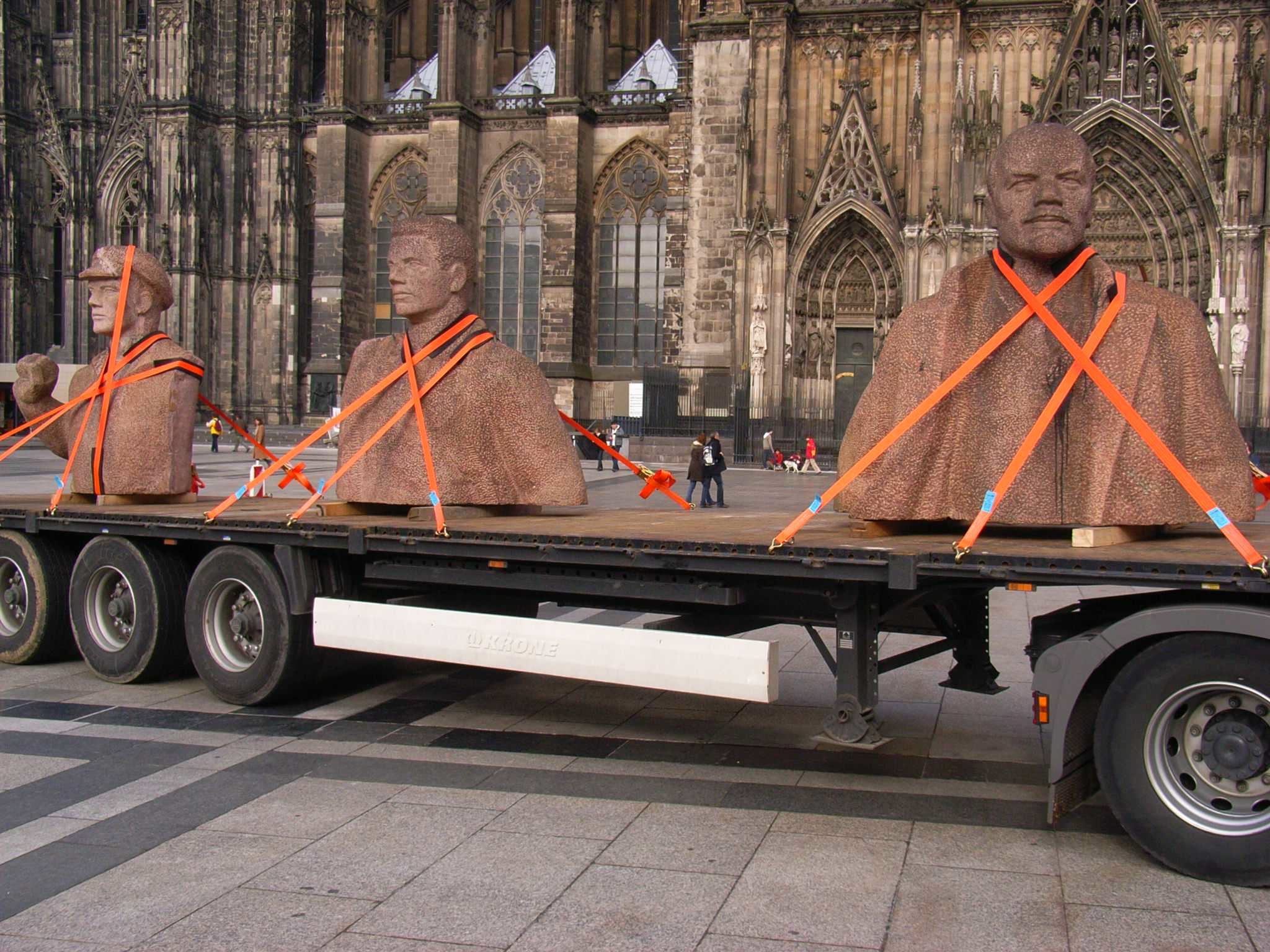
HerzLeninOnTourKöln

The show opens several months later. The gallery is showcasing eight “emerging artists.” The group exhibition is called “My Parents Destroyed Communism and All I Got Was Art with Utopian Strategies.” The Balenciaga woman doesn’t have much to do with the show. It’s really curated by a smart, burly guy with a beard. He’s named Glenn Phillips, works a day job as a curator of contemporary art at the Getty Museum and lives in West Adams.

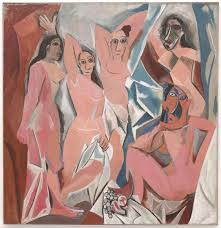
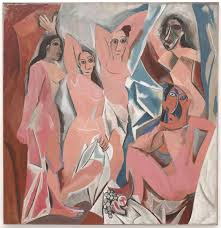
Abbey Shaine’s piece is called “Modernism Fucked Me Twice Last Night.” It consists of a long, narrow, rectangular, plywood room. Unfinished, unpainted on the outside, and inside, heavy, black, absorptive felt covers the walls and floors. An overhead device projects Picasso’s painting Les Demoiselles d’Avignon on a white wall at the far end of the rectangle. And there’s a motion detector, so whenever anyone enters the room, Lil Jon’s hip-hop anthem Get Low grinds out of four big overhead speakers. Abbey hopes Lil Jon jumps to life and Dmitri will be standing there, but then again, maybe the past is better left in the past. She shrugs off the thought of him and considers the installation’s price point: 5.5K with the buyer responsible for acquiring the rights to reproduce the image and the song, which is the joke of the piece since she figures the rights will never be sold and they’d cost a quarter million minimum if you could buy them.

picasso

“My Parents Destroyed Communism and All I Got Was Art with Utopian Strategies” opens in the company of LA’s low key art intelligentsia.

“Hey, Abbey Shaine.” It’s a sweeping arm enfolded around her shoulders and a soft Southern drawl, both belonging to a barrel chested senior curator from a major Southern California foundation. “I’m gonna give you some compliments right now. So how ‘bout you just stand here really sweet and take them? Would that be acceptable to you, Ms. Shaine?”

“I do declare it would,” she mock drawls, grinning, shifting her weight to be more comfortable in his grasp. His hand discretely rests near the ridge of her ass.

“When I look at art, I ask myself questions: Is this piece better than the blank white wall behind it? Is it better than everything else I’ve seen tonight? How long will I remember it? How long will other people remember it? How long do I think I will love it? How many people will love it too? And who are they? How much will I think about it? How much would I miss it? Will it surprise me? How many words could I write about it? How much would I pay for it? How much would I sell it for? What would I trade for it? How much does it matter? How deep is its historical resonance? And to be utopian about it, does this thing make me a better person?” He coughs and adds, “I’m letting you know that I’m answering affirmatively to a lot of those questions when I look at this.” They stand for the next few seconds in silence, staring at a random section of plywood as if it’s real art, while Lil Jon’s chorus booms.

“Now bring yo ass over here hoe and let me see you get low if you want this Thug. Now take it to the floor and if yo ass wana act you can keep yo ass where you at.”

They reflect another few seconds together.

“Thank you,” Abbey says, adding the response she’d memorized for curators and collectors, “That really means a lot to me coming from you”. She smiles, “Excuse me. To be continued!” Abbey gives an apologetic bow.

She climbs through the still-building crowd toward the bar. She feels embarrassed. She made something she thought Balenciaga would like. Something trashy and edgy, and intelligent in a kind of paint-by-numbers, easy-to-read way: Picasso’s the greatest artist of the twentieth century not despite being a misogynist, it’s because he’s a misogynist, and a hundred years later, Lil Jon gets labeled crude and offensive, but he’s just rapping the storyline of the most celebrated painting in MoMA. Balenciaga liked this. She liked it a lot and this depressed Abbey. She’s embarrassed by her need to please.

Her cell’s vibration disrupts her self-loathing. Dmitri? Not Dmitri. Loathing sinks deeper yet into the marrow of her being. It’s Alex Ward, an artist, a model, a fashion photographer and off and on friend.

She answers.

“Yo, Abb. Ya free tonight? I got something good here and I need a girl. I mean, like, I need her right now. You available?”

“Ummm. Okay. Come’n get me.”

It’s ten when Abbey says her goodbyes at the opening. She’s not sure what Alex is talking about, but she’s learned to accept his offers and not ask preliminary questions.

A nearby taxi comes to life. Abbey trots across the street. Before she’s closed the door and turned to greet him his hand finds her upper thigh. She tenses on reflex and feeling the muscle twinge, he smiles. The mass of his upper body leans in closer. With an abrupt thrust, Abbey pushes his hand away. He loses balance and redirects himself to the driver.

“Alex, seriously, what are you doing?” Abbey looks at him with immobile eyes. Once a model himself, tonight Alex looks like shit.

“Eh, I figured I’d try. Why beat around the bush, ya know? These days I’m conditioned for rejection.” For an instant he seems small and adolescent. He goes on. “So, you know, Nate’s at the Playboy Mansion. GQ wants a few pages on him, in his gear. He’s doing this whole LA thing with the line. Dressing LA artists, you know, the older crew.”

“Dennis Hopper’s modeling Nate’s clothing line?”

“No… No… eh. Abbey, You’re so literal. No, the guys who were big back in the day, you know, in the sixties, seventies, but who got lost. The old guys who screw around in Topanga Canyon minus the dollars, retrospectives, and monographs. Those guys. Whatever. Trust me, this’ll be good. We’ve got to take some shots. We want Nate, dressed, and some Playmates also in his stuff. Over-sized dress shirts, cardigans, a blazer…but nothing underneath.” He pauses dramatically, “And you play art director?”

Slide03

They arrive at the mansion. A fresh busload of young girls, aged 18 or 19, have just been delivered from Ohio for what can sympathetically be described as a Playmate internship.

The crowd consists of glad-handing, C-list celebrities, women strategically packaged in intricate bathing suits, and dozens of hungry looking men, eyes wide, mouths open, hands outstretched, ready to consume the carnal fruit of this debauched Eden. A lit bar in the distance compels Abbey through the throng. She tosses back two champagnes, dulling her sensibilities so she can casually lull young women into fine cashmere and trampolining with Nate Ward, Alex’s younger brother.

Alex and Nate appear, clasp each other’s hands chest-high. Brothers, one exceedingly wealthy, the other only commonly wealthy, by two separate fathers (Ward was actually their mother’s name), their relationship goes from supportive to backbiting in less time than it takes a group of aspiring Playmates to compete for attention. A welcoming committee of bunnies, jump up and down, arched eyebrows and rigid, rubbery breasts; they look like a congregation of dashboard bobble-heads.

Slide04

Abbey approaches them. “Hey ladies. Ooh, I love that!” She says, grabbing a manicured hand.

“Bedazzled. They do the manicure at the same time as the vajazzling.”

“Can’t wait to find out what that is. Look. The young guys, they need some models. It’s for GQ magazine. You just have to tolerate them for a few shots. Interested?” She nods her head backward. “That guy, Alex, he works for Vogue. We’ll be at the trampoline. Get whoever you think would be good for high fashion.”
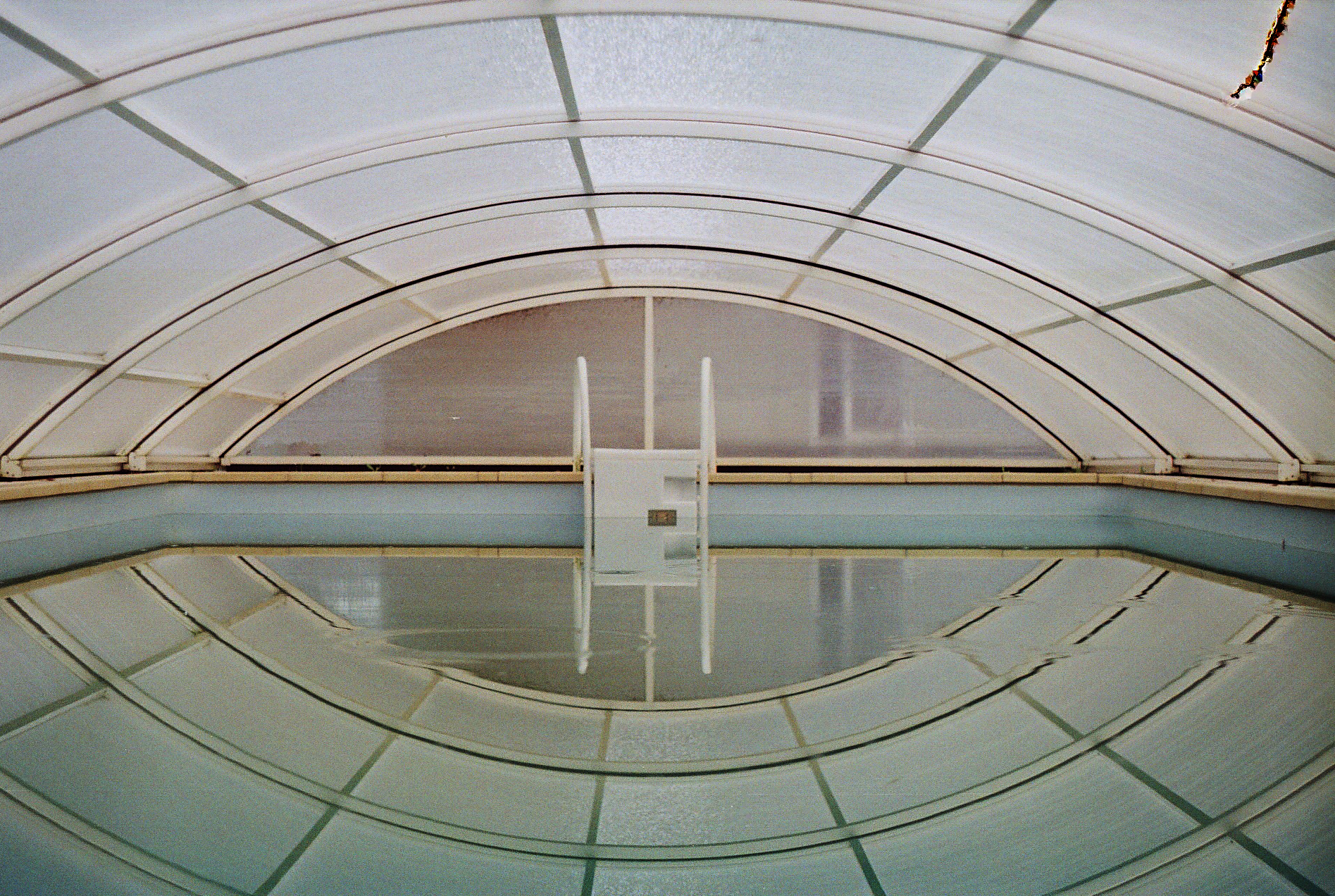
Tattoos and piercings, tan-lineless bodies, spray tan stained clothing. They approach men like unwitting deer, contentedly peeling layers of cheesecloth-like clothing over their heads, beyond hips, and down their legs, revealing fluorescent, porous underwear. The willingness for subjugation and servitude intoxicates and nauseates.

Abbey witnesses a veteran sportscaster in aviators approach one girl. He comes up close and swats her stringy blond hair from in front of her shoulder to behind.

“Hey, why don’t you take that off?” He says, pointing to her outfit of two indiscernible tubes of fabric, one playing a top, the other a skirt.

“Okay,” she says as though she were the one making the proposal. Abbey is transfixed by the exchange. In one continuous peeling motion the woman rolls both the top and bottom tubes down to her ankles and flicks them aside.

“Mmmm. I like that. Oh boy, I like that a lot,” the sportscaster purrs as he steps back to get a better view of the young woman standing naked on a slatted wooded walkway, dramatically lit by garden lighting. He smiles and walks away.

Lacking the grace and arched back with which she removed the fabric, she squats, retrieving the outfit and begins the process of rolling the skirt over her hips.

“Hey. How about taking that off?” Another, younger man has approached.

Abbey watches the exchange remaining still. She’s perfecting gender neutrality, a baggy sweater now hangs over her skinny jeans and a see-through tank, in the hope this will exempt her from wandering eyes. She watches, body rigid. The girl is still bent over weighing her options of taking off or putting on. Abbey grabs one of the line’s dress shirts. “Hey! We’re ready for you.” Abbey throws the shirt at the girl. “Put this on and forget about the skirt.” Abbey walks back to the trampoline, hoping the girl follows.

Several young women readily slip into Nate’s designs. He watches enthralled by their ready flesh and industry specific lingerie. They begin to jump. Nate stands in the middle of the trampoline dressed in a tux of his own design. As the girls jump the cashmere wafts up and dress shirts part revealing the white soft underside of breasts against tanned mid sections and belly button rings.

Alex takes a few photos as Nate stands dumbly in the middle of the Playmates. One is sent high in the air just as another is landing. The trampoline reaches a level of rowdiness that Nate is not prepared for. “Am I going to get hurt?” He cries out from the epicenter of Playmate activity.

Abbey dresses the girls and tells them they look beautiful, or sexy, or both. They are younger than her by maybe five years. Nate is loosing interest in them and asking for help getting off the trampoline. The directions Alex is giving the girls are escalating in vulgarity. From playful jumping, to suggestive posing, now on to pornographic vignettes.

Nate looks on uncomfortably as Alex’s fantasies are enacted.

“Lie down dead center. Undo the tux shirt. Let it fall open. Crawl over her. No! Slower! Again! Really slow. Now rub it. Okay. Okay. Yeah, now use your tongue. Good. Play with her! Pinch her nipple! Now suck it. Right. Right.”
“Christ! Alex, ENOUGH!” Nate yells.

Alex lowers his camera, shoots Nate a What The Fuck look, then dismisses the group, “Okay, ladies, thanks, really, thanks for your help. You’ll all have tear sheets for your portfolios.”

Abbey strides back towards the bar. The boys catch up to her and pull her away towards the valet. She doesn’t resist. They pile into Nate’s black Cadillac Escalade with tinted windows.

They pull up to a squat, brick building painted a mottled black, scarred from graffiti. No lights. No signs. No windows. A vertical, narrow yard of soft purple neon is the only marker. Once close, the light emits just enough illumination to make out a handle-less door. They climb out. Alex leads the way, his white silhouette strikes Abbey as the crisp introductory cadence to an overture of malevolence.

He pounds on the door. It cracks open.

“Okay, yeah, now?” Comes a hollow voice through the inch of space.

“Yeah, Terry Richardson sent me. He’s here tonight. It’s me plus two.”

Abbey rolls her eyes.

Terry Richardson is a New York photographer famous for grainy snapshots of naked girls. Abbey had been to his studio on Bowery tucked in amongst the kitchen supply shops and lighting fixture places. She walked in, shut the door behind her, and followed him to a desk.

“My mom said shutting doors behind you signifies denial.” Terry said looking her up and down and taking her modeling portfolio in hand.

“Maybe the token is more like ‘Find it shut, leave it shut,’” Abbey suggests.

Terry exhales. “Fair enough. Okay, let’s do some Polaroids. Take your clothes off.”

Slide06

At seventeen, it was a defining experience.

So, Alex, Nate, and Abbey file in. Incandescent red bulbs light the space. They confront a mirrored, raised gangway with polished brass poles. The place’s identity is schizophrenic. The look is low budget cabaret, the sound 80’s speed metal, and the clientele’s from Shaft.

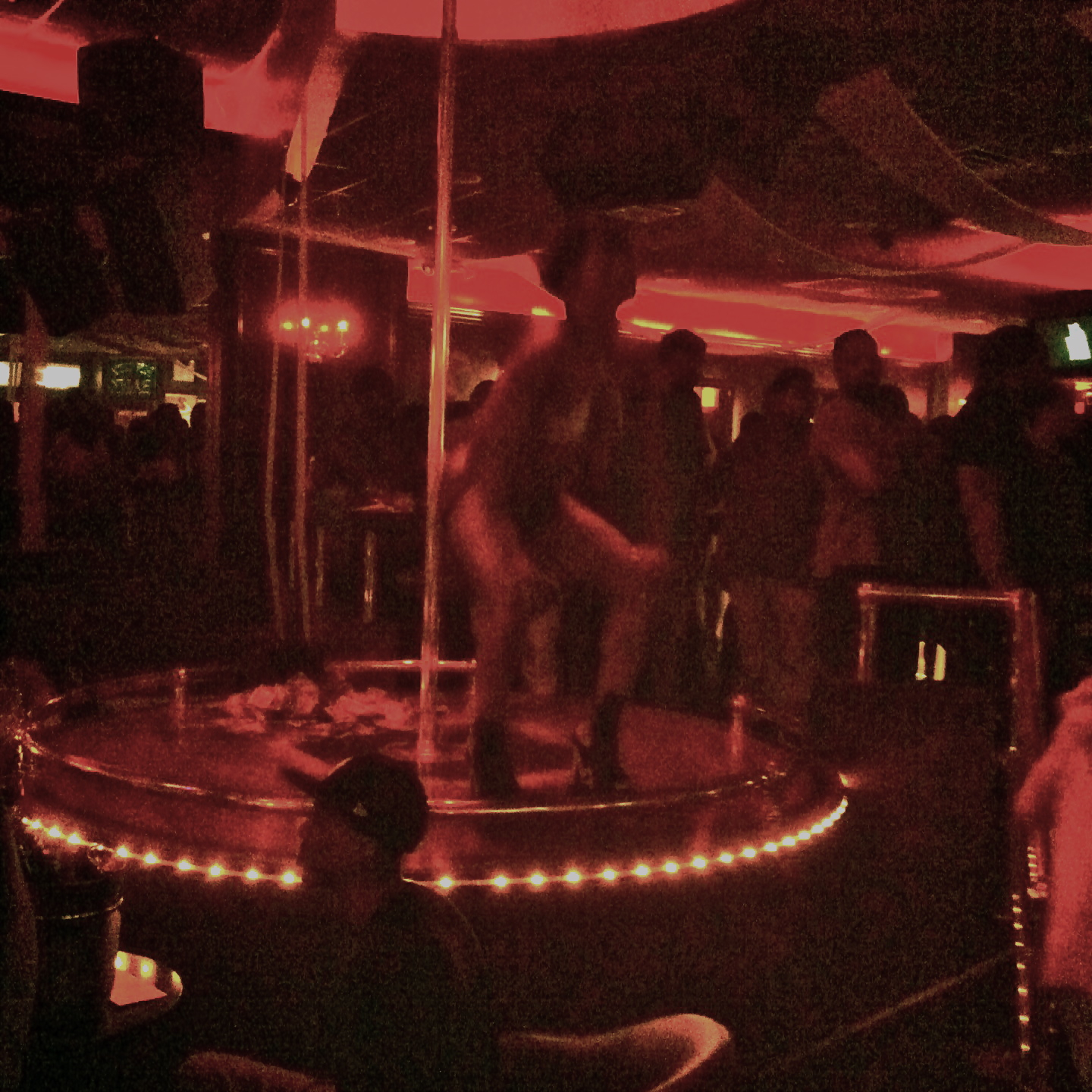
Alex takes her to a banquet by the stage, and there’s no Terry Richardson. A naked Latina hangs, inverted on the pole, head inches from the stage floor, back to the audience. Her legs fly apart in a violent split, then come together to hug the pole between her thighs. With balled up fists she strikes at her bare ass to a black metal soundtrack.

IMG_1547

There’s a commotion stage right and Abbey is pulled away by shrills of laughter and muffled sounds of struggle.

Behind a black curtain, Abbey sees two strippers preparing to go on. A short brunette with surgically-enhanced breasts, is bending down, fooling with her footwear. She’s naked except for a long black cape and thigh-high black boots featuring a gauntlet of clasps. A tall blond wears a nurse’s uniform with a nun’s habit askew on her head. The brunette is giggling, the nurse-nun’s face is contorted by genuine anxiety over her misplaced nurse’s cap.

Brunette says, “Well, you’re Catholic guilt personified aren’t you?”

“Huh? Oh, yeah right. I look ridiculous! I told you I look stupid!” The half-nurse half-nun squats over the box, rummaging through sex toys and erotic paraphernalia. “Help me find the cap! C’mon, I’m next…!”

Abbey speaks up, “Just draw a nurse’s cross on your forehead with some red lipstick and really fuck up your eye-makeup. You know, go goth.”

The nurse-nun turns sideways toward Abbey.

Abbey asks, “You have a lip brush? What about an eye pencil?” On cue, without a pause, Abbey sits the tall woman down. She has the build of a Slavic model, sinewy and thin. Abbey admires the efficient and strong construction. She paints the cross and rings the woman’s eyes in heavy black shadow and liner. She looks like Death’s Slutty Handmaiden.

Abbey rejoins Alex at the banquet where he’s finished both their drinks. Nate’s already left, retreating back to Malibu. Alex’s slurring and aggressive. Abbey leads him out of the club, loads him into a taxi and calls Nate: “Have cab fair ready,” she instructs. She sets him upright in the taxi, holds a clammy white cheek in her hand momentarily, then lets out a sigh, “No expectations from this one.” Abbey retrieves a small ziplock bag from Alex’s breast pocket and directs the taxi. She stands back, shuts the door, and doesn’t watch it drive off.

Back in the club, the black metal nurse’s routine climaxes with an explosion of whip cracks and pelvic thrusts. She exits the stage, her body covered in a thick coat of sweat mixed with runny red and black makeup. At first, Abbey follows her with her eyes, but then she chases after her with her whole body. Slipping behind the black curtain, Abbey grabs the end of the stripper’s whip. The tall woman turns and laughs, gathering in the leather lashes, pulling Abbey into her. Their lips meet. Abbey leans backward and pulls out the baggy of blow.

“So where’s the party tonight, lady?” asks the Nurse, her hands planted firmly on Abbey’s hip bones, rocking them side to side to the opening chords of Misty Mountain Hop.

“Hamster’s Nest at the Chateau. Let’s go.”

Slide08

Knowing the date and locale of Dash Snow’s hamster nests was like a supercool international Morse code in 2007, and through her network of connected friends, Abbey had somehow gotten the message. Though Dash Snow’s hipster cachet wasn’t what it used to be, what with The New York Times Magazine recounting his exploits. Quoth The Times: “You may not be able to find him, but you can hear his name, that zooming syllable—Dash!—punctuating conversations in galleries, coke parties and art fairs from Miami to Berlin. In a uniform of tight black jeans, a ripped T-shirt, and a black leather Martin Margiela vest. Dash looks like the son of Jim Morrison and Jesus Christ.”

Abbey and the Nurse climb up the narrow staircase to the Chateau Marmont lobby and down a red carpeted hallway, drawn by the intensity of a subwoofer.

Thin women run in the opposite direction with burly, bearded, tattoo-ed men chasing them, they leave a wake of excited cries and laughter. One man catches the woman in front of him by the waist and they both land hard on the floor, rolling around in shrieks of laughter.

Abbey leads the Nurse, hooking a finger through the denim belt loops of her booty shorts. They push through a thickening crowd of dishevelled, grungy, youth. The room’s entry pulsates with a traffic jam of bodies. The Nurse grabs a fistfull of Abbey’s hair, stopping their forward momentum and spinning her around. She kisses her. Abbey kisses back. She places a small pill on Abbey’s tongue and offers her mouth again. The kiss is intercepted and the girl is lifted away, disappearing into the throng.

Abbey wades into a sea of shredded paper and miscellany up to her knees. A strobe light is the only illumination of graffiti strewn walls, broken windows, furniture piled in one corner. Abbey is absorbed into the moving, running, dancing mob. Music is pumping from multiple speakers, which propel the crowd into a centripetal motion. The air stinks of malt liquor and smoke and everything is heavy with the oil of bodies and the strata of newsprint. Objects and people vanish and emerge with regularity.

A man leans against the wall. One leg raised, bent at the knee, a boot clad foot visible. The strobe light punctuates movement. In this world of continual turbulence he is a fixed point. Bottles and blunts occupy Abbey’s hands and then are passed along with the casual anonymity with which they arrived. Between the stuff Abbey is ingesting and the post-apocalyptic psychedelia of the environment, confusion and disorientation take over. Abbey knocks hard against something and tumbles into the detritus. She’s tripped over a squatting woman, skirt hiked, urinating. Abbey lies, splayed, and allows her head to fall back into the mess, lost in the fog of the mosh pit.

Slide12

Graduate School. The Male Voice. And Becomingness

Photo25_23A

Russell Ferguson lets out a sigh. He’s standing in the doorway of Abbey’s studio. Ten minutes late for their studio visit. Despite being the chair of UCLA’s MFA program, Ferguson and Abbey have no relationship. He never looks Abbey in the eye.

“Come in!” Abbey jumps up effusively. Maybe too much.

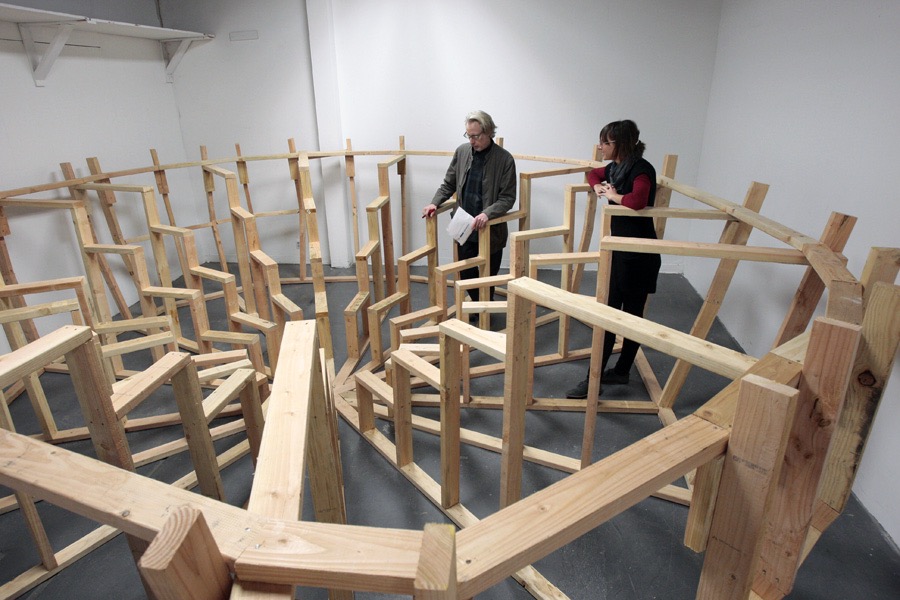
Her entire studio is filled with the wooden skeletal structure of a scaled down sports arena. It looks like the entrails of a schooner. It’s called “Stadium.”

Welling-Dubin

On the walls are large prints of some photographs Abbey took over the summer while attending an artist residency in Como, Italy. The Ratti Foundation specializes in bringing an international group of artists to a historically over-priced, resort town and then encourages them to have critical conversations about art in an environment that always already condemns them as impoverished providers of culture to a wealthy elite.

88330011

88330012

0261010-R3-010-3A

88330009

Photo26_39

F1000019

Abbey hoped that somewhere between the dreamy images of Northern Italy and the roughshod carcass of a stadium there could emerge a conversation on the artist as performer. Who are artists meant to be? How are they meant to inhabit the institutional spaces available to them, and the booze fueled art fair scene, and the stodgy lecture halls? At what point does it all become schizophrenic? At what point do artists just accept that they are the pressure release valve for a capitalist driven society of card punching 9-5’ers who look to the arts, and particularly the artists, to act the freak, entertain, and let loose a primal scream for all of humanity?

stadium

Ferguson wedges himself between structure and wall. He gives a great sigh.

“Water?” She offers.

“No thanks.” He declines. Everything.

Looking around the room, he rubs his palm on a rough two by four. He stands there in silence, then offers, “Maybe you should just make drawings or like small scale models or something.”

“Hmm? I don’t draw.”

“Better start since that’ll be your only prayer for an income. Pretty drawings and pretty little maquettes.”

Abbey has the urge to rip his face off. But then she’d just be pandering to the bad-boy/bad-girl, court-jester caricature of the artist. God grad school sucks, she thinks.

NaomiVSabb

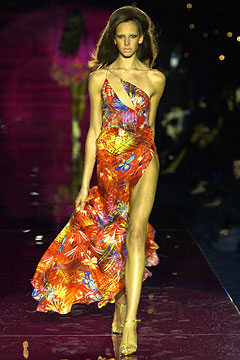
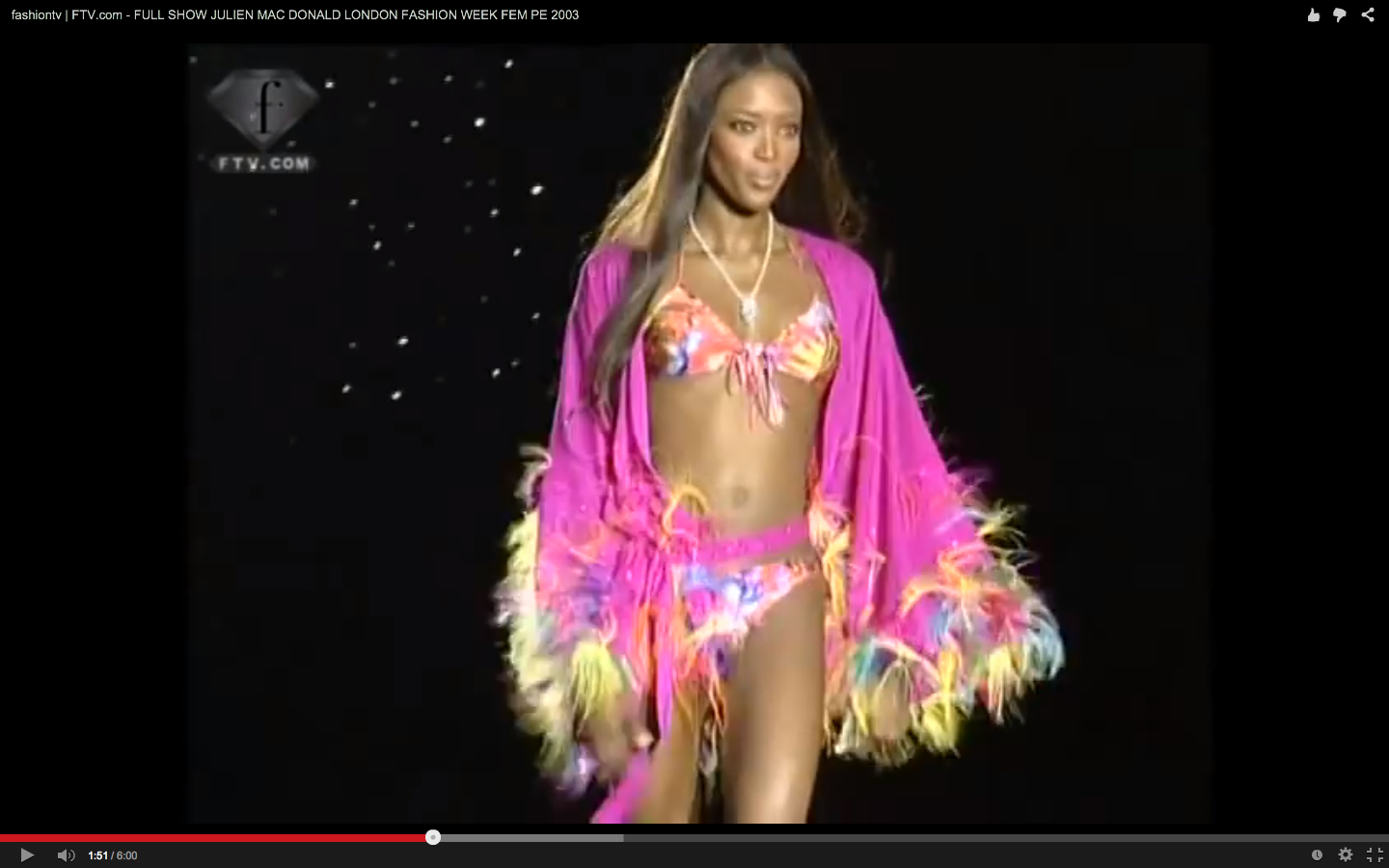
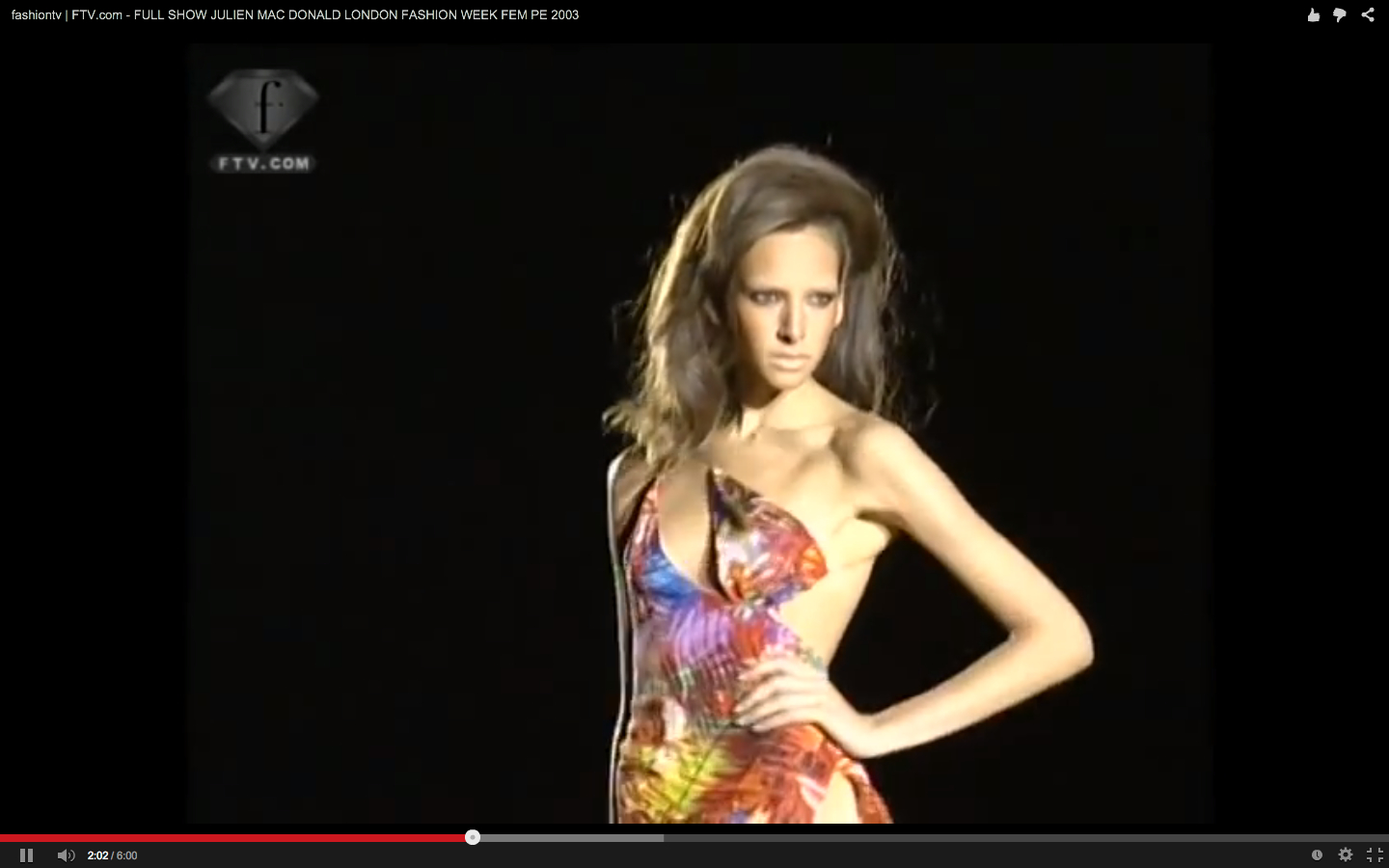
In her former life as a model, Abbey was walking the runway for the master of camp, Julian Macdonald. Naomi Campbell, in a feathered, hot pink robe and bikini, was walking towards Abbey. Naomi already struck her pose at the runway’s edge, voguing for the wall of photographers. Now it was Abbey’s turn.

Naom cat Screen Shot 2015-01-05 at 10.45

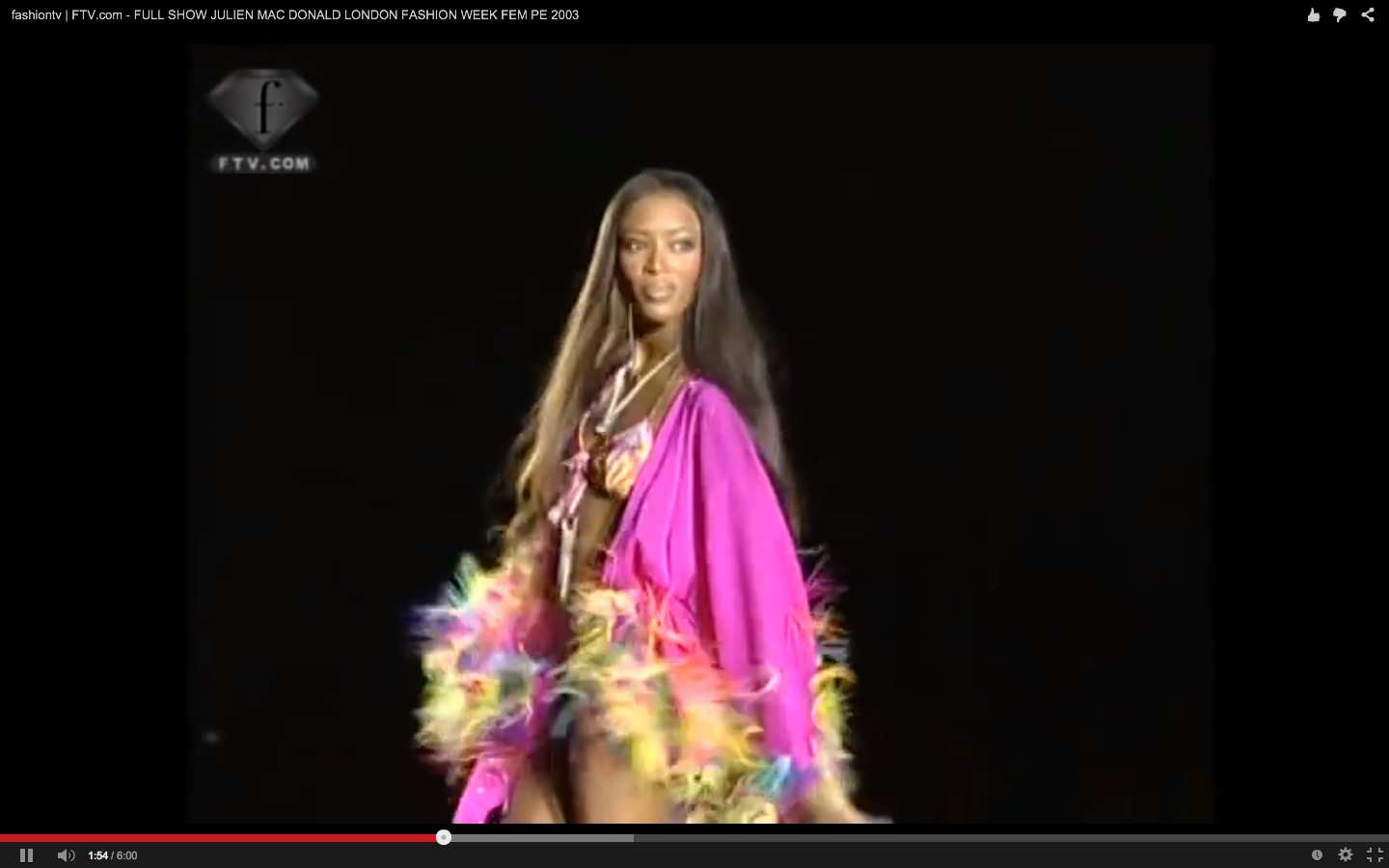
Just as the infamous Campbell passes Abbey, she throws a hard elbow into Abbey’s ribs. Granted the runway was narrow, and the heels were very high. It is completely plausible that Naomi could have lost her balance and accidentally elbowed Abbey square in the ribs.

abb cat Screen Shot 2015-01-05 at 10.45

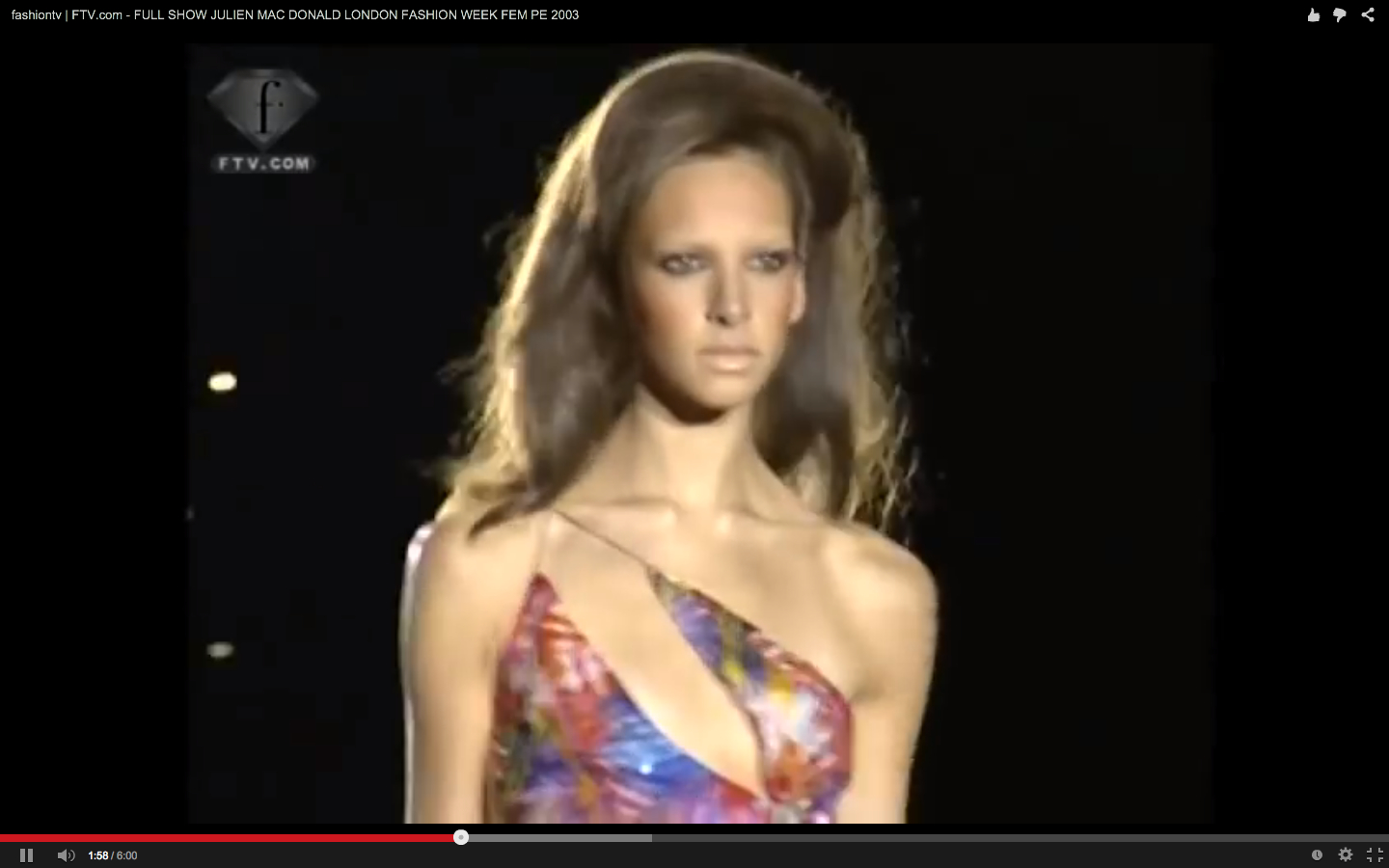
At the moment of the incident, clothed in well-placed strips of gaudy silk, Abbey took the blow and concentrated all her energy on maintaining her balance and stature. As a model her job was to strut, not fall, and Abbey is nothing if not literal.

Only once she was backstage did it occur to her that it likely wasn’t an accident. Naomi Campbell, in all her intricate thinking, had purposefully tried to nock Abbey off the runway. And by sustaining the blow and not budging, Abbey had simply abjured from the experience of being Naomi’s latest victim. What if she had fallen? What if Abbey chose to participate in the theatrics of drama, to which Naomi was extending an invitation? She was making an offer to Abbey, and in her naivety or adherence to the “rules of modeling,” Abbey had rather stupidly declined. Abbey’s career could have entered into the world of British tabloids. Abbey would certainly be booked for Julian’s next runway show along with Naomi. Make it a double feature! Why not? Julian and his PR agency would certainly conclude that a model brawl is good for business.

But Abbey didn’t fall. She didn’t even realize that there was a choice! And now this Ferguson is giving her the proverbial elbow in the ribs to test her resolve at playing nice and being the professional art student.

Instead of tearing his face off, she regains balance. She does not take the bait. But she does mentally rip apart his theory of “beauty sells.”

Beauty is bullshit that sells stuff. And there are more than enough beautiful things in the world instrumentalized to produce more junk.

Abbey muses; in the seventeenth century it was probably pretty amazing to check out a technicolor canvas as big as a moving van. Beauty did stuff then. It was powerful. Beauty had a constructive social role to play, but today? HD, IMAX, virtual reality, AI, Insta filters, and independent films shot in sepia? Where’s the power in beauty? Beauty is too simple. But add to the equation an elbow attack, something destabilizing. That’s when beauty becomes interesting. That’s when beauty reveals its potential and the all too alluring danger zone of sensational, tabloid shenanigans.

Abbey asks Ferguson about socially responsible, destabilized beauty but he’s deep in his iPhone.

“Ah shit, I forgot about that academic lecture. C’mon. Let’s go.” Abbey follows Ferguson into the darkened room where the evening’s lecture is being held.
Kenneth Unger, a visiting art historian, is nearly finished his presentation. The space is packed. He is the artworld’s Underground Academic Jesus: a prophet, about the Savior’s age, six feet tall. He’s sexy in a goofball, nerdy way. He’d become a cult figure on a network of grad student blogs. Abbey’s known him since her days as an undergrad at Columbia. He was the too moody post-doc that haunted the rare-soviet book collection at Avery Library. She was the tart dating her Professor Dmitri Green. They bonded over their lack of respect for most things and disinterest in others.

There’s a projected flow chart. “iPhones – iArt – iShart.”

Kenneth is holding his glasses in one hand and his lecture pages in the other. Looking disheveled, but passionate, he says, “As such, Whole Foods, or maybe better to say, the ideology of Whole Foods-ism has become the backbone in the life construction of the contemporary academic. There’s a Whole Foods located within ten miles of the ten largest American research universities, though there are hundreds of cities and lots of states without a single franchise. Whole Foods tells the academic that she’s not part of the problem; she’s part of the solution, a person acting locally to change the world globally. It’s a nineteenth-century Arts and Crafts aesthetic modulated from the realm of furniture design and architectural embellishment into the field of twenty-first-century lifestyle management. Whole Foods has created the psychological décor for the modestly upwardly mobile, petty bourgeois academic.”

48

“Rather than commitment to any historical idea of emancipation — you know, adherence to the principles of the Enlightenment, something like that — we, the intellectuals, the academics of the early 21st century, have ended up roaming supermarket aisles festooned with the iconography of small-scale emancipation — Free Trade Coffee and Free Range Chicken — that’s what gets us really pumped up. Our forms of emancipation become operative through deft tactical maneuvers on the way to the checkout line, not on the barricades. You might call this “whole people, whole planet” attitude, a kind of “liberal totalitarianism,” but I’d just call it a pathetic imitation of a whole life.”

“At Whole Foods and in university seminar rooms, we are acting as if all the world needs is for us to elaborate our critical insights with a bit more theoretical juice, buttress our ameliorative social gestures with just a bit more strategic shopping, and then the world’s ills will start getting addressed one Judith Butler citation and one organic kiwi purchase at a time.”

Kenneth goes in for the kill, putting his harsh black-rimmed glasses back on, and hugging the podium with both hands, raising his shoulders high. “You know what? You know what I’ve realized? I’ve signed up to be a dissent manager within the cultural sector of our advanced capitalist economic structure, and you know what? You want to know the whole truth? It sucks. Man, does it suck.” He looks down at the lectern, as if he’s really grappling with this fact, like maybe he’s coming to terms with the full implications of the whole truth right this second. Under his breath, he mutters “sucks.” His eyes shoot toward the ceiling. His tongue lolls around his mouth. Now he’s doing a convincing imitation of a son working through a childhood memory during a eulogy to his father. His eyes appear to glaze. His voice cracks on the word “and,” but he pushes on.

“And…And I’m just so fucking tired of doing this.” He stares at the audience, looming, Easter Island-like. Murmuring kicks in. Someone whispers, “It’s coming.”

His face hardens. The skin around his eyes tightens. Kenneth goes on, pointing his finger to emphasize each of his words, “This sucks. Seriously. This sucks.” He whirls around so that he’s a full three feet closer to the front row, “And you know what I say to all of this? Fuck it. Just fuck it. I don’t give a flying fuck.” He hurls his lecture papers straight above him into the air. They explode across the room like a squadron of Blue Angels on Memorial Day.

“Well, that’s kind of beautiful.” Abbey thinks.

But Kenneth keeps talking, karate chopping with his right hand, “You’re supposed to be the secret true friend of activism, radicalism, and progressive causes, to be the foster parent to a range of vapid substitutes for participation in any meaningful, world-transforming project. Now maybe that last part was a bit abstruse, a bit unclear. So let me break it down for you. By that I mean, I help you to throw your life away on utterly meaningless shit, and then I lie to you and tell you that what you’re doing ‘shows real promise.’” He stands at the podium for ten full seconds, holding his gaze at some point just above the back of the audience. Then he says with finality, “What you are doing does not show real promise. Fuck it.”

Lights come on. Hands go up, but Kenneth grabs his Poland Spring bottle and walks out the door, leaving his lecture on the floor.

Abbey follows, catching up with him. Imitating a fanatic, she says, “Excuse me, Professor Unger? Professor Unger? Was this lecture entitled Fuck It 13? Or Fuck It 12? I seem to have lost count and for my records I’d really like to be certain…”

Abbey notices Ferguson. He’s watching her with disdain taking this charade for truth. Fuck it.

“Shut it, Abbey. Where’s that shit hole you call a studio. We’re gonna have to have a studio visit. I need a place to cool down.”

Later that night.

“I’d throw the third brick. Sure, not the first. Probably not the second. But I’d be that not-so-badass motherfucker who throws the third brick. WHAM!” Kenneth triumphantly faux hurling a non-existent brick under a heat lamp at ChoSun Galbee.

http://chosungalbee.com

Kenneth continues, “I’m a proud and unrepentant gamma male. Nothing wrong with it. We’re crucial for social change. And gammas get along well with Alphas, you know, that’s why I called Bill Powers. He’s the apotheosis of alpha. He’s out here doing a pilot for an art TV show or something. You know he publishes Blackbook? He’s a one-man artworld machine. He knows everybody.”

Cynthia_Rowley__Bill_Powers2

http://www.bbook.com

“I was in Blackbook once, wearing boots or scarves or something.” Abbey says, “And, you know, just for the record, next time, maybe we could look at my art for more than five minutes.”

Kenneth responds, “Abbey, really, how long did you expect me to stand there and chat with you about wood grains and Naomi Campbell. Yes, it is a world that lives off sensation. Yes, you are at a disadvantage because you will always be chum in the water. Your only option in the world is to get self-annihilating attention that will go after you for the basest of reasons. If you try to be smart, they’ll say you try too hard to cover insufficient intellect. You don’t care? They’ll call you vapid. You actually try to capitalize off the shit you are and have done, you become Naomi Campbell, hittin people over the head with a telephone. But guess what, sister. It’s no different for the rest of us.”

“Oh, I call some serious bullshit on that one.” Sips from her Hite and continues. “You’re a man being judged by an arena of men. And unfortunately, as with every other woman, that is our plight. Our audience will always be men. Theirs will always be the loudest criticism or praise. Those are the voices that dominate the social psyche. And you, white, solidly middle class, tenured and crying over your kiwis of freedom! Fuck that. I will always be understood as who I serve and how I serve. I am in the hospitality industry, and sure maybe you are too, nurturing the intellect of wealthy donors’ children, but in this mansion of capitalism and servitude my cast is fucked by virtue of being fuckable. And what’s my recourse? Being gay? Yet another fantasy met. Maybe if I gain a lot of weight…” Abbey takes a moment, seriously reflecting on the bull-dyke scenario.

http://www.ourliteralspeed.com/content/ols010aa.html

Bill Powers tears through the waiting area of the restaurant, leaving a wake of startled patrons. Powers is coming straight from the set of The Bravo Channel’s Work of Art where he is one of the show’s critics. He’s decked out in a vintage suit and a maroon ascot. His hair looks like a giant mass of bed head. For Powers the mantra is: “I’m going to die. I don’t have time for introductions and small talk. Let’s get straight to the action. I’ll figure out who you are if you say something worth remembering.”

Kenneth acknowledges Powers’ arrival with the slightest upward lift of his index figure, then out of the blue Kenneth asks, “What’s the greatest work of art of the twentieth-century?”

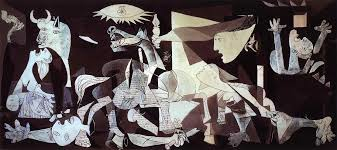
Powers does not miss a beat as he pulls out his chair, “Guernica.”

Unknown

Abbey says, “A white man made a thing circa 1950?”

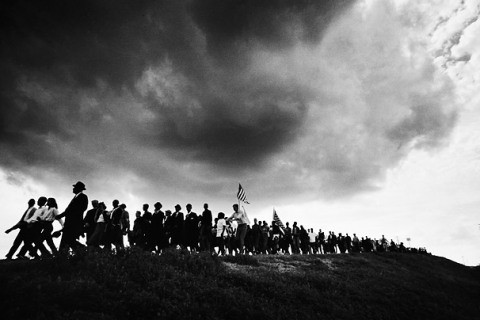
Kenneth pleased with Abbey’s on cue brattiness. “It’s the Bloody Sunday March in Selma, Alabama in March 1965.”

“Ugh, you are such an opportunist!” Abbey announces.

Powers looks bewildered. “What?”

Kenneth is all in. “The march over the Edmund Pettus Bridge was the greatest work of American art in the twentieth century.”

Powers and Abbey are willing to go there. Kenneth is pleased his opening conversational gambit is garnering this reception.

“It’s all there. Harmony. Violence. Negation. Collectivity. Sure, the march owes a lot to Gandhi, but there’s something different here. It’s one thing to tell the British to get out of your country. It’s a whole other thing to say: Hello white neighbor! Come over here and attack me, and then I’ll see you again tomorrow.”

“Why is it art?” Powers asks, like a judge cutting off a mouthy litigant.

0293071973747_209150100

“The whole situation around the march is so artful that eventually it’s got to become art. The way they wore suits and Sunday dresses. Everyone’s in gray, brown, black and white. They marched in these Agnes Martin lines. Two feeble little rows passing over the bridge straight into infinity. And you have to realize they’re marching straight at a wall of Alabama state troopers with baseball bats and gas masks and horses, but the marchers do not deviate. They just walk. No yelling. No talking. Not even any gestures, totally impassive. The opposite of a rabble. No signs with slogans. It’s all extremely formal. These are all modernist gestures. To me, the Civil Rights Movement, when everything’s said and done, will not be seen as a political event. It’s the greatest work of modern art.”

“Not political? Not political? What’s more political than ten percent of Americans demanding their basic rights?” Abbey blurts.

“I know, I know. What I’m talking about is history, the way any statue from 10,000 BC now looks like it’s art. It doesn’t matter if some king beheaded six thousand people at the base of that statue; today it’s going to be meaningful primarily as art, not as an executioner’s block. Form outlives content. Some cheap jug of wine from Delphi is probably sitting in the Louvre today. Same thing here. I’m talking two hundred, three hundred years from now, you see? That march will be understood as this amazing example of collective altruism unleashed in the public sphere, and like all Modernists, the marchers got the basic paradox down: if you’re a Modernist, if you’re like Picasso or some Dada poet, you know, Hugo Ball, or whatever, then you know you have to lose if you want to win. Want to save painting? Make your painting incomprehensible. Want to save poetry? Make it a mutant jumble of sounds. And if you’re living in Selma and you’re black, want to save your life? Make your life unlivable.”

Powers ticks off two rapid-fire queries: “Mass acts of altruism will be seen in the future as art? Martin Luther King is the greatest American artist of the last century?”

“Yes and yes.”

Abbey perks up, “Let me get this straight: first, you got the avant-garde, Baudelaire and Manet, right?”

“Yeah.”

“Then museums go avant-garde. They give homes to those original avant-garde gestures. That way they show how freethinking and open they are.”

“Yeah.”

“And then about the time the Museum of Modern Art takes off and modern art is accepted by the general public, the sensibilities that drove modern art migrate, uh, into… uh, new areas of public experience outside visual art? Like civil rights? That’s what you’re saying, Kenneth?”

“Exactly. Think about the timing. Postmodernism, Pop Art, Warhol, all of that’s happening at the same time the civil rights movement comes along. It’s just obvious that the civil rights movement was this huge Modernist happening, but no one’s realized it yet. I mean a real happening, not some self-congratulating, I gotta be me, Woodstock masturbation.” He pauses. “But that’s all done. The avant-garde, all of that. It’s totally done. Now we’re living in the age of dissenting and surprising art, WTF/OMG art.”

“LOL” Abbey adds.

“Let’s not forget IRONY. All caps.”

“Yeah. Sure.” Kenneth waves over the waitress. “Another order of pork dumplings, please.”

Looking at Abbey, Powers says, “And you, young lady are the purveyor of WTF and OMG to the overeducated and overmonied. Cheers to your future career.” He bows his Hite Stout in her direction.

Kenneth says, “Dissent and Surprise for an elite clientele.”

Powers adds, “But the one thing you can’t do, cause it screws with the vibe, is point too much to the machinery behind the WTFs and OMGs. Like you don’t want to see the wizard in action.”

Kenneth says, “The artworld has euthanized Toto. He won’t be pulling back the drapery so you can inspect the cheap mechanics: the artist sucking up to her letchy profs at the trendy art school; the art critic writing as a paid publicity hack; the handsome magazine editor dry-humping the artist at the afterparty at the Chateau.”

Abbey cuts Kenneth a narrowed eye glower.

“Wha?” Kenneth says defensively.

“Did I tell you that story?” Abbey asks with real embarrassment.

“Ha! See?! All this stuff does exist. See what I’m saying?”

“Well, as one who actually was dry humped by the editor of a major fashion magazine at an after party at the Chateau, no point in denying it. Might as well embrace my cliché. The interesting thing is that I think both said editor and myself are confused about who and what he dry humped. He knew me as a model, so according to him he dry humped a model, but reality dictates that this took place like a few weeks ago, so he actually dry humped an artist. A major fall in the ranks of social hierarchy. So, which is it?” She looks back from Kenneth to Powers in mock helpless confusion.

Powers closes his eyes, stretches his arms outward, palms up, then speaks as if he’s a Zen master, “You are truly the anus in the Venn diagram of dry humpage.” He inclines his upper body toward Abbey in a monkish nod.

Digging into the fresh tray of dumplings, Kenneth announces, “You can make normal art all day. Got some pretty little lo-fi paintings? No problem. As long as the flowery landscape is, like, a picture of Heinrich Himmler’s grave in the springtime or some shit. You know, gotta surprise ‘em. Crazy art? Also, no problem. You’ve got a big red, white and blue hot air balloon filled with howling hyenas as your art? Sure, do it. Call it George W. Bush’s Unconscious and you’ll be all over the Internet. There are no critical standards. Surprise ‘em, you know? Or you can make art that builds out of the artworld reality that you live in, but then you have to dissent from it. Make your gallerist take laxatives everyday so she shits continuously, then turn the shit into a frozen shit-sculpture portrait of the gallerist as an anti-commodification gesture? Go for it! You see? You can attack the artworld reality, or you can pretend it doesn’t exist, but what no one does is just make that artworld reality their art.”

“Um, I’m pretty fucking sure that is what I’ve been doing!” Abbey says.

“Oh, right by juxtaposing bits of information that kinda, sorta are adjacent to art and providing a wooden platform, stadium, arena, whatever the fuck, to facilitate that conversation? It’s like the most didactic display of a hope for democracy!”

“You’re an ass.” Abbey shoots.

“And you’re being too weak! Too reliant on the viewer’s mind to do all the work and connect the dots. You are such an optimistic liberal! You think every art viewer reads the New Yorker and has the classically cynical mind of a Russian Jew! Oh, and cares about artists. I mean, who really cares about artists? No one till there worth a few million and rep-ed by Gagosian or appear on Stefan Simchowitz’s Facebook page.”

Screen Shot 2015-01-05 at 4.55.32 PM

Powers throws up a palm and he and Kenneth meet with a decisive high-five.

Abbey’s exhausted. “All I know is this, I am not going to become an artist today by trying to become an artist.”

Kenneth nods, “Yeah, go on.”

“It’s pointless to try to get conventional success by making art in the studio or producing some giant interpretive dance with transgendered youth, or whatever your particular shtick is. Instead you’d make your art be about the way you actually become an artist. Like analytical Cubism makes you think about how paintings are made, instead of just giving you a pretty painting. The content of your art and the content of your life kind of more or less become synonymous. You manifest a kind of miniature artworld. You’d make art about becoming the dry humped female artist, instead of just being a dry humped female artist. That way anyone looking, thinking, or participating in your art is pretty much implicated as a participant in cultural production! Their desires, their expectations of the female artist to perform are the art! Fuck satire. Fuck irony. Make it literal. And make it about the process, about a becomingness. Not being, becoming. What you do would not be about anything, it would become something. I mean, literally, it would become whatever it is and that’s what it would become. My Literal Becoming. I’m A Literal Debutant. My Literal Speed.”

“Our Literal Speed.” Powers blurts.

“Um, sounds good to me. ‘It would become whatever it is and that’s what it would become.’ How can you argue with that? It’s the Seinfeld paradox.” Kenneth says, pausing his beer at his lips. “Our Literal Speed.”

A hand lands on Abbey’s shoulder. She’s startled. It’s Dmitri Green looking down at her, a clenched smile forming.

Abbey stands and lifts her right hand to him as he opens his arms to her. A misfire. They regroup and compromise on a brief hug of familiarity. He’s slightly graying at the temples.

images

“Top five percent of attractiveness for his age group.” Powers declares.

“Dmitri Green, this is Bill Powers and Kenneth Unger.”

Dmitri eyes the men trying to discern whether Abbey’s sleeping with either or both of them. He places a hand on the base of her back.

“Good seeing you, Abbey.” He kisses her on the cheek, and rejoins a cackling, black clad group heading out the door.

“So, becomingness? That’s the famous Prof. Green, heh? The key to female becomingness seems to be the men they schtupp.”

“Relentless.” Abbey says diagnostically.

Model Student


DMITRI

During her first semester at Columbia, Abbey Shaine loses all interest in Epicurus and Epictetus and instead falls for her professor, Dmitri Green. Young-ish, brilliant, and constantly in a state of self-propelled enthusiasm, Dmitri is exciting. Sleeping with a professor, and falling in love with one, has a craven velocity to it that makes her feel like life has become bigger, super sized.

How did they meet? He’s teaching a seminar on architecture and philosophy at Columbia. He arrives to class looking disheveled and put-upon, like it’s his cross to bear to be a brilliant, dynamic thinker. The philosophical wars he must wage in the basement of Avery library between the pages of post-structuralist theory! And this works on Abbey Shaine.

After the first seminar she approaches him, “I think I should drop this class,” She looks into his dark eyes, thinks these are the pathways to knowledge and wisdom, “You see, I’m a freshman and this class will likely be too advanced. I have no foundation…” Those are the words she speaks, but her mind silently articulates, “I should not be falling so easily in love with a middle aged man, two inches shorter than myself, with narrow shoulders. And I should drop this class now to save us the trouble.” He says, “Don’t be ridiculous. You asked the most intelligent question of the day.” He silently registers her no bra and clingy white sweater and wondered if she has an ass.

As a lecturer he’s unintelligible. But Abbey Shaine’s hooked on his style: a performative, intellectual wrestler of sorts. Dmitri seems to be searching for the theorem which, Deleuze-like, could bleed from one discrete arena of inquiry to the next, melding all things into one cohesive, complex web of meaning. He constructs worlds of thought which, in content resembled the love child of the Book of Genesis and MIT’s Zone Books series. The product is a panacea to existential, professorial angst; bathing the road to tenure and publication in a light of ineffable glory! Abbey Shaine cannot eat, she cannot sleep, she becomes very thin and feels eminently fuckable.

me

So, on instinct, one Tuesday evening, after seminar, Abbey Shaine follows Dmitri Green to the 1 train going south. She rides next to him, talks nervously about an installation art practice that exists no more than her reason for going downtown–she lives on campus and presumes this is un-sexy to a professor. He asks where she lives. “Brooklyn,” Abbey Shaine says. A lie she says it without hesitation, thus securing a ride downtown with him every Tuesday and Thursday evening for the next four months.

For an entire semester she sits next to Dmitri on the subway listening to his long-winded responses to her carefully crafted questions. It’s like handing a flight path to a pilot and forty-five minutes later they’d arrive at her supposed destination, Borough Hall. She says goodnight, gets off, watches the train depart and then crosses to the other platform to wait for the Harlem bound train to arrive.

KRAUSS

For the final class, Abbey Shaine has a plan. She rents his favorite movie, Contempt, from Kim’s and has it in her bag. She’ll let him know that she possesses this thing they mutually enjoy and if nothing transpires then she will lure him to a “friend’s” dorm where Rosalind Krauss’s The Originality of the Avant-Garde and Other Modernist Myths, a book he’d lent her, was waiting to be retrieved by him. Should she say Le Mepris or Contempt? She struggles.

le mepris

As they walked to the subway, performing the bi-weekly ritual, he inquireds about her evening plans. She pulls out the DVD, hands shaking with desire.
“A bottle of wine and Contempt.”

They’re walking west across the main red-brick walkway. It has rained. It’s a very fine New York winter evening. One of those nights that are clear and windless. The stars are out. The twinkling holiday lights decorating the cherry trees provide an atmosphere of romantic perfection that verges on the ironic. Abbey Shaine’s heart races, and she swears her genitals ache. Will he take the bait?

“You fucking bitch.” He says eyeing her suspiciously.
That was not the response she expects.
“What? You wanna watch?”
“Yes.”

That’s it. They ride the subway to his Brooklyn home. They enter. He opens a bottle of wine. Not one glass in, Dmitri Green stands up and says the sexiest line to ever incorporate itself into Abbey Shaine’s log of human interaction: “Now I’m going to turn off the light and hit on you and if you don’t like it, you can slap me.”

Abbey Shaine doesn’t know what “hit on” means, but she wants it. They never make it to the movie, ever.

A few days later, they’re in bed. Dmitri’s holding her and, apropos of nothing, he says, “You know, after Picasso finished Demoiselles he stashed it in the closet. He was embarrassed.” She doesn’t know what Dmitri means, but loves the idea that she’s expected to have opinions about Les Demoiselles d’Avignon. Dmitri talks about Picasso and De Kooning the way normal people talk about their co-workers, and this makes her feel like she has been initiated into some other, better world.

ipcasso

Monogamy

monogamy

A sharp intake of breath. She holds the air in her abdomen creating pressure in far away places. She takes his hand and wraps it around her neck, showing him that a lot of pressure is not too much. She grinds against him, feeling his cock rubbing against her insides. No breath. All sensation. She comes in gasps of pleasure straddling him. He cannot come after her display. He removes her from her perch, pulls her into his body. For Abbey it’s womb-like, being cocooned by his arms and legs. She closes her eyes tight against the details of his body, preferring to focus on the feeling of a large, encompassing presence. She relies on his steady breath and warmth to lull her back to homeostasis. Abbey rarely feels small, and sometimes maybe even often, she fears that the men who share her bed feel physically inadequate and week. She sleeps, reminding herself that he is larger. He is more powerful. She is safe.

Hours later, Abbey Shaine’s hair is caught in his sweaty armpit and she is pegged. She looks toward the bedside table with the digital alarm clock. Fuck.
She lifts his arm, freeing her hair. “I have to pee.”
He rolls.

monogamy2
She jumps up. His home on the Rue de Grenelle is larger and grander than she wants it to be. The rooms are not merely painted, but glazed to a high sheen in muted primary colors. She grabs her phone to text to Dmitri.

monogamy3

Open bottles of red wine fill the rooms of this inner-city palace with the perfume of contemporary decadence: it smells a little cheep and shameful. Completely appropriate for an 18th century manse. She retrieves the condom from between her legs, empty. She gives his lack of climax a moment’s thought but figures it may be associated to his occupation. All those hours on those small bicycle seats constricting the blood flow to the testicles. Maybe he’s sterile? Maybe those tight shorts and constant pressure have robbed him of his ejaculatory capacity?

She pees in the shower while shampooing. Removing all evidence of his presence. The hair rescued from his armpit is knotted and stinks. An entire bottle of Molton Brown conditioner is absolutely required to untangle it. She thinks briefly of the infinite alternative lives she could be living if she wasn’t living this one, with an academic; with a misanthropic academic; with an academic who views tenure as an iron neck ring and university politics as shackles. Sometimes all she wants is beautifully scented products minus the social critique.

The cyclist walks in and watches her bathe.

“Can I join?”
“I’m finishing up.”
He hands her a towel.
She uses it to wipe the steam from the mirror.
“Do you have a comb?”

He is still watching. He presents her with his toiletries. A nice caviar leather satchel with a heavy brass zipper. Masculine chic. That is how his road bike sponsors use him, and it suits.

Monogamy1
She uses his comb and digs through it for a toothbrush. She wishes he would leave, and almost asks when he infers the logic of her efficiency and gives her a kiss on the nape of the neck, an area made ruddy by their night games, before getting into the shower.
She uses his toothbrush. Defers on his moisturizer and deodorant that have action verbs on their packaging. Energizing Double Action Balm. Ultra Pro Power Gel. She will tell Dmitri of this adventure, but she doesn’t need him to know the man’s smell.

She leaves the Rue de Grenelle. Trotting over the ancient cobblestones, away from fine, leather carrying cases and infinite caches of luxuriant products, Abbey is exuberant to re-enter her life of willful denunciation. Perhaps she is confusing the power of walking away with a fear of striving, but for now that seems an unproductive train of thought.

My girl, my girl, don’t lie to me
Tell me where did you sleep last night
In the pines, in the pines
Where the sun don’t ever shine
I would shiver the whole night through
My girl, my girl, where will you go
I’m going where the cold wind blows
In the pines, in the pines
Where the sun don’t ever shine
I would shiver the whole night through
Her husband, was a hard working man
Just about a mile from here
His head was found in a driving wheel
But his body never was found
My girl, my girl, don’t lie to me
Tell me where did you sleep last night
In the pines, in the pines
Where the sun don’t ever shine
I would shiver the whole night through
My girl, my girl, where will you go
I’m going where the cold wind blows
In the pines, in the pines
Where the sun don’t ever shine
I would shiver the whole night through
My girl, my girl, don’t lie to me
Tell me where did you sleep last night
In the pines, in the pines
Where the sun don’t ever shine
I would shiver the whole night through
My girl, my girl, where will you go
I’m going where the cold wind blows
In the pines, in the pines
Where the sun don’t ever shine
I would shiver the whole night through

Dmitri and Abbey are staying across the river at the Hotel Costes. An old friend of Dmitri’s from university is the concierge. He took the job after knocking up a young Moroccan girl in Paris. She’s no longer in the picture, but the job is, and the rate he gets for friends adds a charming aspect to an otherwise dull and defeated former academic.

Dmitri’s in the breakfast room. Freshly shaven, a rarity. He looks like he’s been scalded and flayed. Raw chicken flesh. He seems engrossed in the paper. Taking pains to keep the crease rigid, he wears an imperfect white dress shirt that hasn’t, maybe ever, seen the belly of an iron. She smiles with familiarity.

“Morning.” She sits across from Dmitri. “You look sharp.”

“You look like the cat that got the cream.”

“I feel fine.”

“It’s not so rewarding, flexing your muscles?”

Abbey grabs a croissant from the basket and precedes to dissect it.

“When my mother was a young woman she tried to commit suicide a few times.” She says.

“Yes, you told me, darling.”

“One time, when she was younger than I am now, she waded into the Atlantic, off Far Rockaway. She walked into the ocean never intending to come out. When she was found and dragged onto shore they couldn’t resuscitate her.”

“Hmmm.”

Dmitri leans in. Head on fist. Abbey Shaine focuses on the white of his knuckles and the blue veins of his hands, the hands of a scholar, not at all like the tanned, foreign hands from last night.

“They pulled her out and gave her mouth to mouth. Nothing. Blue as the water’s grey.”

“What are you then? Some Messiah?”

“My grandmother comes hobbling out. Okay, maybe she wasn’t hobbling, but in my mind she’s always already this ancient holocaust survivor.”

“Uhuh.”

“Bubby roles out as slow and relentless as time. Pulls mom’s underwear down and grabs a fist full of her pubes and yanks. Mom screams back to life. ‘Old Polish trick.’” Abbey Shaine says with a put on Polish accent.

“You fucking nut.”

“It’s true!”

monogamy4

Halitosis. The Female Model

dentist

She has no symptoms of illness when the dental assistant asks if she knew she was walking around with a 103-degree fever. She answers that she did not know that, but that, now that she thought about it, she has been feeling tired. The teeth cleaning appointment proceeded as planned, but afterward she calls her husband to tell him that she isn’t feeling well. She’s gonna cancel her seminar that afternoon. She’ll see him in the evening. She drives home in discomfort. Once there, she slips into a sluggish sleep with occasional bouts of shallow breathing. Her temperature rises to 104. Her husband comes home to find her unresponsive. He rushes her to the emergency room where she is observed overnight.  The next morning she is moved to intensive care.

The ER’s initial hypothesis was that she’d contracted some sort of aggressive viral pneumonia. Her vital signs begin to fluctuate: her breathing stabilizes, but then the pulse goes wild; when her pulse is finally regulated, her blood pressure drops. All that could be determined from the blood samples was that she suffered from acidosis, an accumulation of acid in the bloodstream.

That afternoon, the doctors tell her husband and two daughters that she suffered a rupture or aneurysm in her colon and highly acidic body waste was released into the bloodstream. The hospital staff is attentive and professional. They employ sophisticated computers, pumps, drips, and monitors, but they cannot not stabilize her condition. From dentist to death, the whole sequence takes forty-three hours.

An autopsy is performed. She did not die of viral pneumonia. There is no significant amount of fluid in her lungs. She did not die of a rupture or aneurysm. There is no damage to the stomach, bowels, or colon. Nothing’s wrong with her heart or brain. The final report concludes that a viral infection other than pneumonia killed her, but its exact pathology remains unknown.

sphinx

Six weeks later, on a school trip to the Brooklyn Museum, Abbey is dawdling in the Great Hall, absorbed in the turquoise-black face of a sphinx. No nose, bejeweled features stripped out millennia ago, even defaced, she thinks this sculpture looks just like her. Arching eyebrows, almond-shaped eyes, chin tapering to a delicate V, it may be four thousand years old, but the polished rock looks sleek and sexy, an object Abbey would like to own.

A tap on her shoulder. Black, identifiably homosexual to Abbey’s eyes, the man has shoulder-length dreads under a Kangol cap.

“Hi, I’m Kyle. This is Fujiko. We’re with IMG. It’s a modeling agency. We represent Gisele and Naomi.” He goes on, listing names like they’re exotic travel destinations, his hands gesturing in seven directions at once. His smile is frequent.

Abbey says, “Wha? Sorry. IMG?” She’s trying to piece together why the Kangol man would be introducing someone else to her or why he’s mentioning where they work, or why they’re talking to her and no one else in the group. If they’re talking to me, there must be something wrong, Abbey thinks. Her middle class upbringing instilled in her a fear of not doing things in appropriate ways at appropriate times with appropriate people.

Her father and mother came from working class families. They took classes at Temple and Brooklyn College when they were in high school. They learned foreign languages and travelled to out of the way places for research. They got PhDs, but the family’s close relatives didn’t have steady footholds in the middle class. These relatives were the kinds of people who came to Thanksgiving dinner with a shirt caked in cat fur or who begged to borrow the family car, then would bust out a break light and not offer to pay for it. Kangol and Fujiko are violating basic tenets of her life. Abbey thinks. “Did I do something wrong?”

Abbey’s teacher approaches. She asks, “May I help you?” looking back and forth between the three, angling to bring the conversation to a close.

Abbey lies. “Ms. Howard, it’s okay. They took classes with my mom.”

The teacher frowns and returns to the herd of students.

“So, IMG? I don’t understand.”

Fujiko says, “We’re a modeling agency, but we are a lot more than just models. We represent Tiger Woods, the Williams sisters, the Pope.”

“You represent God?” For a split second, Abbey wonders if they are angels who’ve come to tell her about her mother.

“We’re like talent scouts, you know?” Fujiko goes on, “Can you come to our office today? We can tell you more. Show you around. Do you have any interest in modeling or fashion?”

The reality of what is happening begins to send shockwaves through the power plant of Abbey’s imagination, an imagination that not so long ago dwelled on the design of dollhouses and sleepovers. These were adults speaking to her about adult subjects with no reference to the desires of her father or her teachers or any other authority figures. She represses an instinct to throw her arms around these strangers who have just offered to usher her past the crowds of gawky teenagers waiting for admission into adulthood.

She goes on as coolly as she can manage, “I think we’ll be done here around four. My sister can take me. Can she come too?”

Abbey and her older sister Susanne sit in IMG’s waiting area, a wall of windows above 23rd street.

“Abbey Shaine? Fujiko’s ready for you.”

Susanne gets up, ready to follow her.

“Can you wait here? I want to do this alone.”

“Then what am I here for?”

“It’s the only way Dad would let me stay in the city. Please, Suse.”

Taussig

Abbey’s sister Susanne is pissed to be missing her Columbia anthropology seminar with Mick Taussig. She claims he’s hot, wears bicycle shorts to class, and flirts with her. Susanne imagines she’s indulging Abbey’s benign teenage fantasy. She sees the trip to IMG as an act of big sisterly camaraderie in the wake of tragedy. Susanne has her seminars and post as chief editor of the Columbia Daily Spectator, hard won against that Long Island, Queen of the Jews Jordana. These are the activities and successes that dictate Susanne’s being. Not A Dead Mother. Abbey and her father are the victims of this train wreck. She’s fine.

The secretary leads Abbey back. Fujiko beckons her into a symmetrical grid of black desks. Opposite the desks are two walls filled with row after row of composite cards. Each comp card has the images and measurements of a model formatted onto a five and a half by eight and a half inch card. These are called The Boards.

compacard

You have the top shelf girls, the ones in demand, all the way down to the bottom shelf, The Floor: the ones gone AWOL, pregnant, or in rehab. The bookers take calls, inspecting The Boards, eyeing who’s trading higher, who’s due to make a move, who’s faltering after a splashy debut. It’s all cutthroat, but Abbey doesn’t notice any of this. She just sees a shrine dedicated to identically beautiful women with bookers giggling French, staccatoing Italian, and rolling Portuguese with IMG offices around the world.

Abbey wanted it.

“I know this looks exciting and fun, but it’s hard work. You’re away from your family. It gets lonely. It’s,” Fujiko emphasizes, “hard work.” She squeezes Abbey’s shoulder to get her attention, but Abbey’s imagining her card next to Gisele’s and Heidi’s.

Kyle comes up, lays a stack of stapled paper on the desk. Fujiko says, “Here’s a standard two year contract. I want you to take it home and show it to your parents.”

Abbey flips through it. Her father would never consent to any of this, and if Suse saw it, Abbey’d have to hear some gender studies rant about Charlotte Gilman and Doris Lessing. Abbey reaches into her book bag, grabs a pen, and signs.

“Great!” says Kyle.

“Well, you know, she’s still a minor. We’ll need a guardian. You really should get your parents to read it through,” instructs Fujiko.

“One second.” Abbey jumps up and walks out to Suse in the waiting room. “I need you to sign something.”

“What is it?”

“A consent form so I can get my hair-cut and have some photos taken.”

“Then can we get out of here?”

“Sure.”

Abbey takes her back.

“This is Susanne, my sister and guardian. She’ll sign.”

In modeling, for every gig a few girls are put on hold. It’s called an option.

Options pop up every day. Bathing suit shoot in Malta. Gap campaign in New York. Japanese Vogue in Sicily. Nylon cover in Berlin. You might get booked for all or none.

Whenever she gets an option, Abbey calls her father.

“Dad, I’m going to Greece. A magazine job! Elle!”

Without a trace of enthusiasm, playing up the role of widower Princeton professor, he says, “Go to the Acropolis, dear. Retrace the Panathenaic Procession.” This was how it goes. Before any job is even confirmed, she presents it to him as a done deal, stressing her success, and then he deflates her enthusiasm for the transient by reminding her of the steamroller that is time. But, she figures, at least he has some idea what she’s doing.

The summer of 2001 she lands a big option. She’ll be modeling for an artist in a spread for The New York Times Magazine.

The photographer is Taryn Simon. Simon’s notorious for her treatment of models. When Abbey asks her booker about the photog’s reputation, he barks his best Simon: “Shut the fuck up and get in the shark tank, bitch!”

Taryn

Morning in Paris, still dark outside. Abbey finds the production trailer. Climbs on. Introduces herself. Joins the crew. An hour later Taryn enters. Combat boots, skinny, long stringy brown hair. She pulls her shades off. “I’m the photographer. We’re going now. It’s an hour to the location.” She stalks off, travelling separately.

The trailer pulls up to a leafy park in the banlieue. The models are called back, one at a time for hair and makeup, and then led into the woods.

“Wanna smoke?” A girl asks Abbey, Eastern Europe thick in her voice. She has black hair, pale skin and blue eyes set above high cheekbones.

“Sure. Where you from?”

“Hungary. Originally Romania. Originally Transylvania. I have like three passports.”

“What’s your name?”

“Agota.”

“Okay, yeah. I know your comp from the wall. You’re stunning. The cover of Vogue Beauty. Nice. I’m Abbey.”

Agota

“I’m alright. I lack symmetry. My mouth and chin. And I walk funny.”

She shifts into a few steps of her catwalk march. Abbey nods. Her walk is a little funny. There’s definitely some duck waddle in there.

“I don’t think it matters. They say my features are all over-sized.”

“But you’re American. Why you do this shit?”

A lighting assistant comes up. “Let’s go girls.” They follow him into the park.

They reach the shoot. Simon’s tripod is low to the ground, pointed toward the sky.

“Shit. That’s fucked up,” Agota says, pulling on her cigarette.

A model is suspended twenty-five feet above them. She’s dangling, Christ-like, equidistant between two trees, writhing naked in a harness.

“Shark tank,” Agota says. “Fucking cunt.”

“I’m worried about us.”

“We’re fucked.”

They’re led past the hanging model to the base of an oak tree. There are two footstools and yards of rope.

“Right, girls, onto the stools. We’re gonna tie you two ladies to either side of the tree and then when we’re ready for the shot we’ll get rid of the stools. 1-2-3. Easy.”

Agota and Abbey climb on, pressing their backs to the tree. The assistant binds them with lengths of rope around their chests and arms. Then a second coil immobilizes their calves. To keep them suspended, the rope is pulled tight. The fibers pinch Abbey’s arms and constrict her breathing to a shallow wheeze. The bark bites into her thighs.

“Okay, we gotta see if it’ll hold.”

The assistant jerks the stools out. The women sag, grating their bare skin against the bark, etching friction burns on their arms and legs. They groan.

“Sweet! Looks rad.” The assistant says.

“PUT THAT FUCKING THING BACK!” Agota demands.

Like a chastised child, the assistant grabs for the stool, trying to wedge it back in, but as he’s doing it, he starts having second thoughts, like he’s remembering instructions from the photog.

“I can’t. You slipped too much. I can’t get it back under. No room.”

“DIG OUT THE GROUND!” Agota directs.

“No. Can’t. It’ll be bad for the shot. She’ll be over soon. You can hold on.”

Abbey feels Agota’s sharp inhale straining her own chest.

A tech sets up the generator and lights, navigating around the girls with a light meter.

“We’re gonna take some test polaroids to make sure it’s ready.”

The assistant starts snapping pictures. Abbey’s unclothed from her hips down, but she can’t readjust the bunched up dress. She loses track of time. All her energy goes toward staying still. She’s sweating. She can feel the ropes swelling with absorbed perspiration.

“Agota? How you doing?”

“Shut up! Fuck. My grandparents died in wars so I can be tied to a tree?”

Abbey contemplates a flood of black and white images of Agota’s family in Nazi paramilitary uniforms, chasing Jews through the forest, Abbey’s grandfather running for his life, diving behind a tree.

Abbey’s eyes are closed against the pain when she hears Simon approach.

Simon says, “How we doing over here?”

“TAKE THE GODDAMNED PICTURE!” Agota says.

“Got it. Right.”

As the camera starts clicking, Simon says, “You ladies must love your jobs right now.”

The final image: two tiny, frail girls collapsed in a vapor of fog beneath a menacing canopy of black branches.

Two months later, airplanes crash into the World Trade Center and the editors of The New York Times Magazine deems the photos “too violent” and Abbey never agrees to model for an artist again.

http://www.imgmodels.com/new-york/home

Anxiety

Abbey had her first anxiety attack at 16. A teenager living alone in Paris, in the 3rd, on Rue Saint Martin. Too far north to associate with romantic notions of the Marais but just south enough to avoid the bustling sex worker scene that dominates the Boulevard Saint Martin.

In bed, sleepless, with shallow breath and racing heart, Abbey hugged the cool wall that felt slightly damp and on occasion off-gassed a smell so particular that it wasn’t dissimilar to the smell of a loved one’s pillow. Abbey focused on the coldness of the plaster and breathed in the dingy intimate odor of the ancient building trying to transform it into something tender.

These nights came more often as the distance from her life at home in Philadelphia with her father and sister grew. Now she had Svetas from Volgograd, Helens from Gyula, and Natalya’s from Pinsk. Instead of teachers there were managers and bookers. Men with accents, slicked back hair that curled at the neckline, and three-piece suits that looked appealingly soft but far too formal to make them touchable. The women spoke very quickly and their smiles were the kind that registered as a squinting of the eyes more than a happy reaction of the mouth, if that makes sense.

When Abbey first arrived, Jenny, the head booker, took her by the shoulders and gave her that smile. Jenny’s lips moved but her eyes disappeared, as if she didn’t really want to see Abbey as she delivered her spiel of impending success and the avalanche of money and fame to come. Suits and smiles that inspired the most conflicting emotions, pulling you in and totally alienating you all at once. The Central European girls had it down. They returned squinty eyes with squinty eyes and if the authority present was male, easy, they tucked their chin to their chest, peered up through their dark lashes and nodded deeply to whatever was said to them. The second Abbey started parroting this behavior, Massimo, the senior vice president of IMG, stopped eyeing her with suspicion and smiled and petted her.

IMG_4370

When they first met, Massimo congratulated her on a large story, lots of centerfolds, covering the season’s couture collection.
“A coup for such a new model!” He exclaimed.
“Thank you. I have to say, we took so many photos I was a little sad to see that some of them didn’t make it through to publication.”
“You’re being greedy.” He walked off.
When he spoke to her next, Abbey made sure to lower her chin and nod. He seemed to like that.

The anxiety couldn’t be traced to anything specific, any one overarching concern. It was the general feeling of being lost in an ocean, a large, grey, tumultuous ocean that had zero concern for Abbey’s wellbeing.

To combat the anxiety Abbey came up with a problem to consider. It’s a very specific problem. It included a convex form made of brass with water running along its external contour, like an upturned bowl, with a running spigot of water pouring a constant, enveloping skin of water over its external surface. The challenge was this: was there some way of manipulating the interior lip of the brass bowl to make the water climb up it, against gravity, towards the bowl’s interior center? Could this be achieved by producing a very unique curve, whose line was so gradual that it could trick gravitational pull? Or perhaps there was the perfect velocity the water could achieve so that it would magically cling to the bowl’s interior surface after exhausting the exterior surface area, like the delicate meniscus that forms with a brimming glass? Abbey would think this problem through, dreaming of water’s controlled movement over a smooth surface. And eventually it worked. This game of fluid dynamics calmed her. The sea mellowed. The ancient smell ceased to tingle her nostrils and found home there.

Eventually the anxiety attacks diminish. The rhythm of modeling took on a metronomic swing. Being constantly surrounded by adults kind of rubbed-off on Abbey and she started to see herself as an adult or adult-like, which was good enough. Abbey started to drink wine at Le Fumoir, Flor, or one of the places on Rue Vielle du Temple, a book sitting unread on the table. The wine eased her into sociality. Her constant, mocking self-awareness faded, the 1/8th of an inch of flesh that padded her hip-bones ceased to concern her. Wine rendered everything okay, not great, but she was okay.

In Milan, during a fashion shoot. Abbey was dressed in the season’s newest Dolce and Gabbana, and holding onto thick sailboat, mooring lines,when she felt the 5 o’clock aperitivo rolling around and the overwhelming itch of desire for a glass of Montepulciano. She made it known. The day was long, it seemed. Longer than it should have been, surely. It’s not like she was getting paid anything for the bullshit print work, maybe 150 Euro, maybe. “Someone get me a glass of wine, please!” Her voice was shrill even to her own ears. “Since when did the palliative treatment for life bleed into work?” Abbey wondered and it freaked her out.  That sudden psycho-emotional pang of need caught her off guard, or rather it just caught her, like a tackle from some unseen linebacker. To need anything so strongly, bodily, sent the waves of that big, grey ocean roiling.

At 19, Abbey was still a virgin, never had a boyfriend, a great love, or even a kiss since a few errant make-out sessions in the old cemetery of her middle school. The beast of physical desire was mostly unknown to her.

Unknown

Cathexis. In Paris, Abbey found an old dingy translation of Freud, and the term stuck. It helped her understand the feelings she had for the stinky corner, or her pathological need to feel her own sharp hip-bones, like a child’s constant fondling of a teddy bear’s ear, even Abbey’s meditational brass and water quandary had something of the fetish to it. But this glass of wine operated differently. It did the opposite of all the other objects and actions with which Abbey cathected. Unlike the hipbone fondle or the intimacy she shared with her apartment odor, the wine pulled her out of herself and made her available. With just a glass during a simple aperitivo, men all around shouting for their negronis or evening espressos, grabbing fistfuls of the antipasto on the bar or a solitary glass on the Rue Saint Martin, at one of the cafes facing the Centre Pompidou, Abbey was open. A conversation could happen. Men would approach or other models would join her. It’s like models are all embedded with low-jack technology allowing them to locate each other and swarm extemporaneously. Abbey was open to other things as well, like the memory of kissing Charles DeVoe in the St. Peter’s library and under the low-slung trees of the cemetery on 4th street in Philadelphia. She’d recall the taste of her mom’s pancakes, always dotted with blueberries, and the smell of their home. But she would also feel the absence of her mom, the plunging sadness that comes with remembering death and what it takes away. No, wine was not good. Not good at all. Availability was of no service to her.

She lost the habit that day when she heard the need in her own voice. The wine she demanded came an hour later and she flushed it down the toilet. It’s crazy to demand wine on set, crazier still not to drink it after some poor schleper obtained it.  So, the habit was lost and Abbey returned to herself for a few more years of celibacy, self-control, and lots of self-monitoring.

Years later, 4am, a crappy and cramped hotel on the outskirts of Karlsruhe, Germany. Abbey is pressed against the cool plaster wall trying to steady her breath and find sleep. She visualizes the water pouring over the bowl, rounding its lip and following the contour magically up and in till it evenly and unrealistically slowly cascades from within the upturned, bowl. In the morning Abbey is delivering the keynote address to a room full of academics, artists, and theorists as the opening act for a three-day conference. She’s been nauseous and dizzy for days. A pregnancy test sits in her toiletry bag at the ready, but not just yet.

Abbey just finished her undergraduate education at Columbia and accepted a position at UCLA’s MFA program. She will make art under the direction of Charles Ray, Catherine Opie, and Andrea Fraser. She is happy, she thinks. She has a rent controlled apartment on State Street, a street that has held onto a bit of old Brooklyn charm. She’s in love, at least she thinks, with Dmitri. He has two PhD’s, one in art history from Columbia and one from Harvard in religion, and he loves her? She runs through this list of “accomplishments” trying to convince herself that she’s good enough and smart enough.

Abbey is not yet convinced of her right to have a voice, an opinion. She’s uncertain of her ability to accurately narrate her own experience of life, even her diary is permeated with second-guessing. Just the thought of a baby decimates her. Abbey acknowledges that under the conditions of a child and being hinged to Dmitri she will never find certainty in a voice that is hers and hers alone. Abbey Shiane; baby mama to Dmitri Greene of two PhD’s. None of this will bleed into her coffer of self-worth. She gets up, plods across the sticky, green, shag carpet and grabs the paper from her backpack with urgency.

GETTING THERE FURSTEST WITH THE MOSTEST, Keynote Address, Zentrum für Kunst und Medientechnologie | Karlruhe

Nathan Bedford Forrest, a cavalry commander of renown during the American Civil War – and a truly odious man – supposedly claimed that his military tactics were based on the principle of “Getting there furstest with the mostest.” Maybe Forrest never said this. Maybe this is just a legend about him, but for the sake of argument, let’s agree that he said it.

What this meant was that one dispatched a critical mass of armed men on horseback to a location proximate to the enemy, yet tactically advantageous – say, in a forest or on a hill top — an action that would ideally persuade the enemy to abandon its own violent objectives. From this standpoint, it is irrelevant what you plan to do once you control a situation, or what others might wish to do in your place. Arrive “in force” at the right place at the right time and the rest will take care of itself.

“Getting there Furstest with the Mostest” is an imprecation to advance without worrying about the constraints on one’s forward progress — to move without a grand design as to what will eventually happen; it is a belief in a kind of speed. In any professional military situation there is a built-in propensity toward the fetishization of command hierarchy and superfluous weaponry, so in the realm of military planning, placing one’s trust in “getting there furstest with the mostest” embodies a profoundly “de-professionalizing” attitude, although not a de-skilling. And it is worth noting that Forrest never received any formal military training.

Forrest’s innovations were only fully recognized after a delay, when during the Second World War armor commanders began to employ similar tactics. Once their units broke through the enemy’s initial lines of defense, their forces could have turned around in order to wreak havoc “from the rear.” This would appear to be the most “logical” decision, as it immediately consolidates the situation in the attacker’s favor.

However, instead you witness the strategic logic of the Breakthrough.

Rather than securing a ready advantage – the tanks pushed further onward, away from their antagonists – thrusting through the countryside, across the horizon, streaming forward as fast as fuel and moving parts would allow. This manner of attacking concretized Forrest’s insight: by getting to unexpected locations in sufficient numbers — the enemy’s ability to comprehend the parameters of the situation begins to falter. One could even say that something like an “event” in Alain Badiou’s sense of the term takes place. The enemy forces find themselves confronted with too many choices: a situation that breeds discord, hesitation and — ultimately – self-destructive paralysis.

If we are living within a neoliberal “military-entertainment complex,” as is stated in a recent issue of the journal October, then it seems accurate to say that the Cultural Left has been hesitant to contemplate the military implications of this phrase. Is it not time that we begin to take “the militarization of the world” seriously as a cultural project? Even with a new administration in Washington, it seems inevitable that we will be obliged to come to terms with the Military-Entertainment Complex’s methods and means, even in contemplating our most intimate hopes and fears.

Among academics today, tactical flexibility is a must.

With the perfecting of information technology, it is only a matter of time – if in fact it is not already the case – that cultural administration and professional management will determine an academic’s value according to how many hits her name returns on various search engines. The Internet can quantify and verify your informational worth in seconds. This technical development will almost certainly lead American public university systems to abandon tenure in favor of “pay for performance” – an alternative that the general public will consider much more democratic. So far, academics have hardly begun to respond to such transformations.

So one might ask: what would “Getting there furstest with the mostest” look like in the contemporary academic arena?

Such an orientation would pivot on the fact that it will be necessary in the future to design environments in which the textual ceases to be the exclusive mode for the distribution of “scholarly information.” Furthermore, it will also become necessary to abandon the assumption of authorial and professional synchronicity (that is, the automatic pairing of the scholar and the voices that inhabit her texts), and to revisit the unexamined requirement that modes of explication and presentation be narrowly stable and singular, rather than improvisational and collaborative. As an act of intellectual self-preservation, the scholar will need to produce situations that create advantageous conditions for future action without knowing precisely what these conditions will yield.

In other words, we must embrace the strategic logic of the Scholarly Breakthrough.

A kind of “thinking-in-situations” will become the definitive mode of future art historical and art critical activity. The individual will discover the value of being in particular spaces at particular times to engage in quasi-improvisational undertakings that will not yet have been efficiently “mapped,” “quantified,” or even named.

Such approaches offer the best prospect for shrugging off the sickly embrace of the mediocre text and our managed subjectivity, by redefining, or better, “dedefining” our actions as the production not of “finished works,” but of “texts-in-process.” As such, Bernadette Corporation’s “production novel” Reena Spaulings – which purportedly was written by a team of 150 people — is a prototype of this genre. By employing similarly problematized modes of attribution and “authorship,” the future scholar will “get there furstest with the mostest” by abandoning the accomplished, authorial text in favor of collaborative manifestations of theoretical intensity, and all manner of presentational force multiplication.

In this way, the academic will become much more scholarly by ceasing to be a “professional scholar.”

“Time = money is an economic equation derived from the scholarship that if life is the pursuit of money (life = money) and time is the primary aspect of life (life = time), then necessarily time = money. In an inevitable adjunct, the essential time-component of music makes it the pre-eminent modern art form. Because music requires a commitment of time from the listener, it is now considered precious in a way other art forms are not.” Ian Svenonius, The Psychic Soviet

Mid-century transformations in the popular music industry may suggest useful parallels with the situation of contemporary scholarship:

Today, we are leaving a period dominated by University Press-published, Ivy League Department-backed, Blue Chip Singers – the scholarly equivalents of Elvis, Sinatra, and Chuck Berry — superstar scholars who produced great texts — hit singles, one could say — without spending much time wondering about how their material reached the public (that is, without wondering who played the instruments, produced the records, designed the packaging, organized the tours, etc.).

Instead, we are entering a zone in which all materials connected to scholarly activity are potentially available for transformation into vital, signifying surfaces. We are on the verge of seeing the scholarly equivalent of singer songwriters, gatefold album covers, outdoor music festivals, artist-run record labels, and super groups.

University Administrators and Straight Cultural Professionals – that is, the people who pass critical and managerial judgment, like the befuddled, yet beguiled Ed Sullivan of the late 1960s, will not be able to reject these coming contributions because they will be offered up by serious people in serious venues under the rubric of established professional activity. However, when the need to establish the value of such activities arises, much more attention to the dynamics of intellectual labor and the didactic possibilities of form will be required.

“In the middle, where nothing is supposed to be happening, there is almost everything.” Bruno Latour, We Have Never Been Modern

Hybrids.

It is already a cliché to say that the Hybrid will shape the fate of human presence on this planet – up to and including the mixing of the human and the post-human (as we already see in the proliferation of “performance-enhancing drugs”). It is also obvious that stable notions of ethnic identity, retail specificity and institutional propriety are rapidly disappearing. As a result, it is not in the zones of criticism, analysis and judgment in which one will find the most compelling cultural activity today, but in murky in-between areas.

Likewise, as a hyper-mediated world of half-forms and quasi-content surrounds us more vigorously via the Internet and twenty-four hour news cycles, the textual orientation of contemporary scholarship is having the inadvertent effect of flattening the signifying structures of whole constellations of non-textual practices. Not unlike the holders of a theological worldview confronting a rapidly secularizing environment, today we have a text-based critical apparatus incapable of coming to terms with an explosion of activities that have let loose all manner of textual/visual/performative hybrids.

As the art historian, curator and critic come into greater contact with such unhinging and destabilizing forces, intellectually-serious activity is ceasing to focus on the creation of self-contained books, exhibitions or articles. Instead, critical interventions are growing more adventurous as administrative demands for novelty and “client recruitment” increase.

None of this is new.

Even from its beginnings in the sixteenth century, art history has been constituted as a paradoxical activity. It is an arena in which “scientific analysis” and “artistic activity” border each other with few enduring boundaries separating the two endeavors. As a result, art history has always been in danger of being transformed into a subset of its own object of study. Recall that Vasari wrote not as an amateur but as an artist; his schema of stylistic rise and fall was an extension — not an explanation — of his painterly practice. Similarly, Riegl insisted that art history only worked when it was “artistic” itself..

As the putative subjects of the art historian’s inquiry moved closer to the present — as the art historian began to study not only Ancient and Medieval themes but also modern ones — art history began to occupy terrain that was increasingly similar to that of art. And with the plunge into the Contemporary, art history was further transformed into an academic discipline very much in synch with Modernism’s expressive devices and productive mechanisms. This is a collective professional repression that must finally be confronted.

In retrospect, it is not hard to understand what was happening. Art historians were beginning to realize, however dimly, that they were infringing on alien aesthetic territory – and that the projects of the visual artist and the art historian were drawing ever closer together.

Consider the forms endorsed by the editors of the journal October. Clearly, the journal’s favored art practices corresponded closely to the actions of the art historian:

Hans Haacke investigating provenance records;

Marcel Broodthaers curating art exhibitions;
Dan Graham publishing materials in art magazines;
James Coleman manipulating slide projections;
Andrea Fraser giving gallery talks;

Michael Asher printing art catalogues.

Thus, there can be no question that the era’s most acclaimed “critical” artists were those whose practices intersected most inventively with the daily professional activities of art historians. Benjamin Buchloh referred to these impulses under the rubric of “the aesthetic of administration,” yet perhaps it would be more accurate to call this “the aesthetic of the art historian.”

In the standard version of art historical practice, the slide lecture, the roundtable, the publication, the academic conference – that is, the art historian’s literal medium —- is never the message. All of the meaningful stuff of art history, so this untold story goes, exists within a circumscribed discursive landscape of representation and interpretation. However, it is only a matter of time before art history’s ancillary spaces and incidental activities cease to be viewed as abstract, neutral backdrops. They are becoming historical in front of our eyes.

From this perspective, it seems that our discipline has come full circle. First, we witnessed the production of a refined, rigorous vocabulary, and the cultivation of a profound sense that there were “stakes” to art history and art criticism, the qualities that made the publications of the High October-period (roughly, from the late 1970s to the mid-1990s) the only postwar art writing that always carried its own weight. The October writers created and preserved a space for “verifiable” criticism and an interpretative sensibility that was neither exclusively formalist, nor narrowly sociological in its thrust. In other words, for most of us, they made art contemporary.

Then at some point, these writers’ books and essays became progressively looser in form and more adventurous in content. And gradually it began to dawn on us that the most significant art historians to emerge in the 1960s and 1970s were perhaps not so much historians of modern art, but Modernists who employed art history in the service of a mixed media practice. In this sense, we see the gradual maturation of a commonly-held para-artistic project that begins with Rosalind Krauss’s hearing about David Smith’s death in 1965 and the ensuing production of her book Terminal Iron Works…

…that then culminates with T.J. Clark’s appropriately titled 2006 study, The Sight of Death – a work that functions as a nearly indescribable hybrid of self-portraiture, poetry, observation and, most striking, a literal record of the art historian acting as an art historian. It should come as no surprise that the work bears the appropriately “modernist” subtitle “an experiment in art writing.” And for anyone who has read it, it is obvious that The Sight of Death is an art project that just happens to take the form of reading a book.

One must remember that an older academic generation considered Krauss, Buchloh, and Company to be vulgar and lazy: they wrote about their friends and lovers; they failed to patiently reconstruct the past; they employed interpretative techniques that had remained far beyond the scope of art history.
Timid and opportunistic, our generation of art historians, critics and curators has converted these disjunctive and innovative forms into the decoration of official method. Somnambulistic careerism and its accompanying methodological conservatism have bred an aversion to self-risking experiment. As a result, our academic environment is now dominated by minor texts, and minor ideas.

But you are probably still wondering: what is Literal Speed?

Perhaps the most familiar and striking examples of such phenomena can be found in the history of the American Civil Rights Movement. That is, the 1955 Montgomery Bus Boycott was not exclusively “about” Rosa Parks refusing to give up her seat, or even “about” demanding civil rights for American citizens – in some very important way, the Bus Boycott was about the ability to launch and sustain the Bus Boycott. In other words, it was perhaps the “Boycottness of the Boycott” that made it so experientially compelling and politically persuasive. The boycott’s beauty as a performance — its strangeness as a collective, improvisational event – empty buses crisscrossing the city juxtaposed to an enveloping proliferation of good natured hitchhikers and their hosts — created an eventful, formal “becomingness” that might be called “literal speed.”

So, as the system as we knew it implodes all around us – perhaps as knowledge workers and artworkers — perhaps we should not only whisper in the hallways about budget cuts, or wonder aloud about dwindling job prospects, perhaps we should ask: what is OUR literal speed?

Thank You.

Abbey puts the text back in its folder and falls asleep. She’ll finish the talk. Pee on the stick and fly home to Dmitri.

poster-a-side-ols-chicago3.19

Dmitri. Lesbians. And Moscow

Photo17_17

Dmitri and Abbey Shaine arrive in Moscow. Dmitri is summoned to a meeting with his sponsor almost as soon as they’re off the plane.

Dmitri tells Abbey to go to the Baltschug and hang out with Natasha. She’s fun. She’ll know what to do. She’s the party girl daughter of a Russian steel magnate — which means her dad was a mid-level Communist Party functionary who lost his scruples about stealing — and now Natasha considers millionaires to be down market.

Natasha knows where to go: Anakonda. At Anakonda, only hot, unaccompanied women get in til midnight. Then an audible whoosh of testosterone gushes in. The men are set loose. The line stretches two blocks down the street. Entrance fee is five hundred dollars.

After Anakonda, they go with some multinational billionaire friends in a convoy of Land Rovers. Over bridges, through tunnels, til they hit a dilapidated industrial area. Everyone gets out of the SUVs, following the bodyguards, Natasha and Abbey enter an abandoned factory. There’s a giant sign over the door, Natasha murmurs to Abbey “Says ‘Chocolate Factory.’” The group congregates on the empty factory floor, it’s a huge space. A hundred yards deep or more, filled with abandoned coils and wires, big hunks of electrical know-how that haven’t functioned in decades. Dirt and garbage. All gray and nasty. Then a blond woman in a tight black dress and red boots appears from behind one of the concrete columns. In perfect English, she says, “Please follow me.” They do. She leads the way around a corner to a broad stairwell covered with dirty, cracked tile. “This way please.” The group reaches a wide concrete landing. There are steps on the right and left. The right leads upward to another empty floor, while on the left there’s a heavy, metallic gate. The woman grapples with the gate, punches several sets of numbers into a keypad. A buzz sounds and the gate opens. “This way” shes says. And another door, this one shiny stainless steel, appears at the end of a short hall. Another keypad. Another code. The silver door opens and there’s an apartment that recedes off into the distance, filled with Gursky photographs, Polke canvases and, strangely, three gigantic National Socialist Arno Breker male nudes in front of the far windows.

Unknown3 Unknown2 Unknown

Every wall and floor is heavy, dark wood. Abbey’s never seen these kinds of dimensions. A mahogany Wal-Mart. Natasha whispers that it’s 35,000 square feet. The entire production floor of the largest chocolate factory in the USSR is now the collector’s “relaxation spot.”

A milky-eyed gaze is tracking Abbey and she feels it. Late 60’s with an unkempt beard and lids so heavy she wonders how he sees anything at all. He walks towards Abbey and Natasha.

“Somewhere between fact and fiction…” Natasha begins the introduction, “…one finds Anatoly Lunacharsky. I introduce to you Abbey Shaine. American accompanying her… You say partner now, no?” Natasha expelled the word with disapproval.

“What does this mean, partner?”

“Liberal, academese term for heterosexual guilt.” Natasha says before she’s distracted by a diamond-encrusted woman of indiscernible age. 30 to 60, Abbey thinks.

Anatoly brings Abbey back, “Want to know something? Since I mostly drunk and I prefer tell my secrets to beautiful women.”

“Uhm, sure. Go ahead.”

“This is big, big secret. Are you ready for that kind of secret? Really big. One so big that you never see world same way again after you hear it?” Anatoly stumbles as he follows Abbey to the low, modernist sofas.

“Yes.” Abbey agrees, adding placating, drunken, elderly Russian to her checklist of Moscow activities.

“You sure?”

“I’m certain,” She says, peering into the eyes that looked vague a moment ago but are now sharp and commanding. Something about him seem belligerent enough to have been very violent and very powerful in the past.

“Okay. There this thing called the Lesbian Commission. You never hear of it. Top, top, top secret. Even Andropov, head of K.G.B., Gensec, he never hear of it. It first meet in 1967 on Greek island. This where name come from. It a group of dissident K.G.B. and C.I.A. Some from each side. Each for own reasons, and this a different, long, different story. Anyway, these guys do not like what happens in United States. Marches, riots, angry women, angry blacks, angry gays, music, hair, drugs, all of it. You know, all of it, everything. The decadence. Now you probably think, you, as American, that Russians behind all this, support social unrest in America. Not true. In particular, Russian Lesbians really angry about these things. They decide decadence and moral decay in America will spread around world and they want it to,” he makes a quick chopping motion with his hand, “stop. Like Malcolm X say, ‘by any means necessary.’ Even if it mean working with enemy. With C.I.A.”

He nods and leans back. “So what happen?”

“Yes, what happened?” Lie or not, the man tells a good story.

“Well, it start in 1968. Lesbians use K.G.B.-C.I.A. network of informants, agents, double agents. They begin targeted campaign. Targeted campaign of what you might call ‘quiet assassination.’”

Abbey think to herself that this is where the conversation needs to end. This is the kind of thing that gets you pulled into a room at passport control and sent to prison. But she keeps listening.

“It start with political figures but go out of control immediately. Martin Luther King, Robert Kennedy, some Black Panthers, okay, these make sense, but then they spread. More easy to get pop stars; bigger impact with youth. Jimi Hendrix, Janis Joplin, Jim Morrison in Paris, Brian Jones from Rolling Stones. Strange side note: Lesbians read article in Rolling Stone say Badfinger next Beatles, so they neutralize their singer too. You never wonder why all these pop stars die from ’69 to ’79? And it never happen again? No one from U2 die. No one from R.E.M. die. Britney Spears and Jay-Z doing fine. Any Spice Girl die? Not that I know. ZZ Top? Aerosmith? I see them last night on VH1. What happen is when Nixon and Brezhnev meet in ’74, they find out from each other, it a big secret, that Lesbians do all this. It a big problem, as you imagine, because it make C.I.A. look bad. Make Nixon look very bad. C.I.A. and Nixon have enough problems. So they agree to eliminate everything, everything, about this from all files. In next five years, K.G.B. and C.I.A. ‘deaccession’ all Lesbians. Elvis, Keith Moon from The Who, Bonzo Bonham from Zeppelin, Bon Scott, Sid Vicious: last big Lesbian operations. Go out with bang. Then they shut down. End of story. Big, big secret. You see?”

“John Lennon, too?”

“No. That some sick nut.”

Photo29_26A

Photo32_29A Photo06_3A

Photo09_6A